Customer support crossed a threshold between 2024 and 2026: AI agents stopped being chatbots that frustrate customers into typing “agent” and became systems that genuinely resolve half to two-thirds of routine conversations on their own. That changed what “customer support software” even means. The question is no longer which tool organizes your tickets best — it's how much of your support an AI agent can own, how well it does it, and what that costs per resolved conversation.
This guide ranks the 10 AI customer support tools we'd actually shortlist in 2026, organized so you can match the pick to how much you want AI to handle: the best overall platform, the pure AI-agent specialists built for autonomous resolution, the best value all-in-one, the fastest AI live chat for small business, and the specialized picks for e-commerce and existing help desks.
We evaluated each tool on four criteria: autonomous resolution quality (how much it actually resolves without a human, and how well), action-taking (can the AI do things — look up an order, process a return — not just answer questions), total cost honesty (seat price plus per-resolution fees plus implementation), and operational fit (whether the architecture matches your volume, channels, and how your team works).
Quick Comparison
| Tool | Best For | Starting Price | Free Tier |
|---|---|---|---|
| Intercom | Best Overall / AI-First | $29/seat + Fin usage | Trial only |
| Sierra | Pure AI Agent | Resolution-based | No |
| Decagon | Enterprise AI Agent | Resolution-based | No |
| Ada | No-Code Automation | Resolution-based | No |
| Freshworks (Freddy AI) | Value All-in-One | $15/agent | Yes (2 agents) |
| Tidio | AI Live Chat for SMB | $29/mo | Yes |
| Gorgias | E-commerce | $10/mo (ticket-based) | Trial only |
| Maven AGI | Enterprise CX Automation | Resolution-based | No |
| Help Scout | Human + AI for SMBs | $50/mo flat | Yes (50 contacts) |
| Crisp | Budget AI Live Chat | $25/workspace | Yes |
How We Evaluated
Every vendor in this category claims AI, automation, and ease of use. We weighted the dimensions where the differences are real and expensive to discover late:
Autonomous Resolution, Not AI Theater
How much the agent resolves end to end without a human, and how reliably. A suggested-reply feature is not an AI agent, and we ranked accordingly.
Action-Taking, Not Just Answers
Can the AI look up an order, process a return, or reset an account — or does every action still need a human? Resolution without action is half a product.
Total Cost Honesty
Seat price plus per-resolution fees plus implementation. A $29 seat with $0.99 resolutions at volume can cost more than an enterprise contract — we modeled, not just quoted.
Operational Fit
Pure AI agent, all-in-one platform, SMB live chat, e-commerce, or an overlay on your existing help desk are different jobs. We ranked tools within the job they're shaped for.
Pro Tip
Before any demo, calculate your monthly conversation volume and the share that's routine (order status, password resets, policy questions). That one number tells you whether per-resolution pricing saves money or multiplies your bill — and it's the first thing a good vendor should ask you.
Pricing at a Glance
Self-serve AI support tools start cheap — from Gorgias's $10 to Help Scout's $50 flat — while the pure AI-agent platforms (Sierra, Decagon, Ada, Maven AGI) price per resolved conversation on enterprise contracts. Per-resolution fees of roughly $1-2 also sit on top of most seat-based tools. Here's how the publicly-priced tools compare:
Tool Categories
“Best” depends on how much you want AI to own. Before reading individual reviews, place your team on this map — it narrows the realistic shortlist to two or three tools:
Pure AI agents (Sierra, Decagon, Ada, Maven AGI) win when you want autonomous resolution to be a primary channel and will invest in implementation. AI-first platforms (Intercom, Freshworks) win when you want a strong AI agent inside a complete help desk. AI live chat for SMBs (Tidio, Crisp, Help Scout) wins on speed-to-deploy and price for small teams. E-commerce AI (Gorgias) wins when commerce-tuned resolution with live order actions is the job.
Intercom
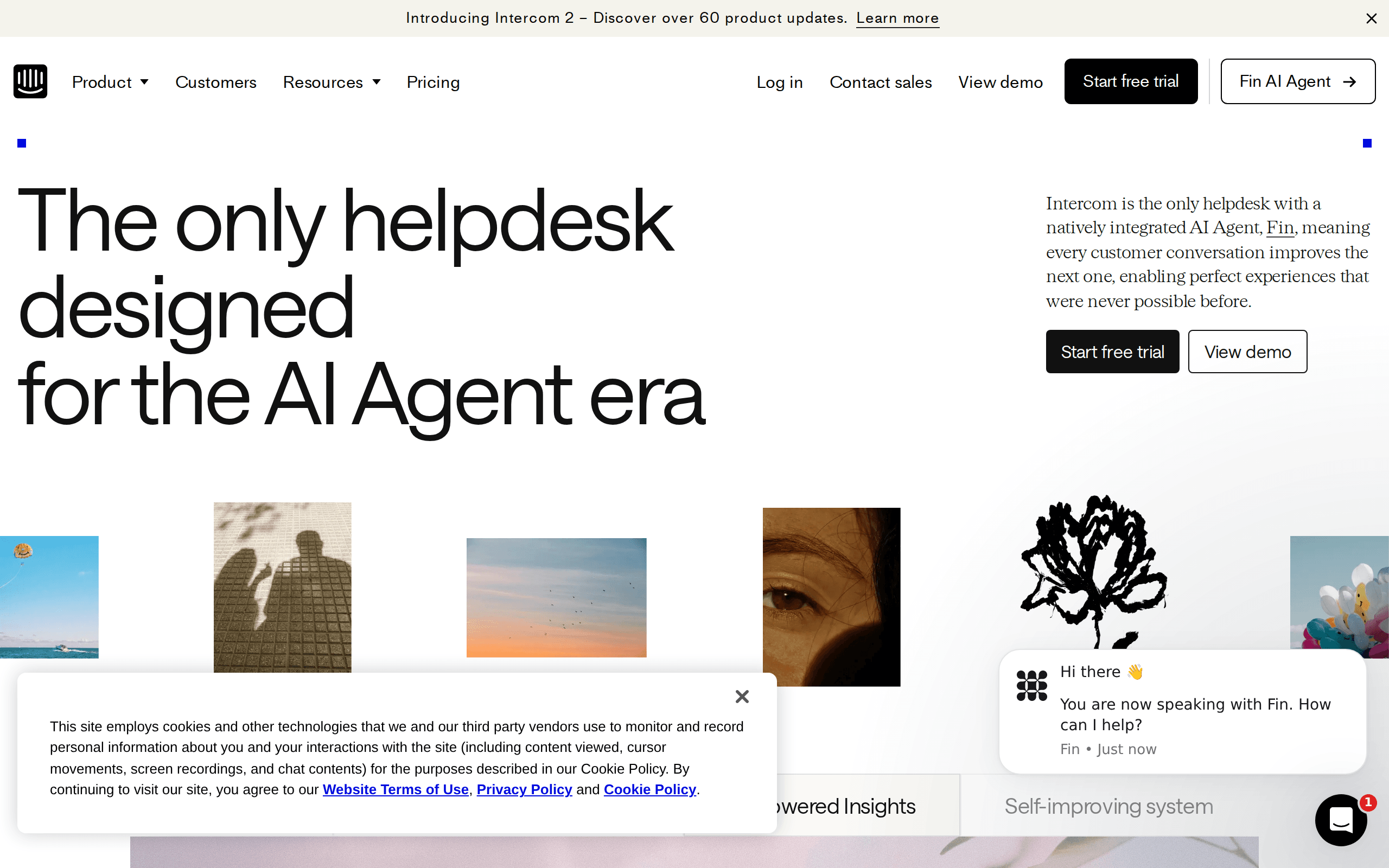
Best for: SaaS and digital-first teams that want a complete support platform with the strongest mainstream AI agent built in
Intercom turned its early AI-first bet into the category lead. Fin, its AI agent, autonomously resolves a majority of routine conversations for well-documented products — answering from your help center, taking actions through integrations, and escalating with full context when it can't — and it consistently benchmarks at the top of the mainstream AI-agent class. What makes Intercom the best overall pick is that Fin sits inside a complete platform: the Messenger for AI live chat, a full help desk and ticketing system, proactive messaging, and a knowledge base that doubles as Fin's training corpus. You're not stitching an AI bot onto a help desk — it's one system. Resolution-based pricing ($0.99 per Fin resolution) on top of seats needs modeling at volume, but for teams that treat support as part of the product, Intercom is the platform to beat.
Key Features
- Fin AI Agent: Autonomous resolution from your knowledge base with action-taking via integrations and context-rich escalation
- AI Live Chat (Messenger): Fin-powered chat widget that resolves in-conversation before a human is ever needed
- Unified Help Desk: Chat, email, and tickets in one workspace with an AI copilot assisting human agents
- Proactive Support: Outbound messages, tours, and checklists that deflect tickets before they're created
- Knowledge Hub: Help center that serves customers directly and powers Fin's resolution quality
Pricing
| Plan | Monthly | Annual (per month) |
|---|---|---|
| Essential | $39 | $29/seat |
| Advanced | $99 | $85/seat |
| Expert | $139 | $132/seat |
| Fin AI Agent | $0.99/resolution | Usage-based |
Pros
- Best mainstream AI agent with genuine autonomous resolution
- Fin lives inside a complete platform — no bolt-on integration work
- Strong AI live chat for product-led support
- Excellent agent copilot and workspace experience
Cons
- Resolution fees on top of seats get expensive at volume
- Overkill for simple email-queue support teams
- Pricing structure has changed repeatedly — model carefully
Verdict: Intercom is the best AI customer support tool of 2026 for most teams. If support runs through chat and your product is well-documented, Fin's resolution rate changes the economics of your support org.
Visit IntercomSierra
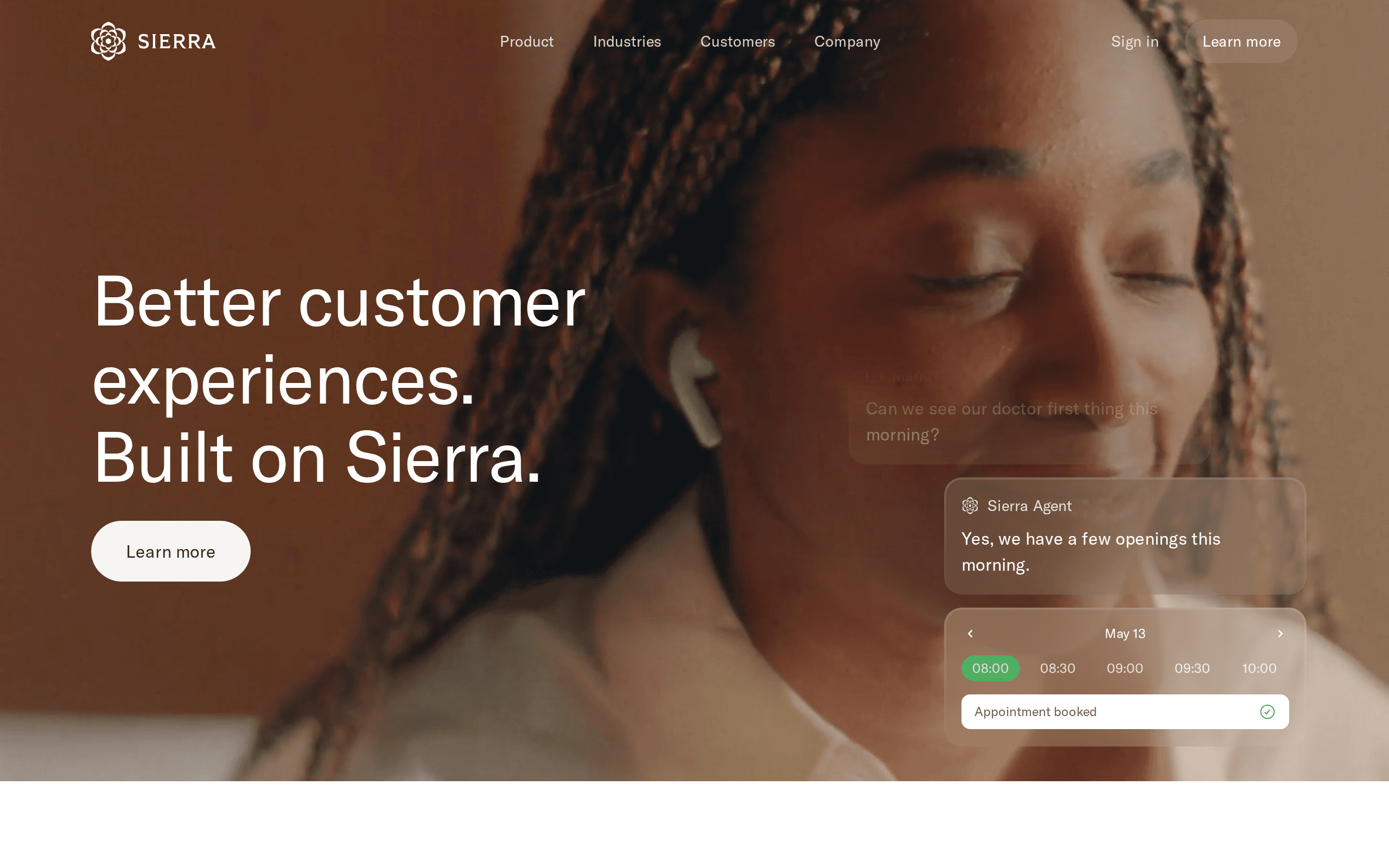
Best for: Companies that want a branded, autonomous AI agent as a primary support channel across chat and voice
Sierra is the highest-profile of the agent-first platforms — conversational AI built from the ground up to be a company's autonomous support agent rather than a feature inside a help desk. The pitch is a branded AI agent that handles real, multi-step customer problems across chat and voice: it follows your policies, takes actions through your systems (process the return, change the subscription, reschedule the delivery), and stays on-brand because conversation design and guardrails are first-class parts of the product. Sierra leans into supervised, auditable agents — you can inspect why it did what it did — which is what enterprises buying AI as a primary channel demand. It's sold on outcome/resolution-based pricing and aimed at companies serious enough about AI support to treat the agent as core infrastructure, not an experiment.
Key Features
- Agent-First Architecture: Built to be the company's autonomous support agent, not a bot bolted onto a queue
- Chat + Voice: One AI agent across digital chat and phone, with consistent policy and brand handling
- Action-Taking: Resolves multi-step problems by acting in your systems — orders, subscriptions, accounts
- Guardrails & Supervision: Auditable reasoning, policy controls, and brand guardrails for safe autonomous resolution
- Outcome-Based Pricing: Priced around resolved outcomes rather than seats — aligned to results
Pricing
| Plan | Monthly | Annual (per month) |
|---|---|---|
| Platform | Custom | Resolution-based |
| Enterprise | Custom | Custom |
Pros
- Among the strongest autonomous resolution for complex, multi-step problems
- Unified chat and voice agent with strong brand control
- Auditable, supervised agents enterprises can trust
- Outcome-based pricing aligns cost to value delivered
Cons
- Enterprise-oriented — not a self-serve, swipe-a-card product
- Requires real implementation and conversation-design investment
- Opaque pricing; you'll need a sales conversation to scope it
Verdict: Sierra is the pick when AI resolution is the strategy, not a feature. For companies ready to make an autonomous agent a primary channel across chat and voice, it's the most ambitious option on this list.
Visit SierraDecagon
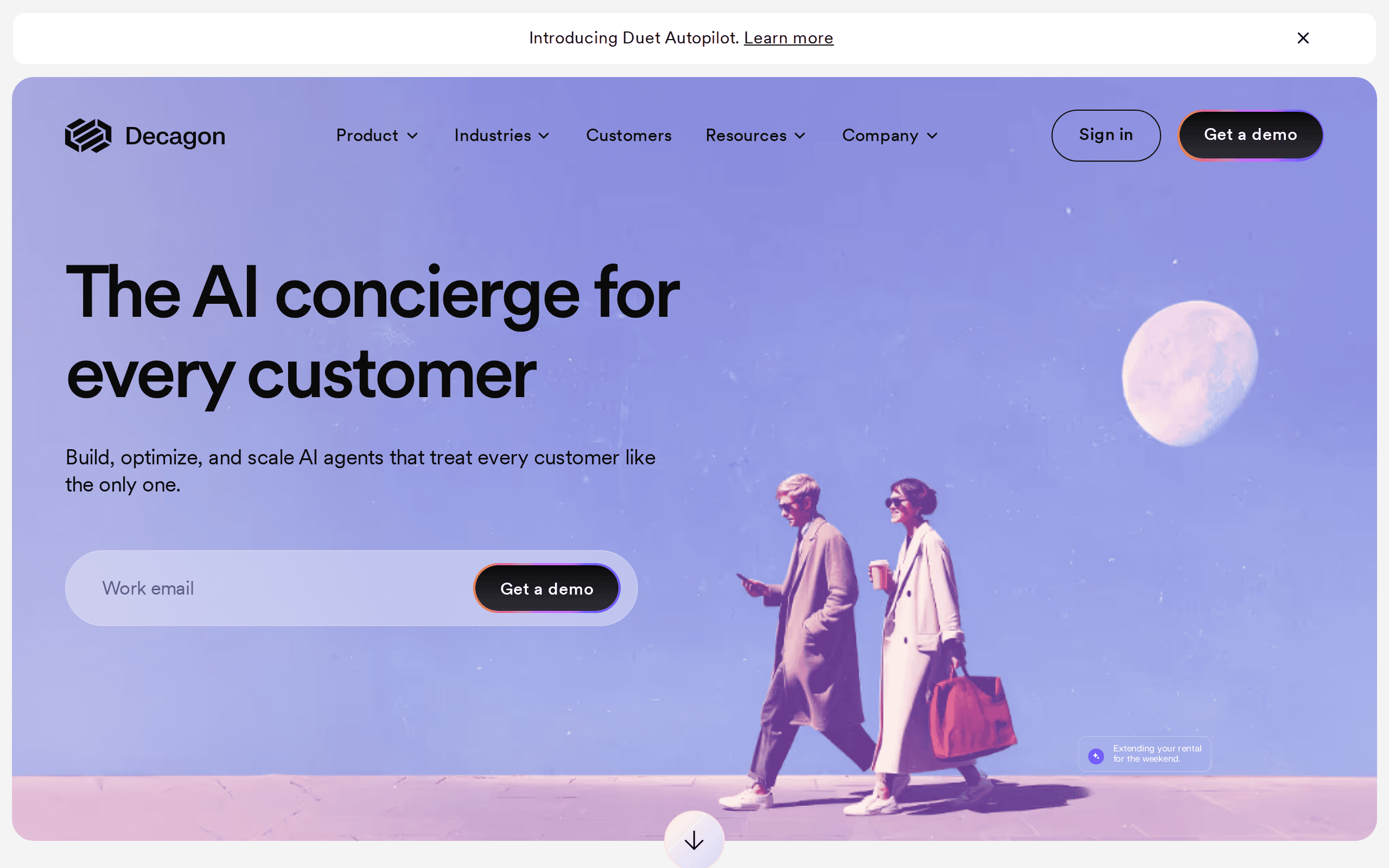
Best for: High-volume enterprises that want a deeply configurable AI concierge with strong analytics and human-in-the-loop control
Decagon is the enterprise-grade AI agent platform that has won a roster of high-volume consumer and fintech brands by treating AI support as a configurable, observable system rather than a black box. Its AI agents resolve conversations across chat, email, and voice, but the differentiator is the operating layer around them: Agent Operating Procedures that let support teams define and version the agent's behavior in plain language, granular analytics on what's resolving and what's escalating, and a human-in-the-loop workflow that turns every escalation into training signal. For large teams where a percentage point of resolution rate is worth real money, Decagon's emphasis on measurability and continuous improvement is the reason it's displacing legacy automation. It's an enterprise sale — implementation and integration matter — but the platform is built for teams that want to own and tune their AI's behavior.
Key Features
- Multi-Channel AI Agents: Autonomous resolution across chat, email, and voice on one platform
- Agent Operating Procedures: Define and version the agent's behavior in plain language — no engineering bottleneck
- Resolution Analytics: Granular reporting on what resolves, what escalates, and where to improve
- Human-in-the-Loop: Escalations feed back as training signal to lift resolution over time
- Enterprise Integrations: Deep connections to order, account, and CRM systems for real action-taking
Pricing
| Plan | Monthly | Annual (per month) |
|---|---|---|
| Platform | Custom | Resolution-based |
| Enterprise | Custom | Custom |
Pros
- Built for high-volume enterprises that need to tune resolution rates
- Plain-language Agent Operating Procedures remove the engineering bottleneck
- Best-in-class resolution analytics and observability
- Strong human-in-the-loop continuous-improvement loop
Cons
- Enterprise pricing and implementation — not for small teams
- Requires investment to configure and integrate properly
- Newer platform; ecosystem smaller than incumbent suites
Verdict: Decagon is the enterprise AI-agent pick for teams that want to measure and improve resolution like an operations discipline. If you're at the volume where points of resolution rate are budget lines, it earns the evaluation.
Visit DecagonAda
Best for: High-volume, multilingual support teams that want to build and scale AI resolution without engineering
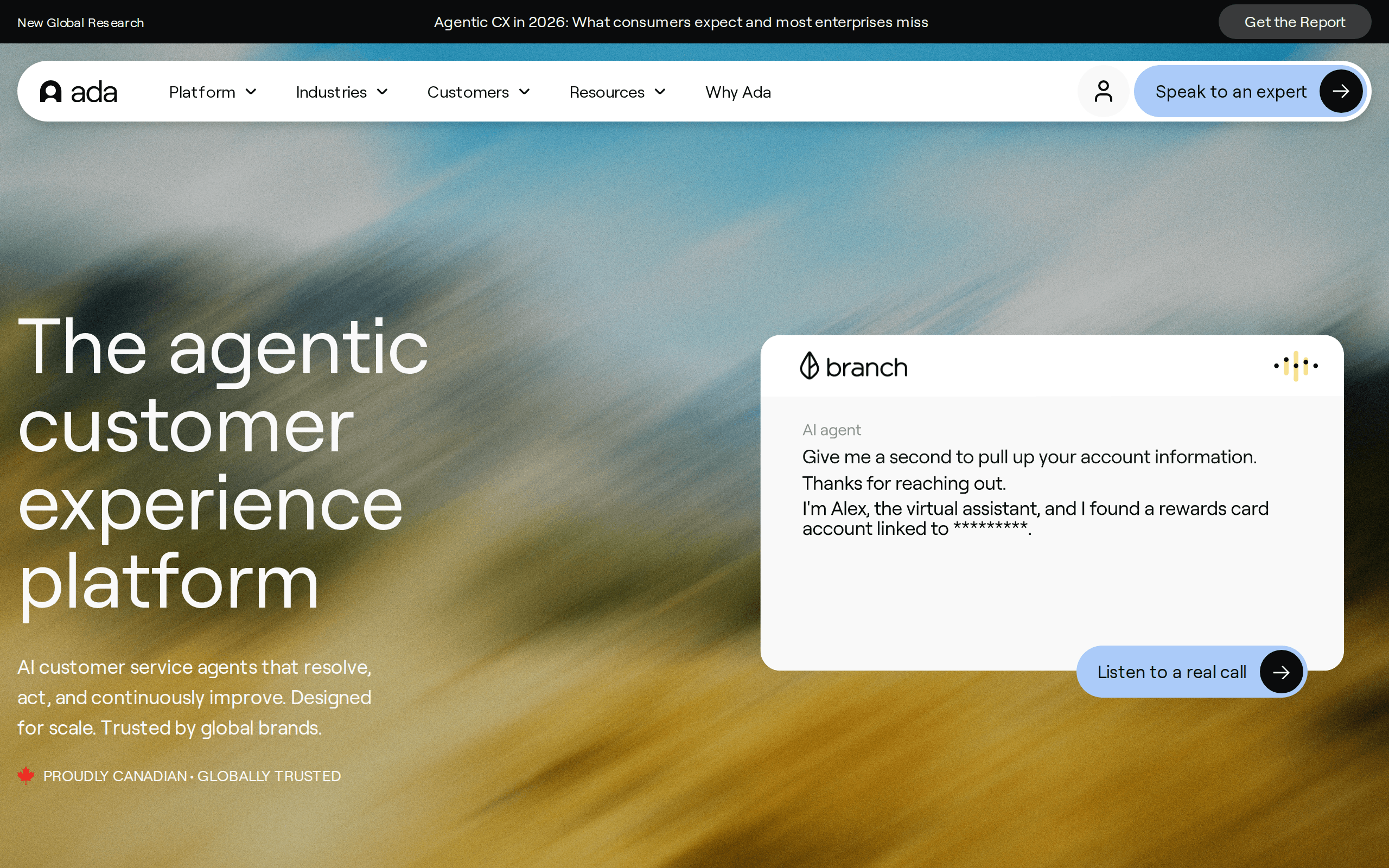
Ada has spent years focused on one thing: letting non-technical support teams automate customer service at scale. Its AI agent resolves conversations across chat, email, voice, and social in 50+ languages, and the platform is built so support and CX teams — not engineers — design, deploy, and continuously improve the automation. Ada's reasoning engine pulls from your knowledge sources and connected systems to resolve and act, and its analytics center on a single north-star metric: automated resolution rate, with tooling to diagnose and lift it over time. For global brands handling millions of conversations, Ada's combination of no-code control, multilingual breadth, and a measurable improvement loop is why it's a default on enterprise AI-support shortlists. It's priced and positioned for scale rather than small teams.
Key Features
- No-Code Agent Builder: Support and CX teams design and deploy automation without engineering
- 50+ Languages: Resolve conversations globally across chat, email, voice, and social channels
- Reasoning + Actions: Pulls from knowledge sources and connected systems to resolve and take action
- Automated Resolution Rate: Single north-star metric with tooling to diagnose and lift performance over time
- Enterprise Coaching Tools: Review, correct, and improve the agent's answers in a structured workflow
Pricing
| Plan | Monthly | Annual (per month) |
|---|---|---|
| Core | Custom | Resolution-based |
| Enterprise | Custom | Custom |
Pros
- Best no-code experience for non-technical CX teams
- Exceptional multilingual coverage for global support
- Resolution-rate analytics built for continuous improvement
- Proven at very high conversation volumes
Cons
- Enterprise pricing — not aimed at SMBs
- Best results require ongoing tuning and content investment
- Less of a full help desk; pairs with a ticketing backbone
Verdict: Ada is the pick for global, high-volume teams that want to own AI automation without engineering. If multilingual scale and a measurable resolution loop are your priorities, it's among the strongest platforms available.
Visit AdaFreshworks (Freddy AI)
Best for: Teams that want a complete help desk plus a capable AI agent at the best price-to-feature ratio
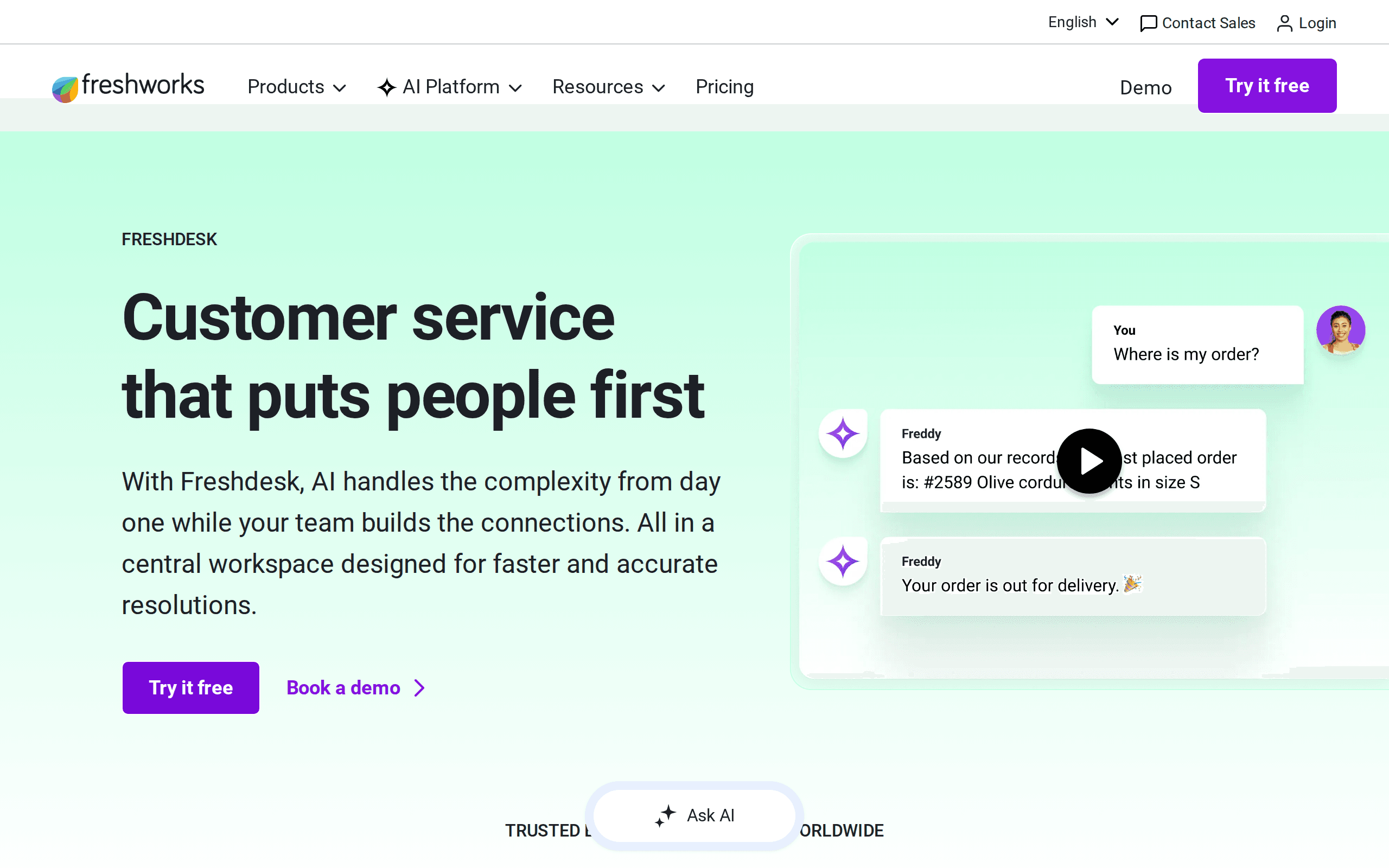
Freshworks pairs Freshdesk — the value benchmark help desk — with Freddy AI, giving teams a complete support platform and an AI agent without the premium price of the agent-first specialists. Freddy AI Agent handles customer-facing deflection by resolving routine questions from your knowledge base, while Freddy Copilot assists human agents with summaries, suggested replies, and tone, and Freddy Insights surfaces analytics. The whole stack starts inexpensively and includes the conventional help desk essentials — ticketing, SLAs, automation, multilingual knowledge base — that the pure AI-agent platforms leave you to source elsewhere. Freddy's autonomous resolution trails the frontier agents (Intercom's Fin, Sierra, Decagon), but for the large majority of teams that want strong AI support inside a complete, affordable help desk, Freshworks is the best value in the category.
Key Features
- Freddy AI Agent: Autonomous customer-facing deflection that resolves routine questions from your knowledge base
- Freddy Copilot: Agent assist with summaries, suggested replies, and tone adjustment
- Full Help Desk: Ticketing, SLAs, routing, and automation included — not sold separately
- Omnichannel: Email, chat, social, and voice with the AI agent across channels
- Multilingual Knowledge Base: Help center that powers both self-service and Freddy's answers
Pricing
| Plan | Monthly | Annual (per month) |
|---|---|---|
| Free | $0 (2 agents) | $0 |
| Growth | $18 | $15/agent |
| Pro | $59 | $49/agent |
| Enterprise | $95 | $79/agent |
Pros
- Best feature-per-dollar ratio with AI included
- Complete help desk plus AI agent in one platform
- Genuinely usable free tier for small teams
- Scales from 2 agents to enterprise on one stack
Cons
- Freddy's autonomous resolution trails the frontier agents
- Best AI features gate behind upper tiers and add-ons
- Interface feels conventional next to agent-first specialists
Verdict: Freshworks is the value pick — a complete help desk with a capable AI agent at a fraction of the specialist price. If you want AI support without rebuilding your whole stack, start here.
Visit Freshworks (Freddy AI)Tidio
Best for: Small businesses and lean e-commerce teams that want AI-powered live chat running in under an hour
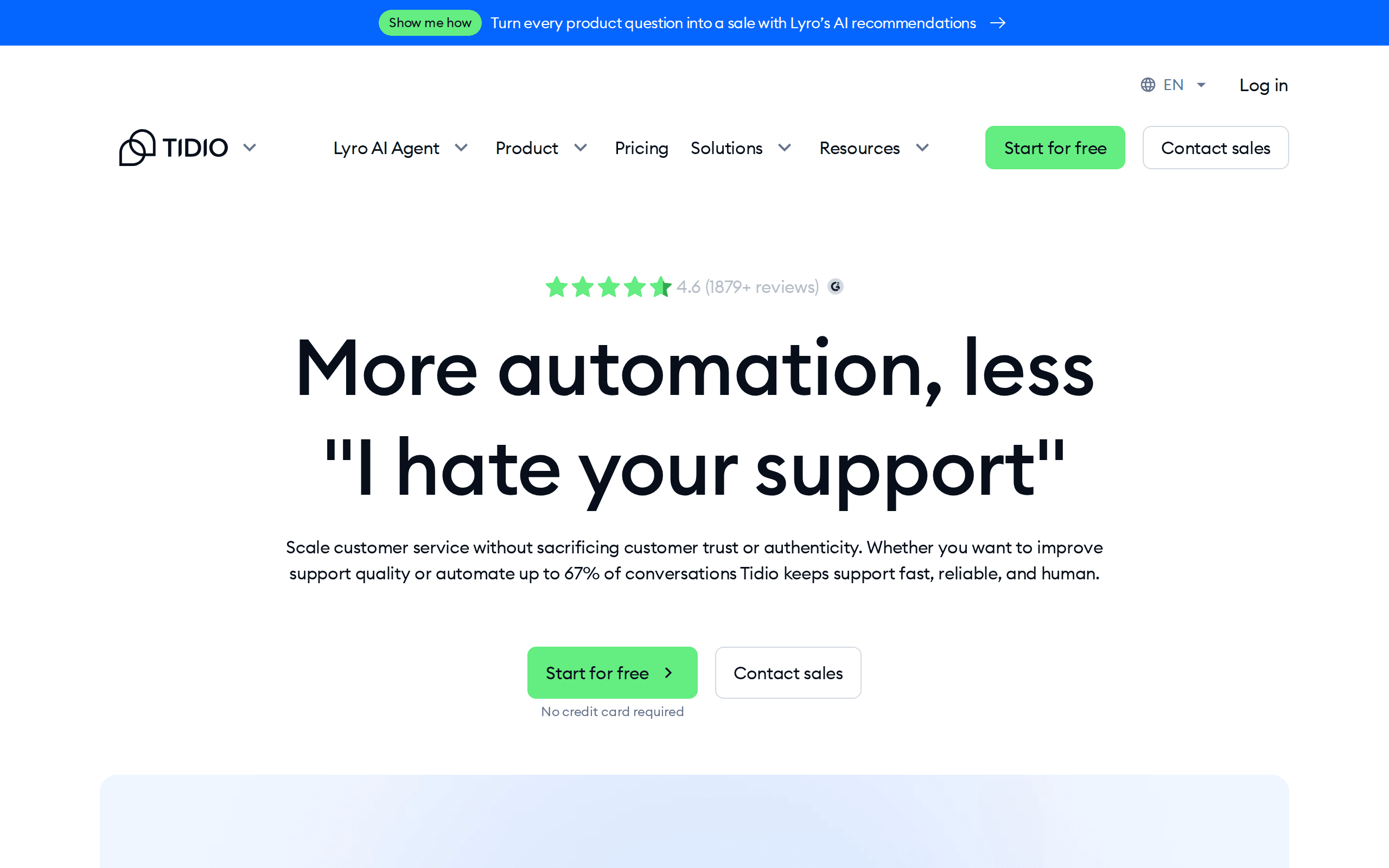
Tidio is the fastest path from zero to AI customer support for a small business. Install the widget, connect email and social, and Lyro — Tidio's AI agent — starts answering common questions from your FAQ content immediately, with no training pipeline to build. The platform combines AI live chat, a lightweight ticketing inbox, and prebuilt automation flows in an interface a non-technical owner can configure in an afternoon, with a free tier and paid plans that undercut nearly everything else here. Lyro typically resolves a meaningful share of routine questions for small sites, and revenue automations (abandoned cart, order status for Shopify) add value beyond support. Tidio isn't built for big-team workflows — routing, SLAs, and reporting stay basic — but for the enormous market of small businesses priced out of enterprise AI platforms, it hits exactly the right altitude.
Key Features
- Lyro AI Agent: Conversational AI that answers from your FAQ and help content with no training pipeline
- AI Live Chat Widget: Fast, customizable chat with visitor tracking and AI-handled first response
- Automation Flows: Prebuilt flows for abandoned carts, order status, and lead capture
- Multichannel Inbox: Chat, email, Messenger, Instagram, and WhatsApp in one simple inbox
- Shopify Integration: Order context and cart actions for small e-commerce teams
Pricing
| Plan | Monthly | Annual (per month) |
|---|---|---|
| Free | $0 | $0 |
| Starter | $29 | $24/mo |
| Growth | $59 | $49/mo |
| Plus / Lyro AI | $749 | Usage-based |
Pros
- Running with AI chat in under an hour
- Lyro needs no training pipeline — answers from existing content
- Free tier plus low entry pricing for small teams
- Useful revenue automations for small Shopify stores
Cons
- Routing, SLAs, and reporting too basic for larger teams
- Lyro resolution capacity scales by conversation volume (paid)
- Not a fit once you need multi-team enterprise workflows
Verdict: Tidio is the small-business pick for AI live chat. If you need AI-assisted chat and a simple inbox without an implementation project, nothing gets you there faster or cheaper.
Visit TidioGorgias

Best for: Shopify and DTC brands that want commerce-tuned AI resolution with live order actions
Gorgias is what AI customer support looks like when it's purpose-built for e-commerce. Built Shopify-first (with BigCommerce and Magento support), its AI Agent is tuned for commerce intents — order status, returns, cancellations, where-is-my-order — and resolves them with live access to order history, shipping status, and customer lifetime value, plus the ability to edit orders, issue refunds, and apply discounts without a human touching the conversation. That commerce-native resolution handles the repetitive third of e-commerce tickets out of the box, and revenue features (chat campaigns, upsells inside support conversations) reframe support as a revenue channel — how the best DTC brands actually run it. Ticket-based pricing fits seasonal merchants better than per-seat models. For Shopify brands under roughly enterprise scale, Gorgias's AI is the default starting point.
Key Features
- Commerce-Tuned AI Agent: Autonomous resolution of order-status, returns, and policy questions built for retail
- Live Order Actions: Edit orders, issue refunds, and apply discounts inside the resolution — no human handoff
- Deep Shopify Integration: Order data, LTV, and shipping status native to the agent and sidebar
- Revenue Automations: Chat campaigns, product recommendations, and upsells inside support conversations
- Ticket-Based Pricing: Pay by ticket volume, not seats — fits seasonal teams and shared inboxes
Pricing
| Plan | Monthly | Annual (per month) |
|---|---|---|
| Starter | $10 (50 tickets) | $10/mo |
| Basic | $60 (300 tickets) | $50/mo |
| Pro | $360 (2K tickets) | $300/mo |
| Advanced | $900 (5K tickets) | $750/mo |
Pros
- Best commerce-tuned AI resolution — actions, not just answers
- Automates the repetitive third of e-commerce tickets immediately
- Ticket pricing fits seasonal volume and unlimited agents
- Turns support into a measurable revenue channel
Cons
- Little reason to use it outside e-commerce
- Ticket-based pricing needs monitoring during volume spikes
- Reporting depth trails enterprise AI platforms
Verdict: Gorgias is the e-commerce pick, full stop. If your support lives in Shopify orders all day, no general-purpose AI agent matches this commerce-native workflow.
Visit GorgiasMaven AGI
Best for: Enterprises that want a highly accurate AI agent connecting many knowledge sources and systems across the full customer experience
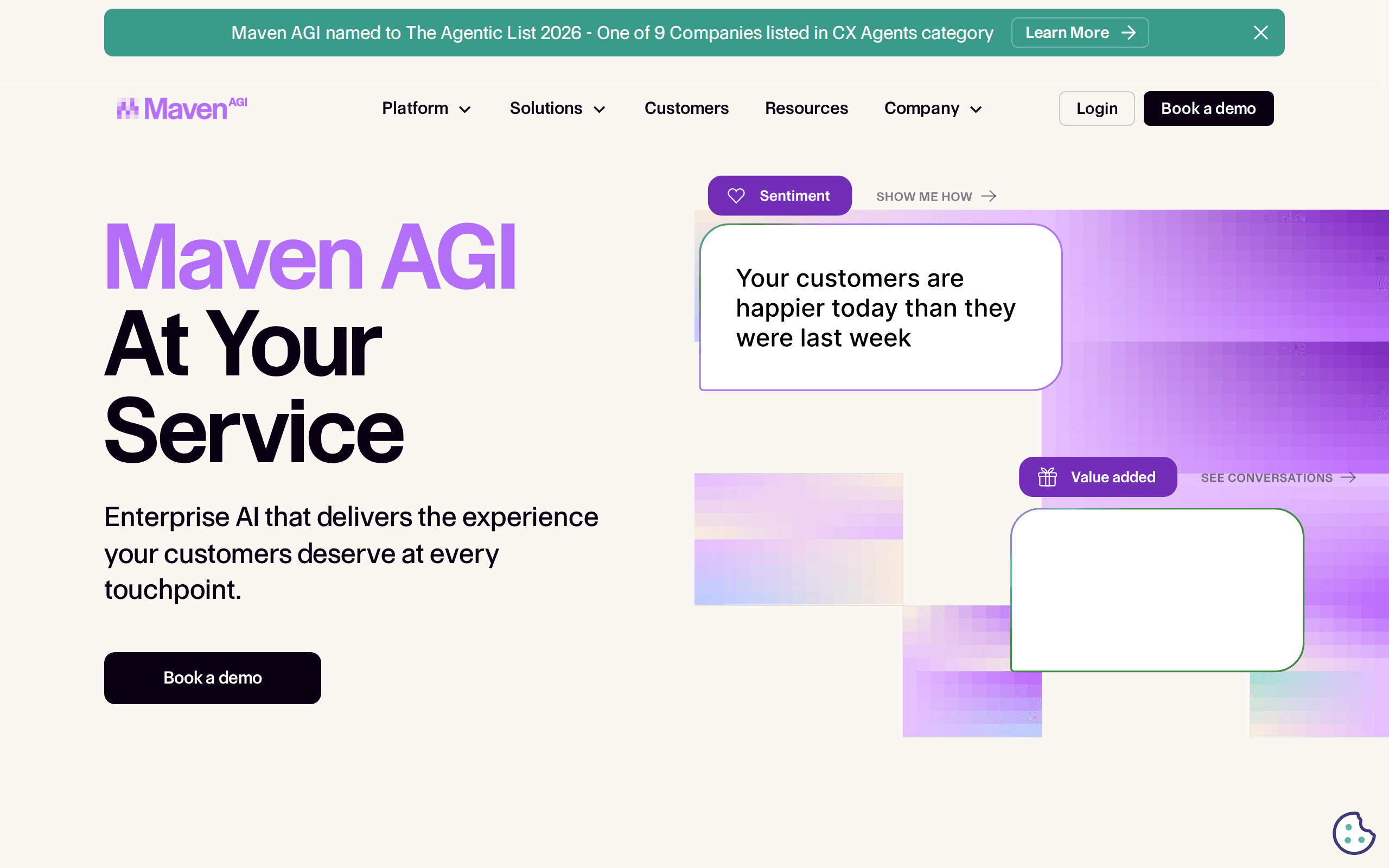
Maven AGI is the enterprise AI agent platform built by a team out of Google and HubSpot, and its differentiator is accuracy at breadth. Where some agents resolve from a single help center, Maven unifies dozens of knowledge sources and backend systems — docs, past tickets, CRMs, order systems, internal tools — into one agent that answers and acts reliably across chat, email, and voice. It's positioned for the full customer experience rather than just deflection: the same agent assists human reps, powers self-service, and surfaces analytics on what's resolving and where knowledge gaps live. Maven leans hard on trustworthy, grounded answers and enterprise controls, which is why it's landed high-volume CX teams that can't afford confident-but-wrong AI. It's an enterprise sale with real implementation, but for organizations that want maximum resolution accuracy across a sprawling knowledge and systems landscape, Maven is among the strongest options.
Key Features
- Unified Knowledge: Connects dozens of sources — docs, tickets, CRM, internal tools — into one grounded agent
- Multi-Channel Agent: Autonomous resolution across chat, email, and voice with consistent behavior
- Action-Taking: Executes real tasks in backend systems, not just answering questions
- Agent Assist: The same AI helps human reps with grounded answers and drafted replies
- CX Analytics: Reporting on resolution, deflection, and the knowledge gaps to close next
Pricing
| Plan | Monthly | Annual (per month) |
|---|---|---|
| Platform | Custom | Resolution-based |
| Enterprise | Custom | Custom |
Pros
- Exceptional accuracy by grounding in many knowledge sources
- Unifies fragmented docs and systems other agents can't reach
- One agent spans self-service, assist, and voice
- Built by an experienced team with strong enterprise controls
Cons
- Enterprise pricing and implementation — not for small teams
- Best results require connecting and curating knowledge sources
- Newer platform; ecosystem smaller than incumbent suites
Verdict: Maven AGI is the pick when accuracy across a sprawling knowledge and systems landscape is the hard part. For enterprises that can't risk confidently wrong AI, its grounding model is a genuine differentiator.
Visit Maven AGIHelp Scout
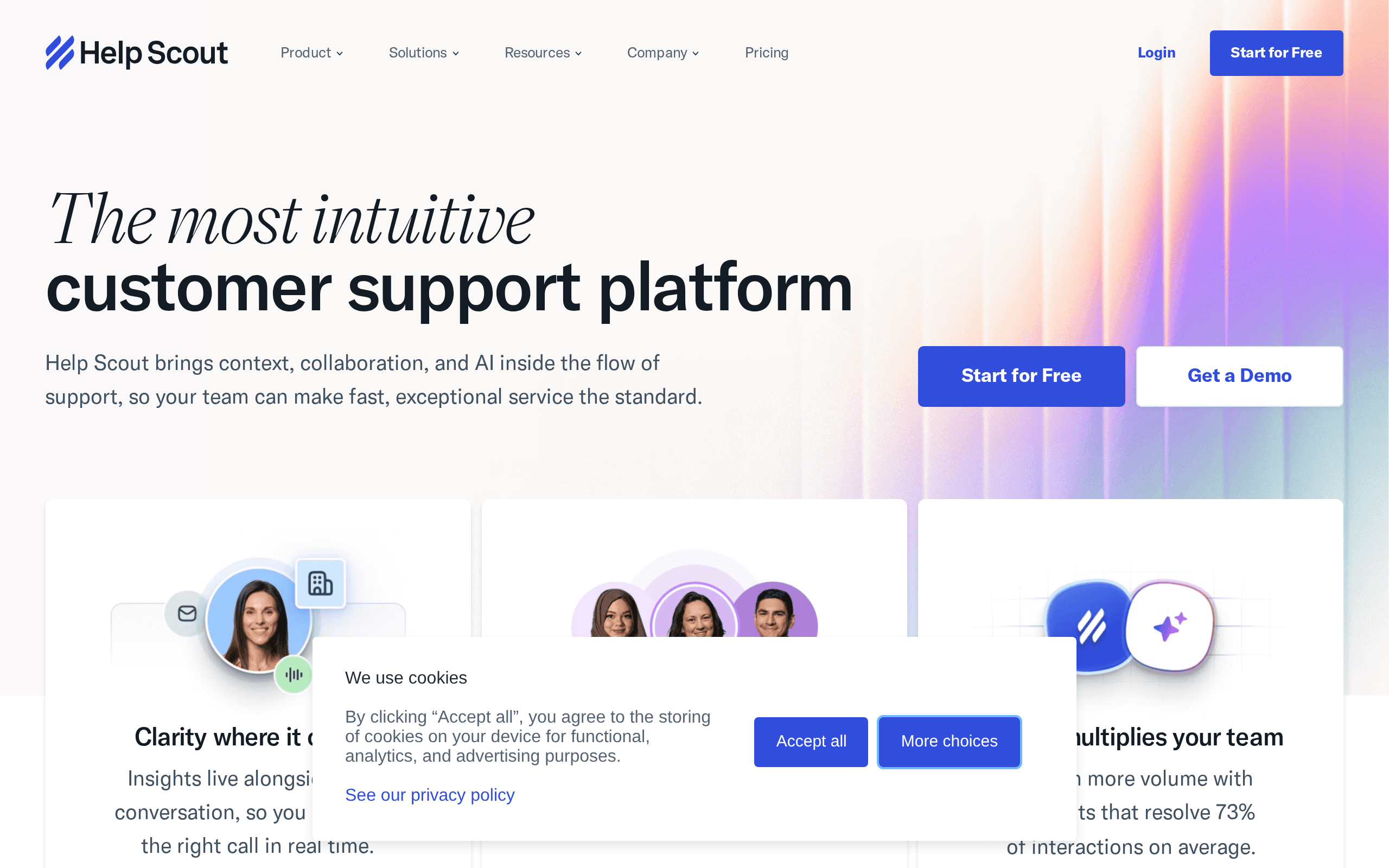
Best for: Small and mid-size teams that want AI assistance without losing a human, email-first support feel
Help Scout has spent 14+ years perfecting a philosophy that AI hasn't changed: support should feel like email from a person, not a ticket from a system. Its AI features fit that ethos — AI drafts, summaries, and tone adjustment that speed agents up, plus an AI answers layer on its Docs knowledge base and Beacon widget that resolves the simplest questions without changing the product's human voice. The shared inbox remains the cleanest in the category (replies arrive as normal emails, no ticket numbers), and contact-based pricing means unlimited teammates on every plan. Help Scout deliberately doesn't chase the maximal autonomous-resolution race of the agent-first platforms; it adds AI where it helps and keeps humans in the loop where relationships matter. For SMBs that want AI leverage without an impersonal, fully automated front door, it's the most pleasant tool here to actually use.
Key Features
- AI Assist: Drafts, summaries, and tone adjustment that speed agents while preserving a human voice
- AI Answers on Docs: Resolves simple questions from the knowledge base via the Beacon widget
- Clean Shared Inbox: Email-native support with collision detection and private notes — no visible ticket IDs
- Beacon Widget: Embeddable help combining Docs search, contact forms, and live chat
- Contact-Based Pricing: Unlimited teammates on every plan — pay by customers helped, not seats
Pricing
| Plan | Monthly | Annual (per month) |
|---|---|---|
| Free | $0 (50 contacts/mo) | $0 |
| Standard | $55 | $50/mo (100 contacts) |
| Plus | $83 | $75/mo (100 contacts) |
| Pro | Custom | Custom |
Pros
- AI leverage without losing the human, personal feel
- Cleanest, most pleasant support experience in the category
- Unlimited teammates — pricing scales by contacts, not seats
- Practically zero onboarding time for new agents
Cons
- Autonomous resolution is lighter than the agent-first platforms
- Contact-based pricing punishes high-volume support
- No native voice channel; lighter omnichannel than rivals
Verdict: Help Scout is the SMB pick for teams that want AI assistance, not AI replacement. If your brand voice matters and your volume is moderate, it adds AI leverage without going robotic.
Visit Help ScoutCrisp
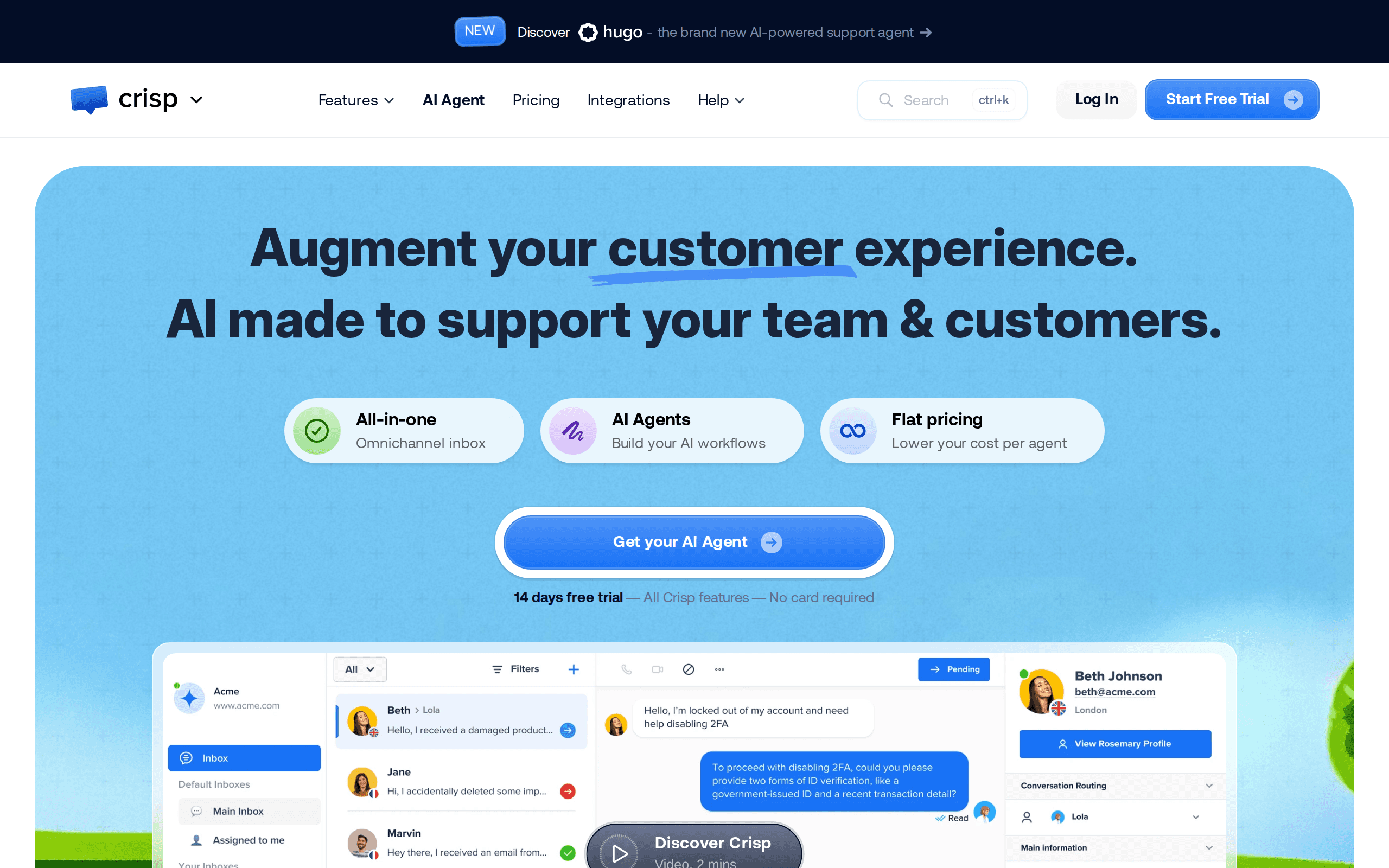
Best for: Startups and small teams that want AI live chat and a shared inbox at the lowest serious price point
Crisp is the budget-friendly way to put AI live chat and a multichannel inbox on your site without an enterprise contract. It bundles a polished chat widget, a shared team inbox spanning email, chat, Messenger, WhatsApp, and more, a knowledge base, and an AI chatbot (MagicReply and an AI agent layer) that answers from your content and drafts replies for agents — all starting from a free tier and inexpensive paid plans charged per workspace rather than per seat. That per-workspace pricing is a real advantage for small teams where several people touch support: you don't pay more as the team grows. Crisp's AI resolution and analytics don't reach the depth of the agent-first specialists, but for startups and small businesses that want a capable AI-assisted support stack for the price of a single Intercom seat, it's the best value entry point.
Key Features
- AI Chatbot & MagicReply: Answers from your knowledge base and drafts agent replies from past conversations
- AI Live Chat Widget: Polished, customizable chat with visitor data and AI-handled first response
- Shared Multichannel Inbox: Email, chat, Messenger, WhatsApp, and Instagram in one team inbox
- Knowledge Base: Self-service help center that powers the AI bot's answers
- Per-Workspace Pricing: Flat plans regardless of team size — not charged per seat
Pricing
| Plan | Monthly | Annual (per month) |
|---|---|---|
| Free | $0 | $0 |
| Mini | $45 | $25/workspace |
| Essentials | $95 | $60/workspace |
| Plus | $295 | $240/workspace |
Pros
- Lowest serious price for AI live chat plus a shared inbox
- Per-workspace pricing — unlimited seats, no per-agent bill
- Capable AI bot and agent-assist for the price
- Genuinely useful free tier for early-stage teams
Cons
- AI resolution depth trails the agent-first platforms
- Analytics and routing too light for large support orgs
- Best fit below enterprise scale and volume
Verdict: Crisp is the budget pick for AI live chat. For startups and small teams that want AI-assisted support without an enterprise price tag, it delivers most of the benefit for a fraction of the cost.
Visit CrispHow to Choose for Your Situation
The decision framework, by the question that actually decides it:
By team size
Solo founders and tiny teams: Tidio or Crisp for AI live chat in an afternoon, or the free tier of Freshworks. Teams of 5-50: Intercom for chat-led product support, Freshworks for ticket operations, Help Scout for AI-assisted human support. 50+ agents at volume: the pure agents — Sierra, Decagon, Ada, or Maven AGI.
By business model
E-commerce on Shopify: Gorgias, full stop. SaaS and digital products: Intercom. High-volume consumer or fintech: Decagon or Ada. Enterprises needing accuracy across many knowledge sources and systems: Maven AGI.
By AI ambition
If autonomous resolution is the strategy and you'll resource it, the agent-first platforms — Sierra, Decagon, Ada, and Maven AGI — go furthest. If you want a strong AI agent inside a complete platform, Intercom's Fin leads. If you want AI assistance without replacing humans, Help Scout keeps the human in the loop.
By pricing model
If predictable, seat-based cost matters more than maximal automation, Freshworks and Help Scout are the safe structures. If you'd rather pay for outcomes, the resolution-based agents (Sierra, Decagon, Ada, Maven AGI) align cost to value — but model your routine-conversation volume first, because at scale per-resolution fees can dwarf seat costs.
Pro Tip
Run your real tickets through the trial, not the vendor's demo script. Export your 50 most recent conversations, feed the common ones to each platform's AI agent, and measure actual resolution quality against your own knowledge base — the resolution rates in marketing pages assume documentation most teams don't have yet.
Frequently Asked Questions
Final Thoughts
The best AI customer support tool of 2026 is the one whose architecture matches how much you want AI to own. Intercom is our best-overall pick because Fin pairs frontier resolution with a complete platform — but a high-volume enterprise should evaluate Sierra, Decagon, Ada, or Maven AGI, a Shopify brand should pick Gorgias, and a small team should start with Tidio or Crisp, and each would be right.
Whatever you shortlist: model total cost including per-resolution fees, test AI resolution against your actual knowledge base, and remember that AI raises the floor of your support only as high as your help content allows. The tools above all earn their slot — within the job they're shaped for.
Related Free Tools
SERP Checker
See which support pages rank for your category terms
Keyword Search Volume
Size the demand for your help-center topics
SEO Content Grader
Grade the help docs your AI agent will answer from
Content Brief Generator
Brief better knowledge-base articles in minutes
Technical SEO Audit
Make your help center crawlable and indexable
Google Autocomplete Extractor
Find the questions customers actually search
Related Articles
Best Customer Service Software in 2026
The broader help desk and support platform landscape
Best AI Sales Tools in 2026
The other side of the customer conversation stack
Best AI Search Visibility Tools
Track your brand across ChatGPT, Perplexity, and AI Overviews
Browse All Articles
Explore our complete library of SEO and GTM guides
About the Author

Co-Founder & SEO Execution
Co-founder of PikaSEO. 11 years in corporate tech, then bootstrapped entrepreneur. Leads SEO execution and content-led growth for SaaS companies.