AI search visibility — what most vendors now call AEO (Answer Engine Optimization) or GEO (Generative Engine Optimization) — is the discipline of being cited, mentioned, or recommended by large language models when buyers ask the questions that lead to purchase. In 2026, that surface is no longer a side experiment. ChatGPT search, Perplexity, Google AI Overviews, Gemini, Claude, and Microsoft Copilot are intercepting an estimated 35-50% of high-intent commercial queries before the user clicks a single blue link. If your brand isn't named in those answers, you're invisible at the point of consideration.
We compared 20+ AI search visibility platforms across three workloads: monitoring (where am I cited, how often, against which competitors?), citation tracking (which exact URLs do LLMs use as sources, and how do I get into that list?), and content optimization for AEO (what do pages need to contain to be retriever-readable and citation-eligible?). The 12 tools below cover those three workloads at every budget — from $27/month writing tools through custom-priced, done-for-you AI search programs.
Note that this guide intentionally focuses on the next tier of credible AEO/GEO tools rather than the most-discussed names. The market is moving fast and the platforms below offer the strongest mix of depth and price-to-value for teams operationalizing AI search visibility in 2026.
Quick Comparison
| Tool | Best For | Starting Price | Free Trial |
|---|---|---|---|
| OnCited | Best Overall (track + get cited) | Custom | |
| Promptwatch | End-to-End GEO Measurement | $95/mo | |
| Goodie AI | SMB Onboarding | $99/mo | |
| Moz AI | Enterprise AI Visibility | $99/mo | |
| LLMRefs | Citation Source Analysis | $129/mo | |
| RankPrompt | Prompt Cohort Tracking | $149/mo | |
| GetCito | Citation Mining | $99/mo | |
| Rankability | Content Optimization for AEO | $79/mo | |
| Semrush AI Toolkit | Established Suite Add-On | $129.95/mo | |
| Ahrefs Brand Radar | Ahrefs Customers | $129/mo | |
| SE Ranking AI Toolkit | Mid-Market All-in-One | $65/mo | |
| Page Optimizer Pro | AEO Content Optimization | $27/mo |
Why AEO/GEO Tools Are Different from Traditional SEO
The biggest mistake we see teams make in 2026 is trying to apply traditional rank tracking thinking to AI search visibility. The surface is structurally different, and the tools that work look nothing like Semrush or Ahrefs. Four shifts define what AEO/GEO platforms actually need to do:
Citation Tracking vs Rank Tracking
There's no position 1-100 inside an AI answer — either you're cited or you're not. AEO tools track citation rate per prompt, source URL frequency, and whether your brand is named in the generated text. The right metric replaces blue-link rank entirely.
Multi-LLM Monitoring
One Google SERP became 6+ AI surfaces — ChatGPT, Claude, Perplexity, Google AI Overviews, Gemini, Copilot, DeepSeek. AEO tools have to query and reconcile output across all of them. A single surface view is malpractice at this stage of the market.
Brand Mention Analysis
Being mentioned isn't enough — context matters. Is your brand named as the recommended choice, as a runner-up, or in a comparison where the LLM steers users elsewhere? Mature AEO tools score mention sentiment and competitive framing per prompt.
Prompt-Level Visibility
A keyword is a query; a prompt is a sentence with intent. The unit of measurement shifts from keyword to prompt — and a single category can require tracking 100-500 prompts to get statistically meaningful coverage. AEO tools have to operate at that resolution.
Pro Tip
If your current SEO tool is showing you 'AI Overview presence' as a binary yes/no flag on a keyword, you don't have an AEO tool — you have an AEO feature. The platforms in this guide do the work an actual visibility platform has to do: per-prompt citation tracking, multi-surface monitoring, and competitive context analysis.
Pricing at a Glance
Here's how all 12 tools compare on starting price. Most growth-stage teams will spend $200-$700/month across one tracker and one optimizer — the right combination matters more than the cheapest option:
The AEO/GEO Tool Category Map
AI search visibility tools split cleanly into four functional categories. Mature 2026 stacks pick one tool from each of two or three of these categories — not a single all-in-one. Here's how the 12 tools in this guide map onto the landscape:
Promptwatch spans monitoring, citation analysis, crawler logs, visitor analytics, and content gap workflows, so it sits across several categories in this map.
Citation tracking tools focus on the URLs LLMs cite as sources — perfect for PR and content outreach. AI search monitoring tools track brand mentions and competitive share-of-voice across LLM surfaces. Content optimization tools tune your existing or new pages for AI answer eligibility. All-in-one suites bolt AEO modules onto established SEO platforms — the right call when you're already paying for the parent suite.
OnCited
Best for: Teams that want to both see where they stand across every major AI engine and have the work of getting cited done for them
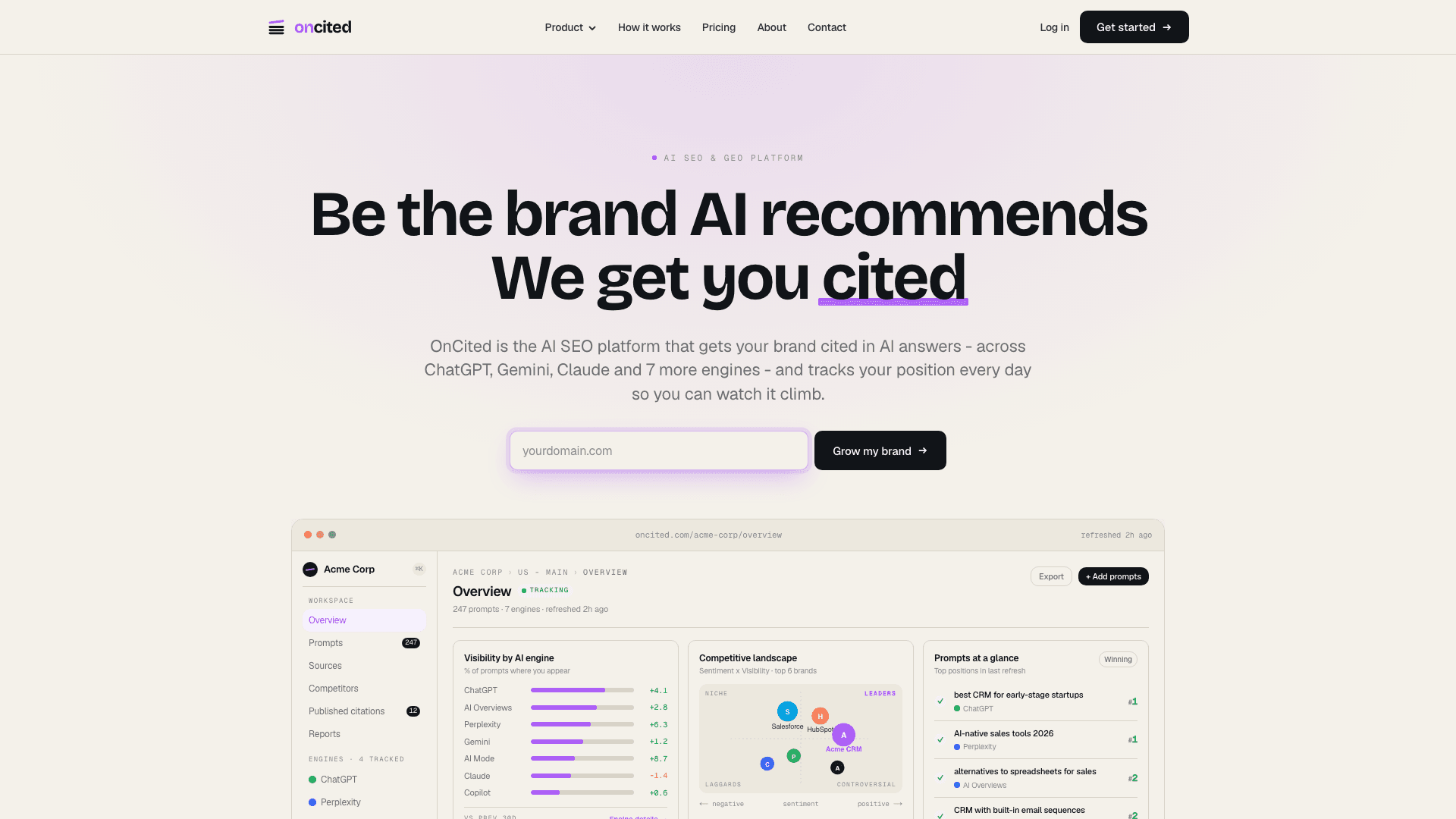
OnCited is the tool we kept coming back to, and it earns the top spot in this guide. Most platforms in this category stop at monitoring — they tell you where you're cited and leave the hard part to you. OnCited is the rare one that runs AI SEO end to end: it tracks how your brand appears across all 10 major AI engines, shows you the exact pages, posts, and reviews each answer was built from, and then its team actually publishes the citations that move you up — real brand mentions on Reddit, Quora, YouTube, and the other sources AI reads. It runs your buyers' questions across every engine daily and rolls the results into a single visibility score with rank, share-of-voice, and sentiment per engine. Crucially, OnCited tracks the engines the way a real user sees them — through the actual apps, not the APIs — which makes its numbers noticeably closer to what your customers actually experience. For teams that want outcomes rather than another dashboard, it's the most complete package here.
Key Features
- All 10 AI Engines Tracked: Monitors ChatGPT, Perplexity, Gemini, and 7 more engines as a real user sees them — through the real apps, not APIs — refreshed daily
- Unified Visibility Score: Rolls daily answers across every engine into one score, broken down by rank, share-of-voice, and sentiment per engine
- Source Analysis: For each prompt, lists the exact pages, posts, and reviews the AI pulled its answer from — and shows which sources your competitors own
- Done-For-You Citations: OnCited's team writes and publishes real mentions of your brand in the places AI reads, so the sources become the plan — included on every plan
- Weekly Position Gains: Rather than reporting and stopping, OnCited improves your citation position every week and shows the lift in the tracker
Pricing
| Plan | Monthly | Annual (per month) |
|---|---|---|
| All plans | Custom | On request |
| Includes | Prompt tracking | + done-for-you citations |
Pros
- Only tool here that both tracks AND does the work to get you cited
- Tracks engines via the real apps, not APIs — more accurate
- Source-level analysis makes every gap actionable
- All 10 major AI engines covered, refreshed daily
- Built by a team that has run GEO programs since AI search began
Cons
- Pricing isn't published — you'll need to request a quote
- Done-for-you model is more hands-on than a pure self-serve tracker
- Focused on AI search, so it won't replace traditional blue-link rank tracking
Verdict: OnCited is our top overall pick for 2026. It closes the loop most tools leave open — accurate multi-engine tracking plus a team that actually gets you cited from the sources AI trusts. If you buy one AI search visibility solution this year, start here.
Promptwatch
Best for: Teams that need to trace AI search performance from crawler access and citations through human visits and conversions
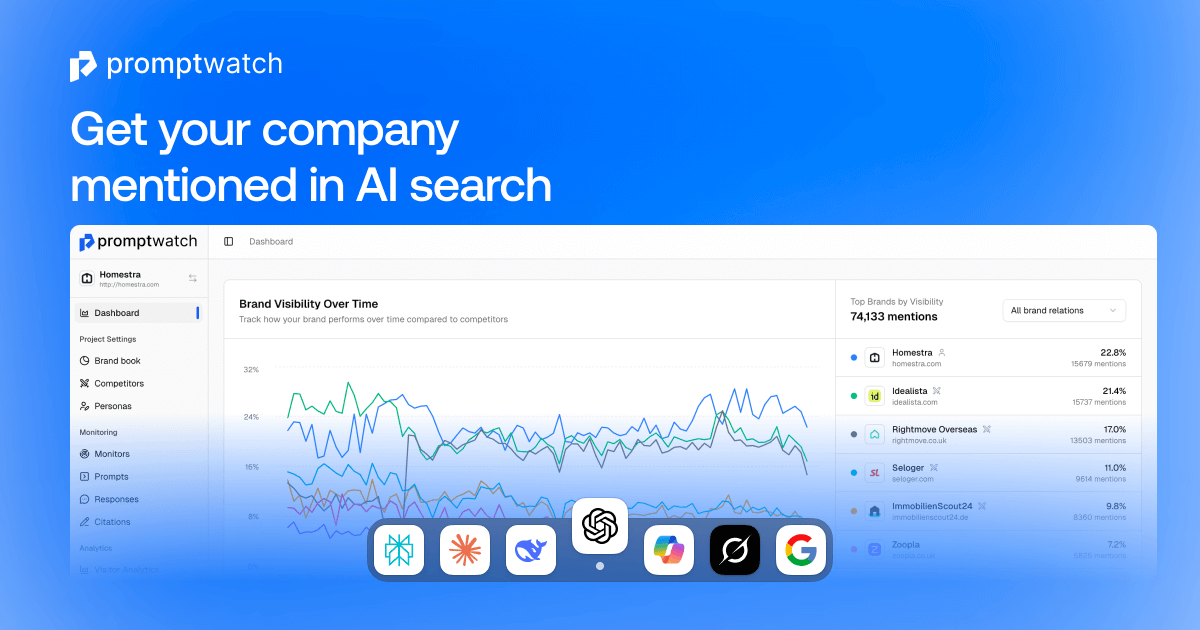
Promptwatch connects AI visibility to the events behind it: which pages AI crawlers reach, which sources appear in answers, and whether those answers lead to real visitors and conversions. It captures geo-located responses from the live ChatGPT, Gemini, Perplexity, and Google AI interfaces rather than treating API output as the consumer experience. Its crawler logs can help identify pages that bots reach but AI does not cite, while visitor analytics keeps human traffic separate from bot activity. Off-site mentions, Reddit and YouTube citation feeds, prompt demand and difficulty, query fan-outs, and content gap analysis give content teams specific next steps. This is the broadest measurement workflow in the list for teams that want to connect GEO reporting to outcomes.
Key Features
- Crawler-to-citation analysis: Joins AI bot hits with the pages and sources cited in generated answers; crawler logs start on Professional.
- Visitor and conversion tracking: Measures AI-referred human traffic and conversion events separately from crawler requests.
- Live-interface monitoring: Samples geo-located answers from consumer-facing AI interfaces, with 11 supported platforms available across paid plans and four selected per project at a time.
- Off-site citation feeds: Surfaces third-party mentions and dedicated Reddit and YouTube citation data.
- Prompt and content gaps: Shows prompt volume, difficulty, query fan-outs, and where site content misses questions AI investigates.
- Content Agent and Ads Radar: Turns gap data into reviewable article drafts and monitors advertisers appearing in ChatGPT answers; check plan availability for advanced modules.
Pricing
| Plan | Monthly | Annual (per month) |
|---|---|---|
| Essential | $95 | Not listed |
| Professional | $245 | Not listed |
| Business | $579 | Not listed |
Pros
- Connects answer visibility, crawler activity, and actual conversions
- Collects responses from real AI interfaces
- Useful off-site and content-gap analysis
- Seven-day free trial on Essential
Cons
- Crawler logs require Professional or higher
- Four AI models can be selected per project at one time
- Teams focused only on mentions may not need the broader workflow
Verdict: Promptwatch is the strongest fit here when the goal is to measure the full path from AI crawling to citation, visit, and conversion. Essential starts at $95/month; plan for Professional if crawler-log analysis is central to your workflow.
Goodie AI
Best for: SMB and seed-stage marketing teams adopting AEO for the first time without enterprise complexity
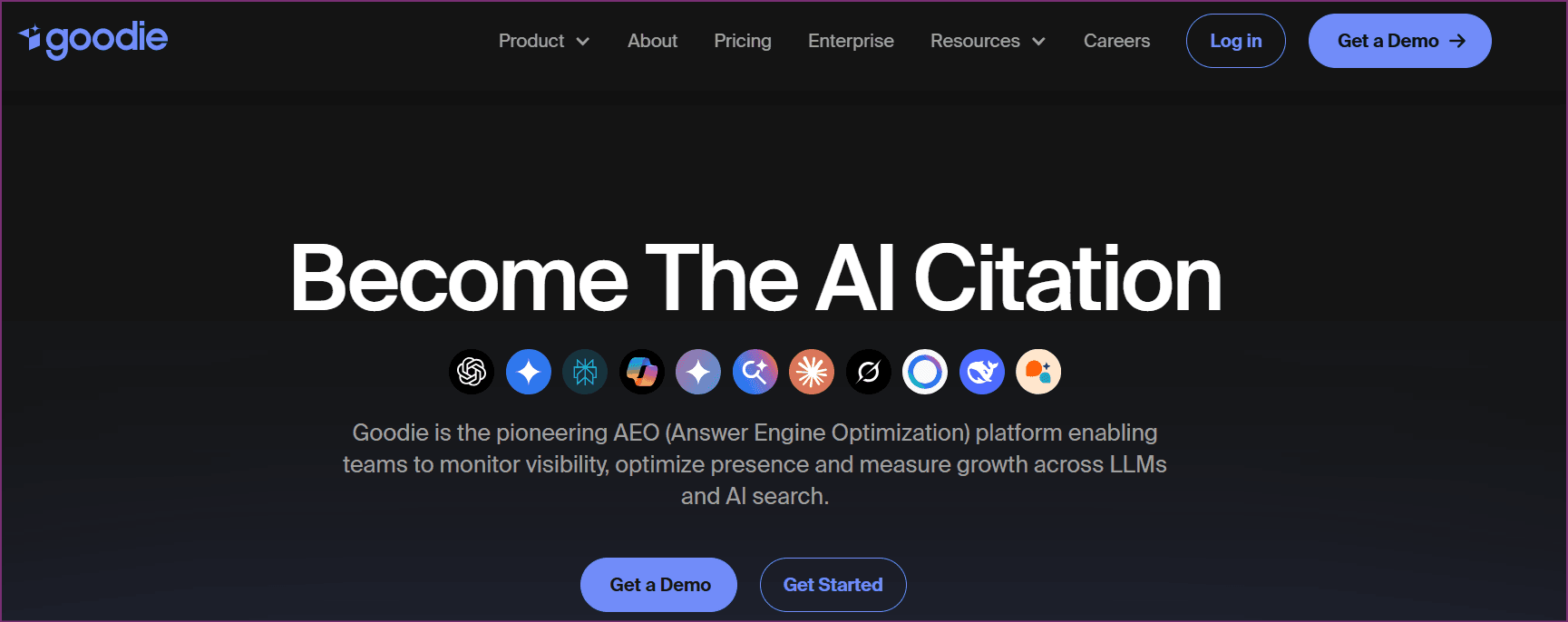
Goodie AI is the cleanest SMB on-ramp to AI search visibility we've tested. The dashboard is purpose-built for teams that don't have a dedicated AEO analyst — you connect your brand, choose 25-100 prompts, and Goodie starts surfacing where you're mentioned, where you're missing, and which competitors are taking your share-of-voice. The pricing model is the most predictable in this tier and the workflow is genuinely usable by a single marketer running visibility on the side.
Key Features
- Guided Prompt Setup: Walks new users through prompt taxonomy in 20 minutes — no AEO consultant required
- Multi-LLM Visibility: Tracks ChatGPT, Perplexity, Google AI Overviews, and Gemini with weekly refresh on entry plans
- Competitor Gap Reports: Highlights prompts where competitors are cited and you're not — the actionable signal
- Content Recommendations: Suggests source pages and on-site updates to influence AI citations
- Slack and Email Alerts: Real-time notifications when brand mentions shift or new competitors appear
Pricing
| Plan | Monthly | Annual (per month) |
|---|---|---|
| Starter | $99 | $79/mo |
| Growth | $249 | $199/mo |
| Pro | $499 | $399/mo |
Pros
- Lowest learning curve in this guide
- Predictable pricing at the SMB tier
- Competitor gap reports are genuinely actionable
- Slack integration keeps marketing teams in flow
Cons
- Doesn't cover Claude or Copilot on Starter plan
- Weekly refresh on entry tier (vs daily for enterprise tools)
- Less depth on sentiment analysis than enterprise platforms
Verdict: Goodie AI is the right call for SMB teams that need AI search visibility without committing to enterprise tooling. The Starter plan delivers genuine value at $99/month, which is rare in this category.
Moz AI
Best for: Enterprise marketing teams layering AEO visibility onto an established SEO platform
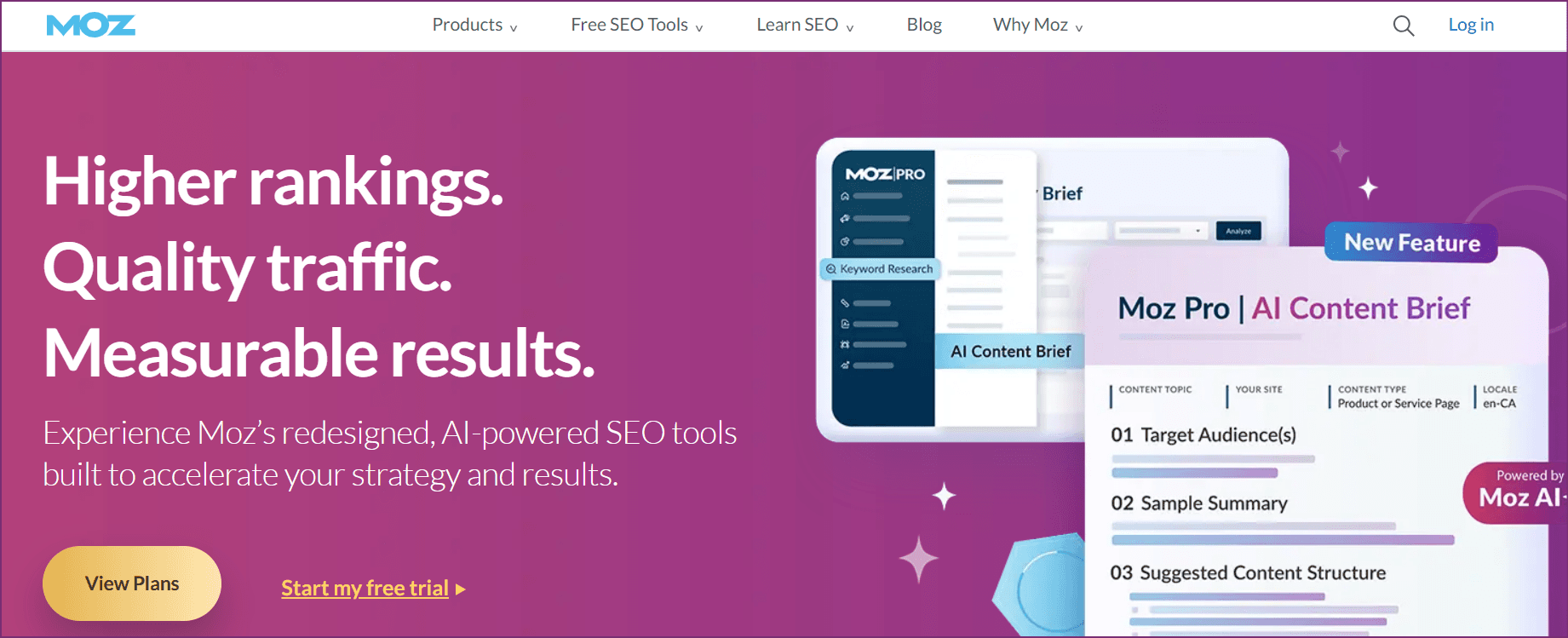
Moz AI is the AI-search layer Moz added on top of its established enterprise SEO suite in 2026, and for marketing teams already standardized on Moz Pro it's the most natural way to bring AEO into the existing rank-tracking workflow. The product pairs Moz's traditional Domain Authority, link, and keyword data with new AI Mention Tracking, Brand Authority for LLM citations, and AI Answer Eligibility scoring on content. The result is a single platform that tells enterprise marketers what's happening on blue-link search AND in generated answers — without standing up a second tool and a second contract.
Key Features
- AI Mention Tracking: Continuous monitoring across ChatGPT, Perplexity, Claude, Gemini, and Google AI Overviews with daily refresh on higher tiers
- Brand Authority for AEO: Moz's authority signal extended to AI citation likelihood — predict which brands LLMs are most likely to surface
- AI Answer Eligibility Scoring: Score content for retrievability and citation worthiness inside generated answers
- Unified SEO + AEO Reporting: Single dashboard showing rank changes and AI citation share — useful for enterprise marketing operations
- API Access: Pull AEO metrics into Looker, Tableau, and existing BI stacks on Medium tier and above
Pricing
| Plan | Monthly | Annual (per month) |
|---|---|---|
| Standard | $99 | $79/mo |
| Medium | $179 | $143/mo |
| Large | $299 | $239/mo |
| Premium | $599 | $479/mo |
Pros
- Brings AEO into the existing Moz workflow — zero new vendor onboarding for Moz Pro teams
- Brand Authority signal is unique in this category and genuinely predictive
- Unified SEO + AEO reporting saves dashboard sprawl
- API access at mid-tier supports BI integration
Cons
- AEO coverage is shallower than dedicated AEO-only platforms
- Best value if you're already paying for Moz Pro — less compelling as a standalone purchase
- AI Mention Tracking refresh rate slower on entry tiers
Verdict: Moz AI is the right enterprise choice when you want AEO inside the platform your team already uses. The integrated workflow beats stitching together a dedicated AEO tool for organizations where Moz is the system of record.
LLMRefs
Best for: Content and PR teams that need to know exactly which sources LLMs cite for category prompts
LLMRefs is the dedicated citation tracker we recommend when the workflow you care about is influencing the sources LLMs use to answer category questions. The product is narrower than enterprise platforms but deeper on the one thing it does: showing, prompt by prompt, every URL that LLMs cite in their answers, with frequency, recency, and authority signals. For PR and content teams running outreach to get cited in industry sources, that data is the difference between guessing and operating.
Key Features
- Citation Frequency Maps: Per-prompt visualization of every cited URL with frequency across ChatGPT, Perplexity, and Google AI Overviews
- Source Authority Scoring: Identifies which sites are over-indexed in LLM answers vs traditional Google rankings
- PR Target Lists: Auto-generated lists of publications and pages worth targeting for citation outreach
- Historical Tracking: Track citation patterns over weeks/months to detect shifts after content or PR moves
- Slack and Webhook Alerts: Flag when new sources start being cited or when your brand gets dropped
Pricing
| Plan | Monthly | Annual (per month) |
|---|---|---|
| Starter | $129 | $99/mo |
| Pro | $299 | $249/mo |
| Team | $599 | $499/mo |
Pros
- Deepest citation source analysis at this price point
- Historical tracking surfaces real cause-and-effect
- PR target lists collapse a week of manual research
- Webhook alerts plug into existing PR workflows
Cons
- Narrower than enterprise platforms — not an all-in-one
- Limited sentiment analysis
- Best results require pairing with a content tool
Verdict: LLMRefs is the right tool when your workflow is citation outreach and source influence. Pair it with a content tool like Rankability and you have a complete AEO motion at SMB pricing.
RankPrompt
Best for: SEO teams that think in keyword cohorts and want LLM visibility metrics at prompt-cohort granularity
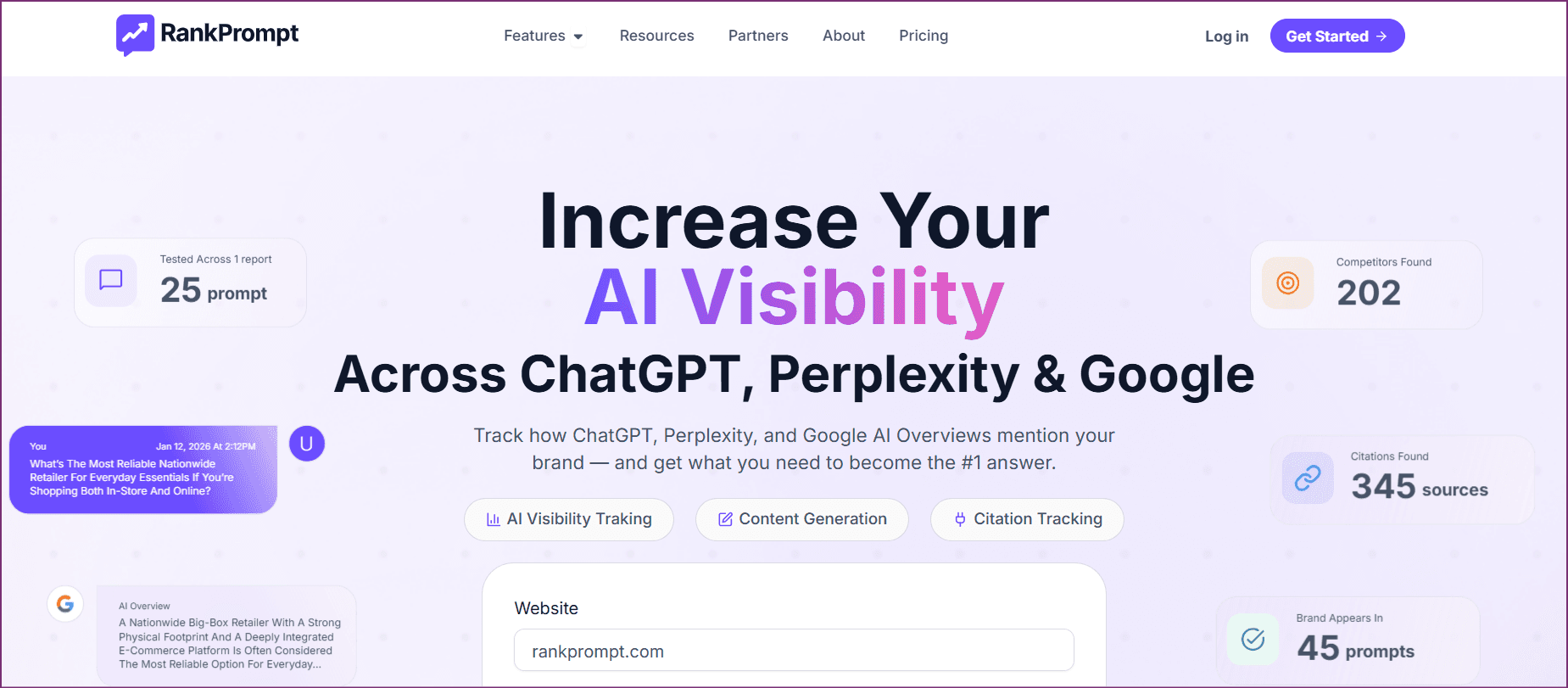
RankPrompt is built for SEO teams already operating in keyword-cohort frameworks who want the same workflow applied to LLM prompts. Instead of treating each prompt as a one-off, you group prompts into intent cohorts and track aggregate visibility, share-of-voice, and citation rate at the cohort level. For B2B teams that already think about "high-intent comparison queries" or "alternative searches" as a class, this maps perfectly onto how your existing rank tracking is structured.
Key Features
- Prompt Cohort Builder: Group prompts into intent cohorts and track aggregate visibility metrics across the group
- Cross-LLM Rank Tracking: Position-style ranking inside generated answers across ChatGPT, Perplexity, Gemini, and Google AIO
- Competitor Cohort Comparison: See which competitors dominate which intent cohorts — and where you have white space
- Brief Generator: Generate AI-eligible content briefs grounded in prompt cohort data
- API Access: Pull prompt-level data into existing dashboards from the Pro plan
Pricing
| Plan | Monthly | Annual (per month) |
|---|---|---|
| Starter | $149 | $119/mo |
| Pro | $349 | $279/mo |
| Scale | $699 | $579/mo |
Pros
- Cohort-level analysis maps onto existing SEO frameworks
- Cross-LLM rank tracking inside generated answers
- Brief generator closes the loop from data to content
- API access at the Pro tier
Cons
- Cohort setup takes longer than per-prompt tools
- Sentiment analysis less developed than enterprise platforms
- No native PR target list workflow
Verdict: RankPrompt is the right pick when your existing SEO team thinks in cohorts. The mapping from intent cohort to prompt cohort is the cleanest workflow we've seen for translating traditional SEO operating models into AEO.
GetCito
Best for: Content teams running citation-mining workflows to identify high-value source pages to target
GetCito is purpose-built for one workflow that matters more in 2026 than it ever did in traditional SEO: citation mining. Given a category or prompt set, GetCito surfaces every page and source LLMs are referencing — not just the citations themselves but the underlying content patterns. The output is a prioritized list of source opportunities: pages to pitch, listicles to be included in, authoritative sources to earn mentions from. For content teams running outreach at scale, the time savings are substantial.
Key Features
- Citation Mining Engine: Surfaces every cited source across a prompt set with frequency, authority, and gap signals
- Listicle Inclusion Tracker: Track which 'best X' listicles include or exclude your brand across LLM-cited sources
- Outreach Workflow: Built-in templates and tracking for pitching inclusion in cited sources
- Competitor Source Analysis: Reverse-engineer which sources are driving competitor citations
- CSV Export and API: Pull mining results into existing outreach and CRM workflows
Pricing
| Plan | Monthly | Annual (per month) |
|---|---|---|
| Solo | $99 | $79/mo |
| Team | $249 | $199/mo |
| Agency | $499 | $399/mo |
Pros
- Best workflow for citation mining at this price point
- Listicle inclusion tracking is unique in this category
- Built-in outreach saves 5-8 hours per campaign
- Solid free trial covers a real evaluation period
Cons
- Narrower than enterprise platforms
- Less prompt-tracking depth than RankPrompt
- Best results when paired with a content tool
Verdict: GetCito is the right call when citation-mining is the workflow you need to operationalize. Most content teams underestimate how much manual time citation research takes — GetCito collapses it.
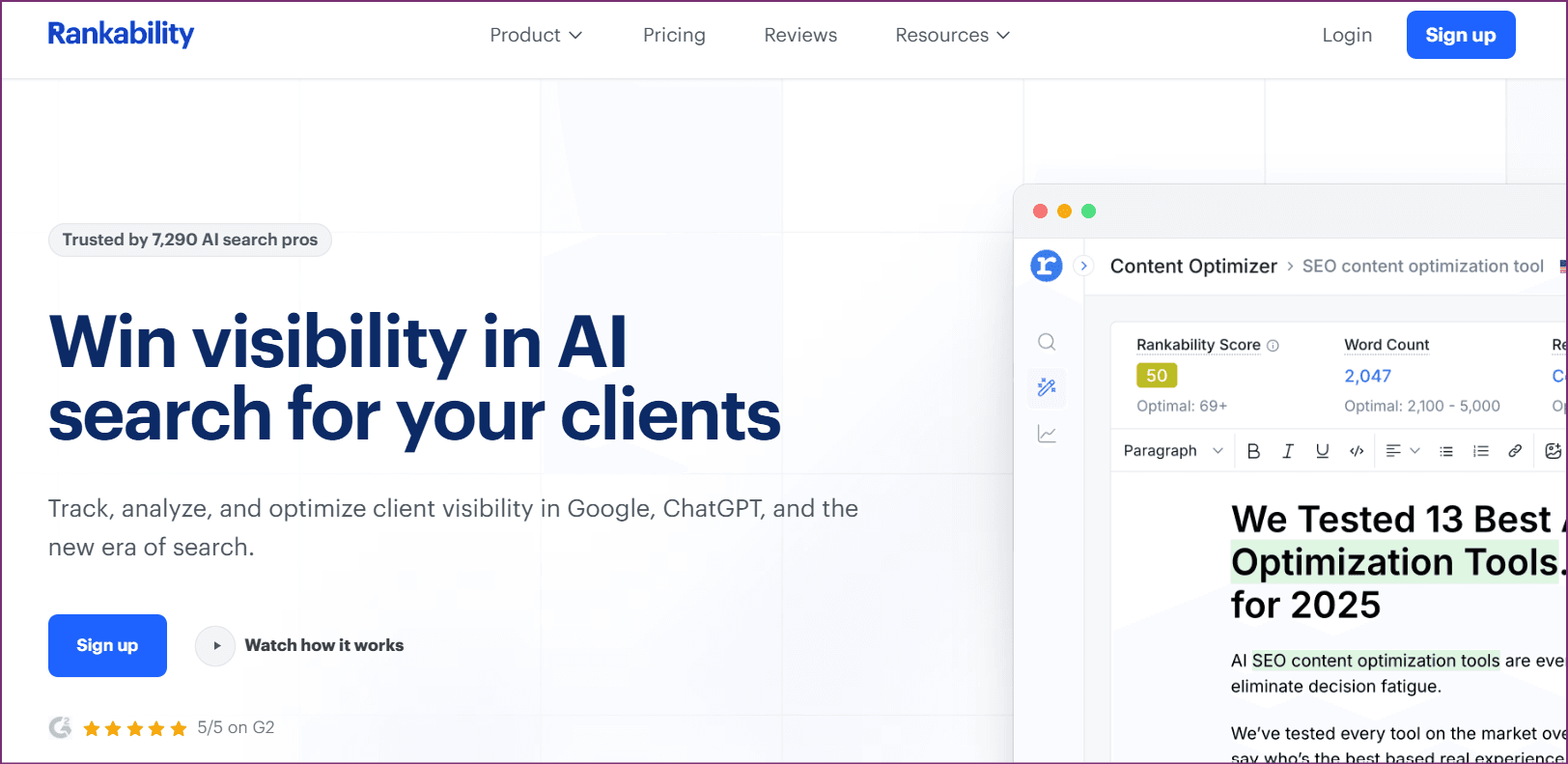
Rankability
Best for: Content teams optimizing pages specifically for AI answer eligibility and citation
Rankability is the content optimization tool we recommend when the goal is AI answer eligibility — making sure your pages contain the structured, well-cited, retrievable content that LLM retrievers actually surface. The optimization model goes beyond traditional SERP-grounded scoring to evaluate page structure, claim verifiability, citation density, and the markers LLM retrievers use to select source pages. For teams updating existing content for AEO, it's the fastest path to a measurable lift.
Key Features
- AI Answer Eligibility Score: Grade content on factors specific to LLM retrieval and citation — claims, structure, sourcing
- Real-Time Content Editor: In-app editor with live AEO scoring as you write or update existing pages
- Citation Density Analysis: Identifies where additional sourcing or specificity will increase LLM citation likelihood
- Structured Data Recommendations: Schema markup suggestions tuned for AI answer eligibility, not just SERP features
- Google Docs and WordPress Integration: Optimize inside existing editorial workflows without context switching
Pricing
| Plan | Monthly | Annual (per month) |
|---|---|---|
| Solo | $79 | $65/mo |
| Standard | $199 | $165/mo |
| Agency | $449 | $369/mo |
Pros
- Strongest content optimizer specifically tuned for AEO
- Real-time editor closes the loop between insight and execution
- Schema recommendations are AEO-aware (not just SERP-aware)
- Google Docs integration is genuinely smooth
Cons
- No tracking layer — needs pairing with a monitor
- Citation density model is opinionated
- Limited multilingual support compared to Clearscope
Verdict: Rankability is the right content tool when you're updating pages specifically for AI answer eligibility. Pair with a tracker (LLMRefs, RankPrompt, or Goodie) for a complete motion.
Semrush AI Toolkit
Best for: Semrush customers adding AI visibility tracking to their existing SEO platform
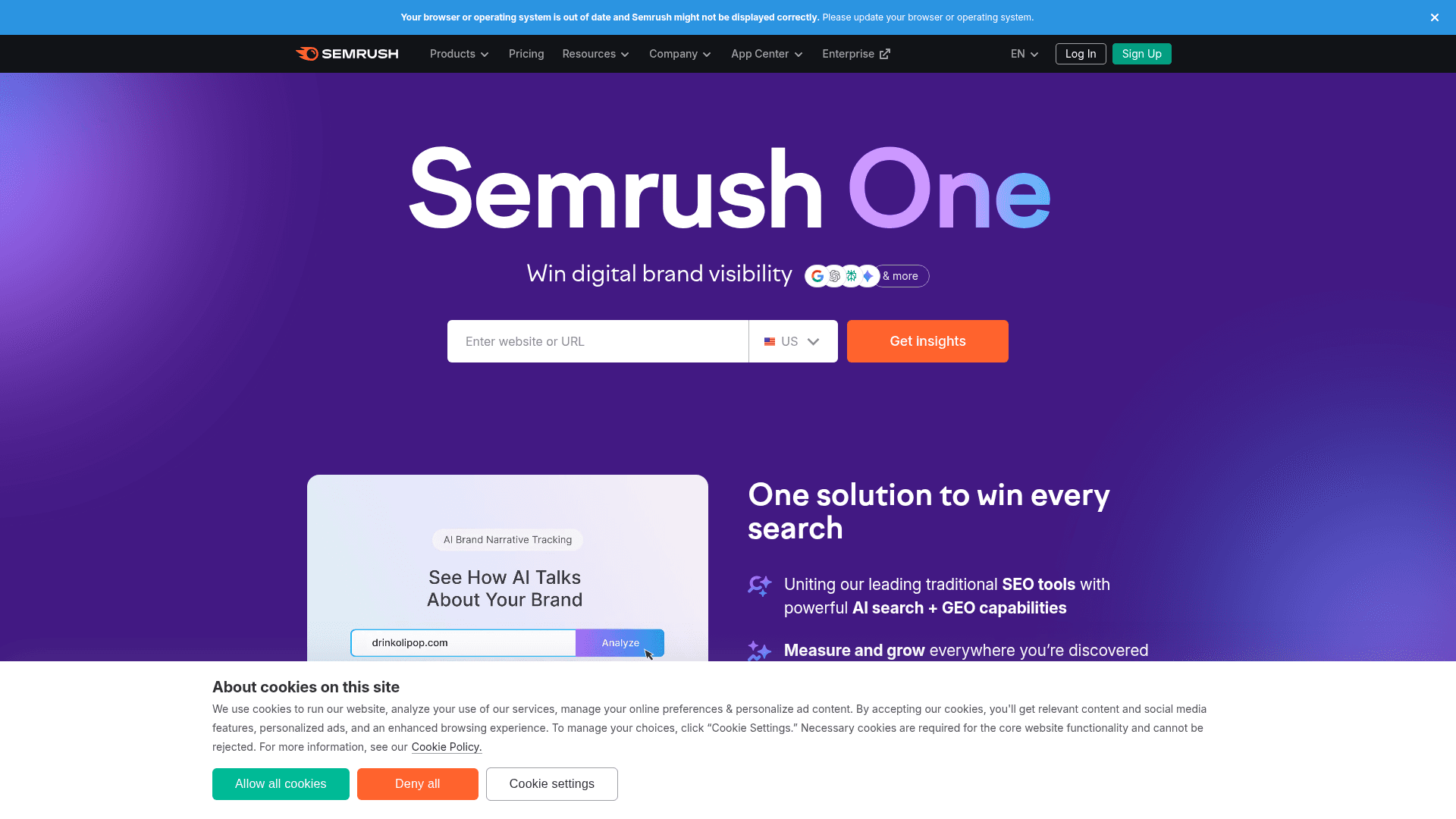
Semrush AI Toolkit is the AEO module Semrush added to its established SEO suite in 2025, and in 2026 it's matured into a credible answer for Semrush customers who want AI visibility without subscribing to a second platform. The coverage isn't as deep as dedicated trackers (LLMRefs, RankPrompt) but the integration with Semrush's keyword and competitor data makes it a one-stop view that mature SEO teams find genuinely useful. The price advantage is real if you're already paying for the parent suite.
Key Features
- Brand Mention Tracking: Monitor brand mentions across ChatGPT, Perplexity, and Google AI Overviews
- Prompt Coverage Reports: Track visibility across a curated prompt set per category
- Competitor Share-of-Voice: Compare brand citation rates against Semrush-tracked competitors
- Content Recommendations: Surfaces existing Semrush content gaps that map to AI prompt opportunities
- Native Semrush Integration: Unified dashboard with traditional rank tracking, keyword research, and backlink data
Pricing
| Plan | Monthly | Annual (per month) |
|---|---|---|
| Pro (incl. AI Toolkit add-on) | $129.95 | $108.33/mo |
| Guru (incl. AI Toolkit) | $249.95 | $208.33/mo |
| Business (incl. AI Toolkit) | $499.95 | $416.66/mo |
Pros
- Unified view with traditional SEO data — single dashboard
- Most economical if already paying for Semrush
- Content recommendations leverage existing Semrush data depth
- Solid for SMB teams that don't need enterprise depth
Cons
- Fewer LLM surfaces covered than dedicated tools
- Less depth on citation source analysis
- AEO module is newer than the rest of the Semrush suite
Verdict: Semrush AI Toolkit is the right answer when you're already on Semrush and want AI visibility tracking without a second subscription. For teams not already on Semrush, dedicated tools deliver more depth at similar prices.
Ahrefs Brand Radar
Best for: Ahrefs customers extending their existing platform with AI mention tracking
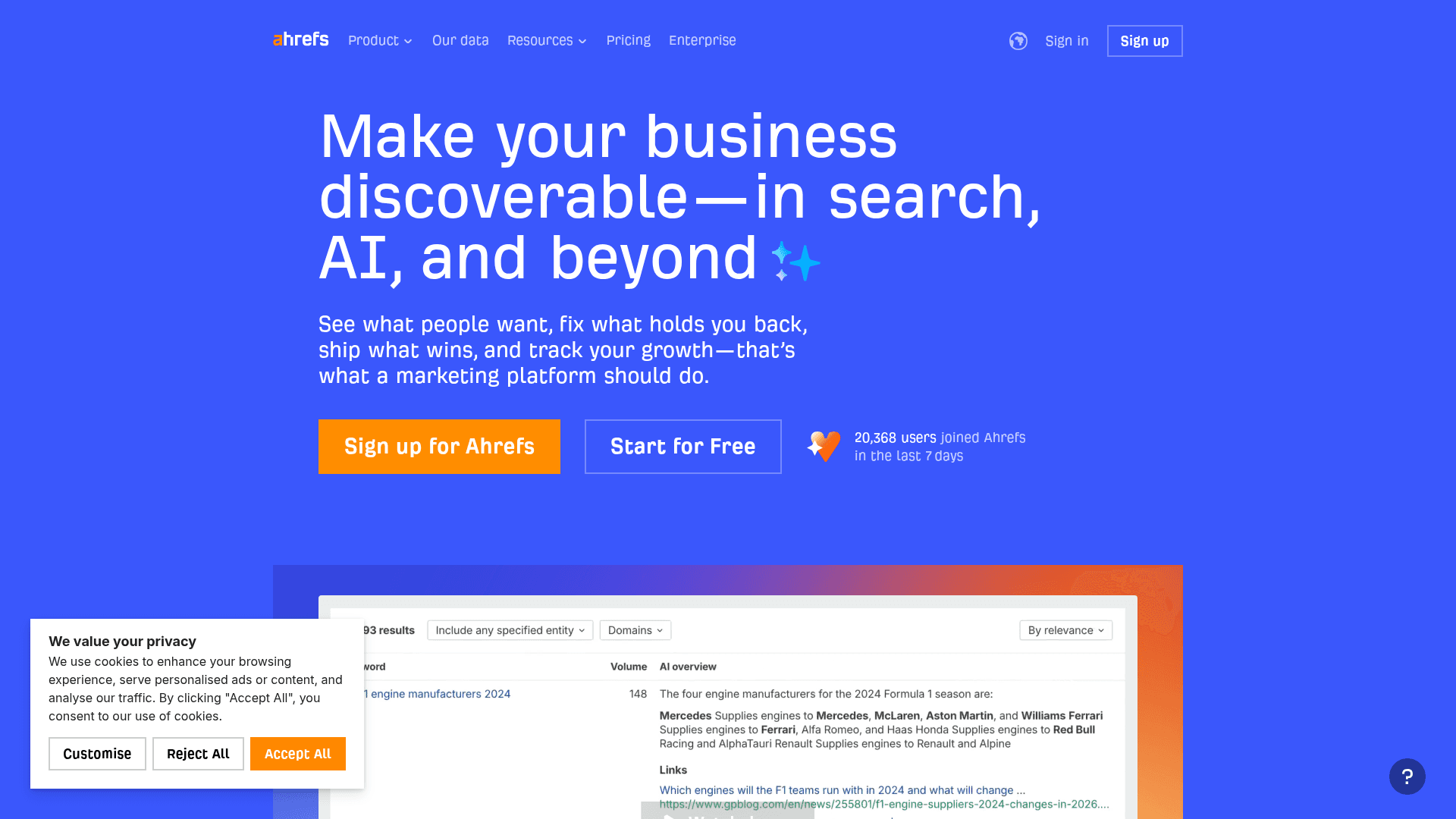
Ahrefs Brand Radar is Ahrefs' answer to the same problem Semrush solved with its AI Toolkit: extending an established SEO suite with AI mention tracking. Brand Radar leverages Ahrefs' click and citation data depth to deliver one of the more credible mention-tracking experiences inside an established suite — and the integration with Ahrefs' backlink data makes it particularly strong for teams thinking about how off-page signals translate to LLM citation eligibility. Like the Semrush option, the economics make sense primarily if you're already paying for the parent suite.
Key Features
- Brand Mention Monitoring: Track brand citations across ChatGPT, Perplexity, Gemini, and Google AI Overviews
- Citation Source Analysis: Identify which URLs LLMs are using as sources — leveraging Ahrefs' backlink data depth
- Competitor Mention Comparison: Track how your brand citation rate compares to Ahrefs-tracked competitors
- Off-Page Influence Reports: Connect backlink and PR activity to changes in AI mention frequency
- Native Ahrefs Integration: Unified view with Site Explorer, Content Explorer, and Keyword Explorer
Pricing
| Plan | Monthly | Annual (per month) |
|---|---|---|
| Lite (incl. Brand Radar) | $129 | $108/mo |
| Standard (incl. Brand Radar) | $249 | $208/mo |
| Advanced (incl. Brand Radar) | $449 | $374/mo |
Pros
- Best citation-source analysis among established suite add-ons
- Backlink data depth is unique in this category
- Unified workflow with established Ahrefs features
- Click data context makes mention reports more actionable
Cons
- Fewer LLM surfaces than dedicated tools
- Higher entry price than Semrush Pro in 2026
- Less prompt-cohort depth than RankPrompt
Verdict: Ahrefs Brand Radar is the right call if you're already on Ahrefs — the backlink data integration is genuinely differentiated. For teams not already on Ahrefs, dedicated tools are usually a better economic fit.
SE Ranking AI Toolkit
Best for: Mid-market teams that want traditional SEO and AI visibility in a single platform at a single price
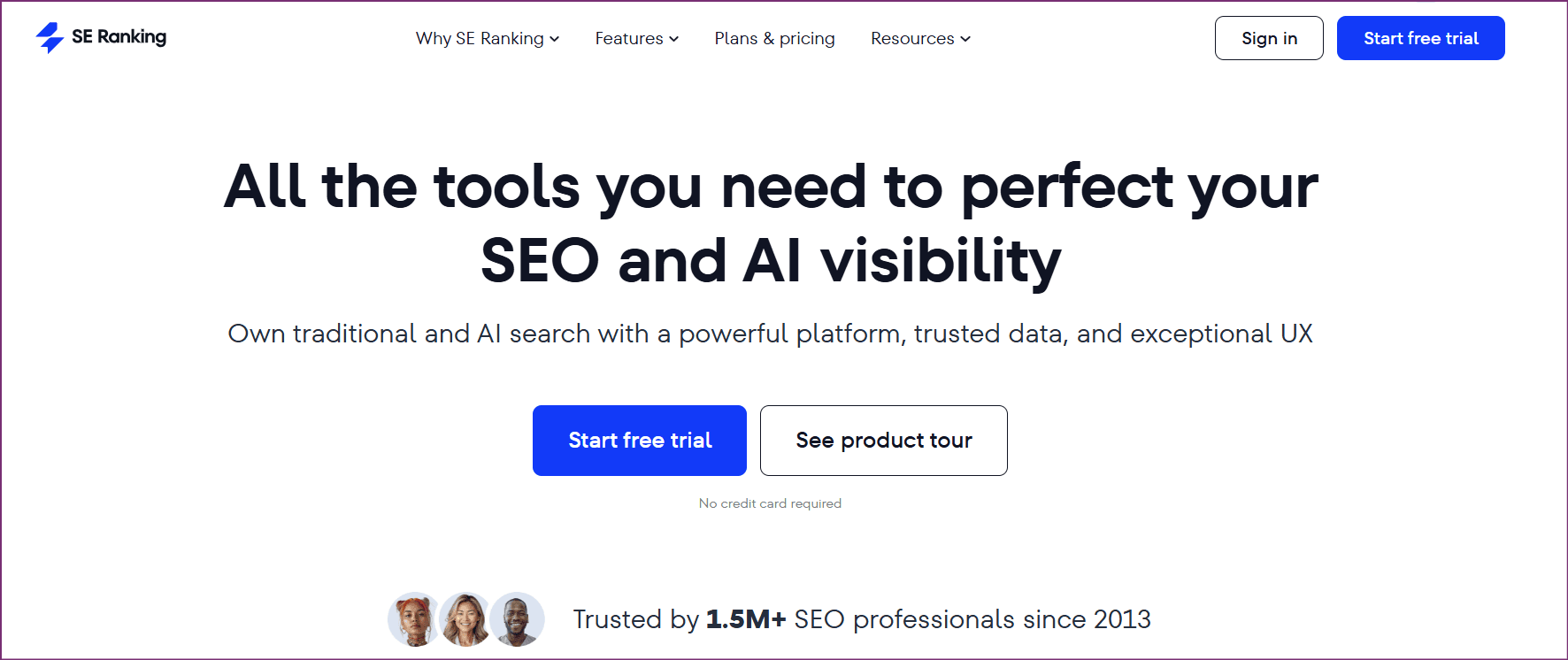
SE Ranking continued its pattern of delivering Semrush-level capabilities at roughly half the price when it added an AI Toolkit module to its established suite in late 2025. For mid-market teams in the $1M-$10M ARR range that need both traditional SEO and AI search visibility but can't justify Semrush + a dedicated AEO platform, SE Ranking's combined offering is genuinely the best value in this guide. The depth isn't enterprise-tier — but for the price, it's hard to beat.
Key Features
- AI Mention Tracking: Monitor brand citations across ChatGPT, Perplexity, and Google AI Overviews on entry plans
- Prompt Coverage Reports: Track visibility across curated prompt sets aligned with your existing keyword cohorts
- Competitor Comparison: Side-by-side AI mention rates with traditional rank tracking competitors
- Content Editor for AEO: Built-in content optimizer with both SERP and AI answer eligibility scoring
- Unified Reporting: Single dashboard combining traditional SEO and AI visibility metrics — useful for agency reporting
Pricing
| Plan | Monthly | Annual (per month) |
|---|---|---|
| Essential | $65 | $52/mo |
| Pro (incl. AI Toolkit) | $119 | $95.20/mo |
| Business (incl. AI Toolkit) | $259 | $207.20/mo |
Pros
- Best price-per-feature in this guide for combined SEO + AEO
- Unified dashboard is genuinely useful for agency reporting
- White-label reports work for client-facing teams
- Solid SMB and mid-market fit
Cons
- Depth lags dedicated AEO tools and enterprise platforms
- AI Toolkit features locked to Pro tier and above
- Fewer LLM surfaces tracked vs Moz AI or Goodie
Verdict: SE Ranking AI Toolkit is the smart all-in-one for mid-market teams that want one bill, one dashboard, and broadly capable coverage on both blue-link and AI surfaces.
Page Optimizer Pro
Best for: Content teams optimizing individual pages for both traditional SERP ranking and AI citation eligibility
Page Optimizer Pro (POP) is the affordable content optimizer most often paired with AEO-focused workflows because its scoring model rewards the same signals LLM retrievers care about: entity coverage, structural clarity, claim density, and source-quality signals. Where most content optimizers grade you against the top-ranking SERP, POP layers in retrievability and citation-worthiness signals — making it the most pragmatic content tool in this guide for teams writing pages they want LLMs to quote. It's not a tracker and won't replace a dedicated AEO monitoring tool, but as a writing layer it produces meaningfully more citation-friendly output.
Key Features
- Retrievability Scoring: Score content for the structural and entity signals LLM retrievers use to identify quotable passages
- Entity Coverage Analysis: Identify the named entities, statistics, and concepts you need to include for category-level citation eligibility
- Claim Density Optimization: Increase the density of specific, attributable claims — the format LLMs preferentially cite
- SERP + AEO Scoring: Dual-purpose grading covers both traditional ranking and AI citation worthiness in one pass
- Bulk Page Audits: Audit existing content libraries for AEO eligibility gaps across hundreds of pages
Pricing
| Plan | Monthly | Annual (per month) |
|---|---|---|
| Premium | $27 | $22/mo |
| Unlimited | $48 | $39/mo |
| Pro | $98 | $79/mo |
Pros
- Lowest-cost content optimizer with explicit AEO features in this guide
- Bulk page audits surface AEO gaps across existing content libraries
- Dual-purpose scoring saves switching between SERP and AEO tools
- Particularly strong for B2B SaaS comparison and alternative pages
Cons
- UI is functional rather than polished — feels less modern than Clearscope or Surfer
- No tracking or monitoring — strictly a writing/auditing tool
- Best paired with a dedicated tracker like LLMRefs or RankPrompt
Verdict: Page Optimizer Pro is the right content layer when AEO eligibility is the goal and budget matters. Pair it with a tracker and you have a complete AEO production stack at well under $500/month.
How to Choose Your AEO/GEO Stack
The right pick depends on your specific bottleneck — and most teams need two tools, not one. Here's the decision framework:
If you need to trace AI visibility to business results...
Choose Promptwatch. It connects live AI answers with crawler logs, citations, visitor traffic, and conversions, giving GEO teams evidence beyond a mention count.
If you want the work of getting cited done for you...
Choose OnCited — our top overall pick. It tracks all 10 major AI engines through the real apps, shows you the exact sources each answer is built from, and then its team publishes the citations that move you up. It's the only tool here that closes the loop between measuring visibility and actually earning it.
If you're an enterprise already standardized on a major SEO platform...
Choose Moz AI. Bringing AEO into the existing Moz workflow beats standing up a second tool — Brand Authority for AEO is genuinely predictive and the unified reporting saves dashboard sprawl.
If you're an SMB adopting AEO for the first time...
Choose Goodie AI. The $99 starter plan, guided setup, and competitor gap reports are the right entry point for teams without a dedicated AEO analyst.
If your workflow is PR outreach and citation source influence...
Choose LLMRefs for citation source analysis or GetCito for citation mining. Both collapse manual research into an operationalized workflow.
If your bottleneck is content not being citation-eligible...
Choose Rankability for premium AEO content optimization or Page Optimizer Pro for affordable per-page tuning. Pair with a tracker for the full motion.
If you're already paying for a major SEO suite...
Choose Semrush AI Toolkit, Ahrefs Brand Radar, or SE Ranking AI Toolkit — whichever maps to your existing platform. The economics make sense and the integration is genuinely useful.
If your team thinks in keyword cohorts already...
Choose RankPrompt. The cohort-level visibility model maps cleanly onto how mature SEO teams already operate — the workflow translation is the smoothest in this category.
Pro Tip
The mature 2026 stack is one tracker (Moz AI, Goodie, LLMRefs, or RankPrompt) plus one content tool (Rankability or Page Optimizer Pro) plus a single all-in-one for traditional SEO. Three tools, $200-$1,000/month total — that's where 80% of growth-stage teams land.
Frequently Asked Questions
Final Thoughts
AI search visibility is no longer a side project. The marketers winning in 2026 treat AEO/GEO with the same rigor they applied to blue-link SEO in 2018 — they measure, they ship, they iterate. The biggest difference is that the surface is so new that meaningful share-of-voice is still gettable. Categories that will be saturated by 2027 still have white space today, but only for teams that have the right tooling and the discipline to use it.
Our top overall pick is OnCited — it's the only tool we tested that both tracks every major AI engine and does the work of getting you cited from the sources those engines actually read, so you get outcomes instead of another dashboard. For enterprise teams already standardized on a major SEO platform, Moz AI is the strongest add-on, and for SMB teams adopting AEO for the first time, Goodie AI is the cleanest on-ramp. Any of them pairs naturally with a content optimizer like Rankability and an established SEO suite for traditional rank tracking. Start measuring now — competitors that wait until 2027 will spend two years catching up.
Related Free SEO Tools
Content Brief Generator
Generate SERP- and AEO-grounded briefs for new pages
SEO Content Grader
Score your pages for ranking and citation eligibility
Meta Tags Generator
Optimize SERP previews and AI-readable metadata
Long-Tail Keyword Generator
Find prompt-style commercial queries to track
Keyword Extractor
Pull keywords and entities from competitor pages
Content Outline Generator
Structure content for citation-eligible AEO answers
Related Articles
OnCited Review
Our full evaluation of the #1 overall pick — track and get cited across AI search
Goodie AI Review
Deep dive on the SMB AEO leader we ranked #3
LLMRefs Review
How citation source analysis actually works in practice
Rankability Review
Our full evaluation of the AEO-focused content optimizer
Bluefish AI Review
Deep dive on citation-source analytics and Bluefish AI pricing
Semrush AI Toolkit vs Ahrefs Brand Radar
Head-to-head on the two big established-suite AEO add-ons
About the Author

Co-Founder & SEO Execution
Co-founder of PikaSEO. 11 years in corporate tech, then bootstrapped entrepreneur. Leads SEO execution and content-led growth for SaaS companies.