
Expense management quietly became one of the most contested categories in B2B software. Card-issuing fintechs made the software free and moved policy enforcement to the moment of swipe; AI made receipt data entry a solved problem; and the expense report itself — the form employees dread and finance teams chase — started disappearing into automated exception queues. Meanwhile the incumbents didn't stand still: the enterprise suites still own global compliance, and the card-agnostic tools found a durable niche serving every company that can't or won't abandon its existing cards.
The result is that “what's the best expense management tool?” has become three different questions. Will you run spend on the platform's cards, or your own? Is the pain expense reports specifically, or all non-payroll spend? And does your complexity live in volume, in entities and currencies, or in compliance? This guide ranks the 10 expense management tools we'd actually shortlist in 2026, organized by the job each is best at — with honest pricing, because “free” and “$5 per user” hide very different economics.
We evaluated each tool on four criteria: automation depth (how much manual work — receipts, coding, chasing, reconciling — actually disappears), honest pricing (interchange-funded free vs. per-user vs. active-user vs. platform quotes, modeled at realistic team sizes), card strategy fit (card-first platforms vs. tools that work on your existing cards), and accounting impact (ERP sync depth and how much faster the month-end close actually gets).
Quick Comparison: The Best Expense Management Software at a Glance
| Tool | Best For | Software Price | Card Program | Free Tier |
|---|---|---|---|---|
| Brex | Best Overall | $0; Premium ~$12/user | Native (required for value) | Yes |
| Expensify | Card-Agnostic Small Teams | ~$5-9/user/mo (with card) | Optional | Individuals |
| BILL Spend & Expense | Free Expense Software | $0 | Native (required) | Entire product |
| Airbase | Mid-Market All-in-One | Quote-based | Native + supports others | No |
| SAP Concur | Global Enterprises | Quote-based | Agnostic (all major feeds) | No |
| Zoho Expense | Budget Pick | ~$3-8/user/mo | Agnostic | Up to 3 users |
| Rho | Banking + Expense Combo | $0 | Native (banking too) | Entire product |
| Payhawk | Multi-Entity Global | From ~€299/mo | Native (30+ countries) | No |
| Fyle | Keeping Existing Cards | ~$6.99/active user/mo | None (works on yours) | Trial |
| Rippling Spend | HR-Integrated | Modular, quote-based | Native | No |
How We Evaluated the Best Expense Management Software
Every vendor demos receipt scanning and dashboards. We weighted the dimensions that separate tools once they're running real company spend:
Automation Depth
Receipt OCR is table stakes. We scored what disappears after it: memo generation, GL coding, policy checks, documentation chasing, and reconciliation. The best platforms turn expense reports into exception queues; the weakest digitize the same old workflow.
Honest Pricing Models
Interchange-funded free, per-seat, per-active-user, per-report, and platform quotes all price the same job differently. We modeled a 50-person company on each — and flagged where “free” means “free if you adopt our card program.”
Card Strategy Fit
The biggest fork in the category: platforms that require their cards versus tools that automate the cards you have. Neither is universally right — we scored each tool for how gracefully it fits both worlds, and what you give up on either path.
Accounting & Close Impact
The buyer is usually a finance team, and the ROI shows up at month-end. We weighted ERP sync depth (QuickBooks universally; NetSuite as the mid-market bar), audit trails, and how many days each platform credibly cuts from the close.
Pro Tip
Before comparing tools, count your real expense flows for one month: how many card transactions, how many out-of-pocket reimbursements, and how many people submit at all. Card-heavy spend favors card-first platforms; reimbursement-heavy spend favors card-agnostic tools with strong ACH; and a low submitter count makes active-user billing (Fyle, Expensify) dramatically cheaper than seat pricing.
Pricing at a Glance
The category runs on three economic models. Card-funded platforms (BILL Spend & Expense, Rho, Brex Essentials) charge nothing for software and earn interchange on card spend. Per-user SaaS runs roughly $3-9 per user per month — with the crucial distinction between seat billing and active-user billing. And the platform tier (Airbase, Payhawk, SAP Concur, Rippling) prices by quote. Here's the field on one axis:
The Best Expense Management Tools, by Category
Before reading individual reviews, place your company on this map — the card decision and your organizational complexity narrow ten tools to a shortlist of two or three:
Card-first platforms (Brex, BILL Spend & Expense, Rho) give away software and enforce policy at swipe time — the automation ceiling is highest, but only if their cards carry your spend. Card-agnostic trackers (Expensify, Fyle) automate on top of the cards and banks you already have — the right answer when rewards, credit lines, or bank relationships make switching a non-starter. Enterprise and global suites (SAP Concur, Airbase, Payhawk) earn their quotes on compliance, multi-entity consolidation, and ERP depth. Suite-native players (Rippling Spend, Zoho Expense) win by leverage: they already hold your HR or business data, so policy and sync come almost for free inside their ecosystems.
Brex
Best for: Startups and scaling companies that want cards, expense automation, banking, and travel in one platform — with software that's free until you need the premium tier
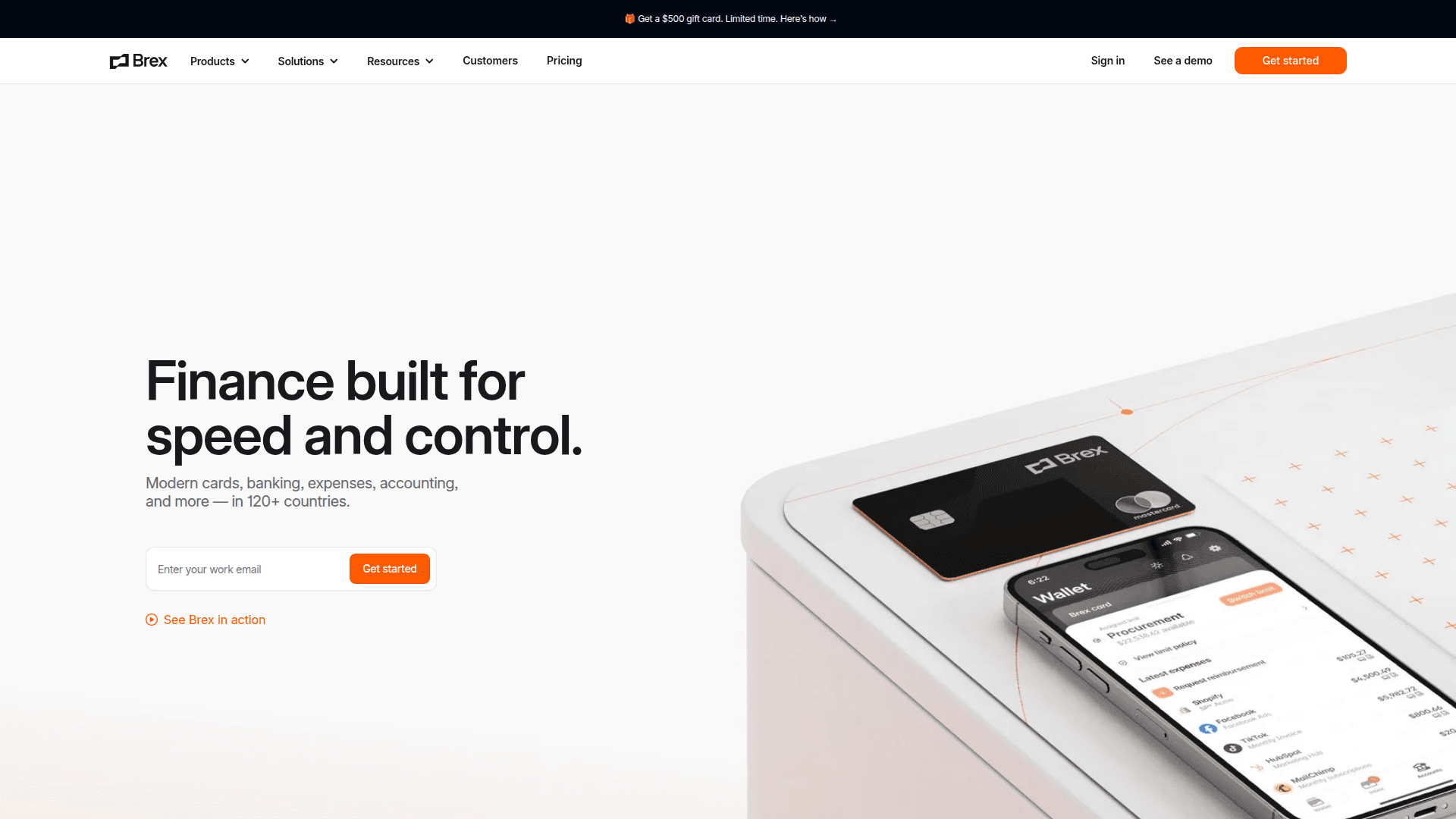
Brex won the top spot by making the expense report itself feel obsolete. Spend happens on Brex cards (physical, virtual, or vendor-specific), receipts arrive by text, email forward, or app photo, and the platform matches them to transactions, drafts the memo, applies the right GL code, and enforces policy — at the point of swipe, not at month-end. What used to be an expense workflow becomes an exception queue. Around that core sits a genuine platform: business accounts with treasury yield, bill pay, travel booking, and multi-currency cards that work for international teams. The Essentials tier is free with card adoption; Premium adds advanced policy controls, ERP integrations, and support depth. The honest limits: the model assumes Brex cards carry most spend, and companies locked into bank card relationships or heavy out-of-pocket reimbursement patterns give up much of the magic.
Key Features
- Automated Receipt Matching & Memos: Receipts by text, email, or photo auto-match to transactions with AI-drafted memos and GL coding
- Policy Enforcement at Swipe: Limits, category blocks, and documentation rules applied when spend happens, not after
- Unlimited Virtual Cards: Per-vendor, per-budget, and per-employee cards with granular controls
- Banking, Bill Pay & Travel: Business accounts, treasury yield, AP, and travel booking in the same platform
- Global Cards & Multi-Currency: Local-currency cards and reimbursements across major markets for international teams
Pricing
| Plan | Monthly | Annual (per month) |
|---|---|---|
| Essentials | $0 (with card adoption) | $0 |
| Premium | ~$12/user | ~$12/user/mo |
| Enterprise | Custom | Custom |
Pros
- Expense reports effectively disappear for card spend
- Free tier covers cards, expense, banking, and bill pay
- Policy controls act pre-spend, not post-hoc
- Scales from two founders to public-company finance teams
Cons
- Full value requires moving spend onto Brex cards
- Reimbursement-heavy workflows are weaker than card workflows
- Premium features and ERP depth sit behind the paid tier
Verdict: Brex is the best expense management platform for most companies in 2026. If you can put spend on its cards, the automation ceiling is the highest in the category — start on the free tier and grow into Premium.
Visit BrexExpensify
Best for: Small teams and accountant-led businesses that want the easiest receipt capture on the cards and banks they already use
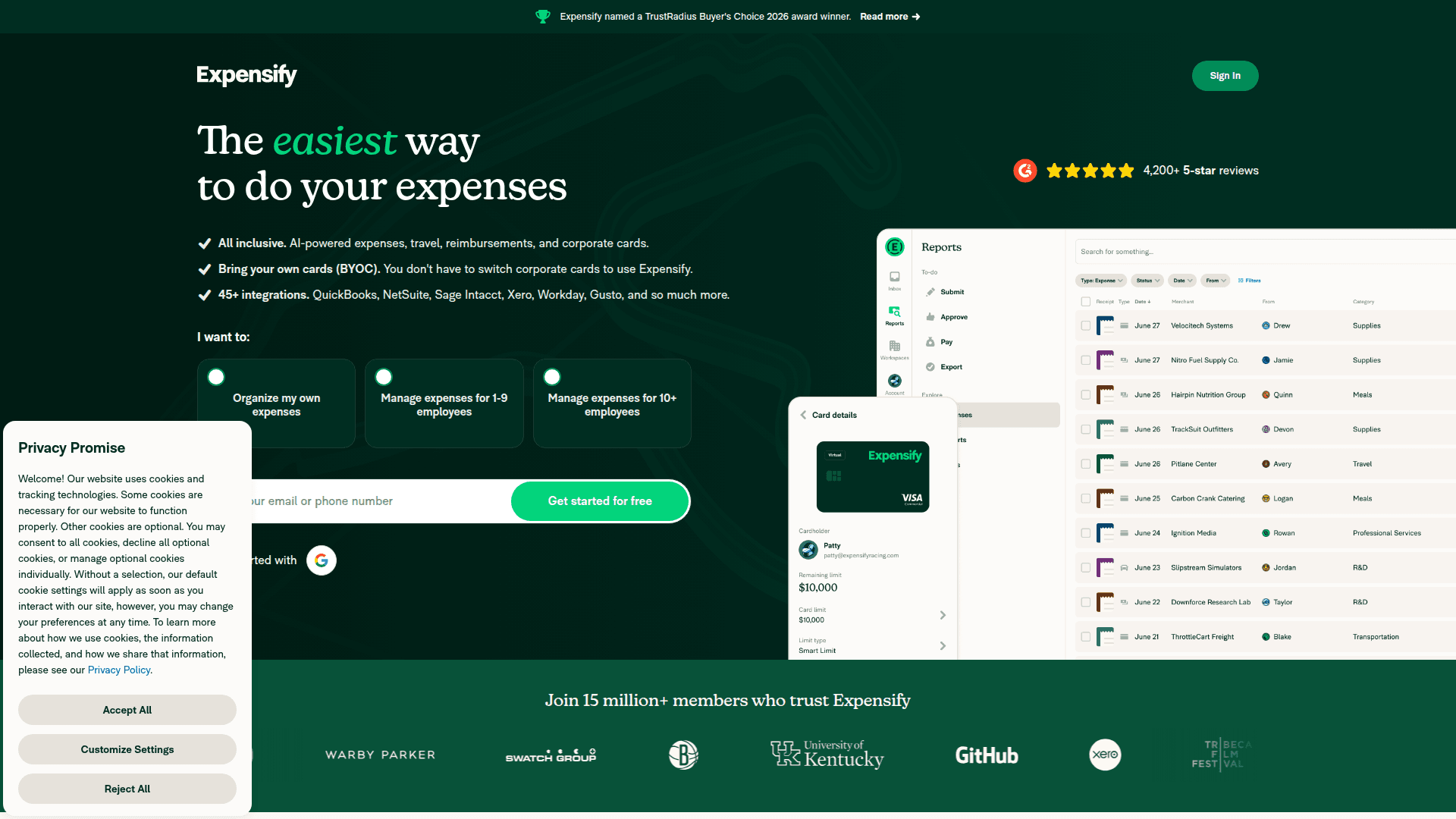
Expensify remains the default answer to 'we just need expense reports to not be painful.' SmartScan is still the best-known receipt capture in the industry: photograph a receipt and the merchant, date, amount, and category fill themselves in; e-receipts and card feeds match automatically; and next-day ACH reimbursement keeps employees happy. It's card-agnostic — it sits on top of whatever business cards and banks you already have — with an optional Expensify Card that cuts your per-user price roughly in half when adopted. The accountant channel is a real moat: thousands of bookkeeping firms run client expenses through it, and QuickBooks/Xero sync is battle-tested. The caveats: approval workflows and multi-entity controls are shallow next to mid-market suites, pricing depends heavily on card adoption and annual commitment, and the long-running 'New Expensify' redesign means the product has two coexisting interfaces.
Key Features
- SmartScan Receipt Capture: Photo, email, or forward a receipt — extraction, categorization, and matching are automatic
- Next-Day Reimbursement: Approved out-of-pocket expenses hit employee bank accounts via next-day ACH
- Card Feeds on Your Existing Cards: Direct feeds from major banks and card programs — no card switch required
- Optional Expensify Card: Adopting the card roughly halves per-user software pricing
- Accountant-Grade Accounting Sync: Deep QuickBooks, Xero, and NetSuite export with category and class mapping
Pricing
| Plan | Monthly | Annual (per month) |
|---|---|---|
| Free (individuals) | $0 | $0 |
| Collect | From ~$5/user | ~$5/user/mo (with Expensify Card) |
| Control | From ~$9/user | ~$9/user/mo (with Expensify Card) |
| Without card adoption | Up to ~2x the above | Up to ~2x the above |
Pros
- Easiest receipt workflow employees will actually use
- Works on existing cards and banks — no migration
- Accountant ecosystem and QBO/Xero sync are best-in-class
- Free tier for individuals and tiny teams
Cons
- Pricing effectively doubles if you skip the Expensify Card
- Approval and multi-entity controls trail mid-market suites
- Two coexisting interfaces during the New Expensify transition
Verdict: Expensify is the card-agnostic pick for small teams. If switching cards is off the table and receipts are the pain, it's the fastest cure — just model pricing with and without card adoption before committing.
Visit ExpensifyBILL Spend & Expense
Best for: SMBs that want budgets, cards, and expense software at zero software cost — and are happy to run spend on the platform's cards
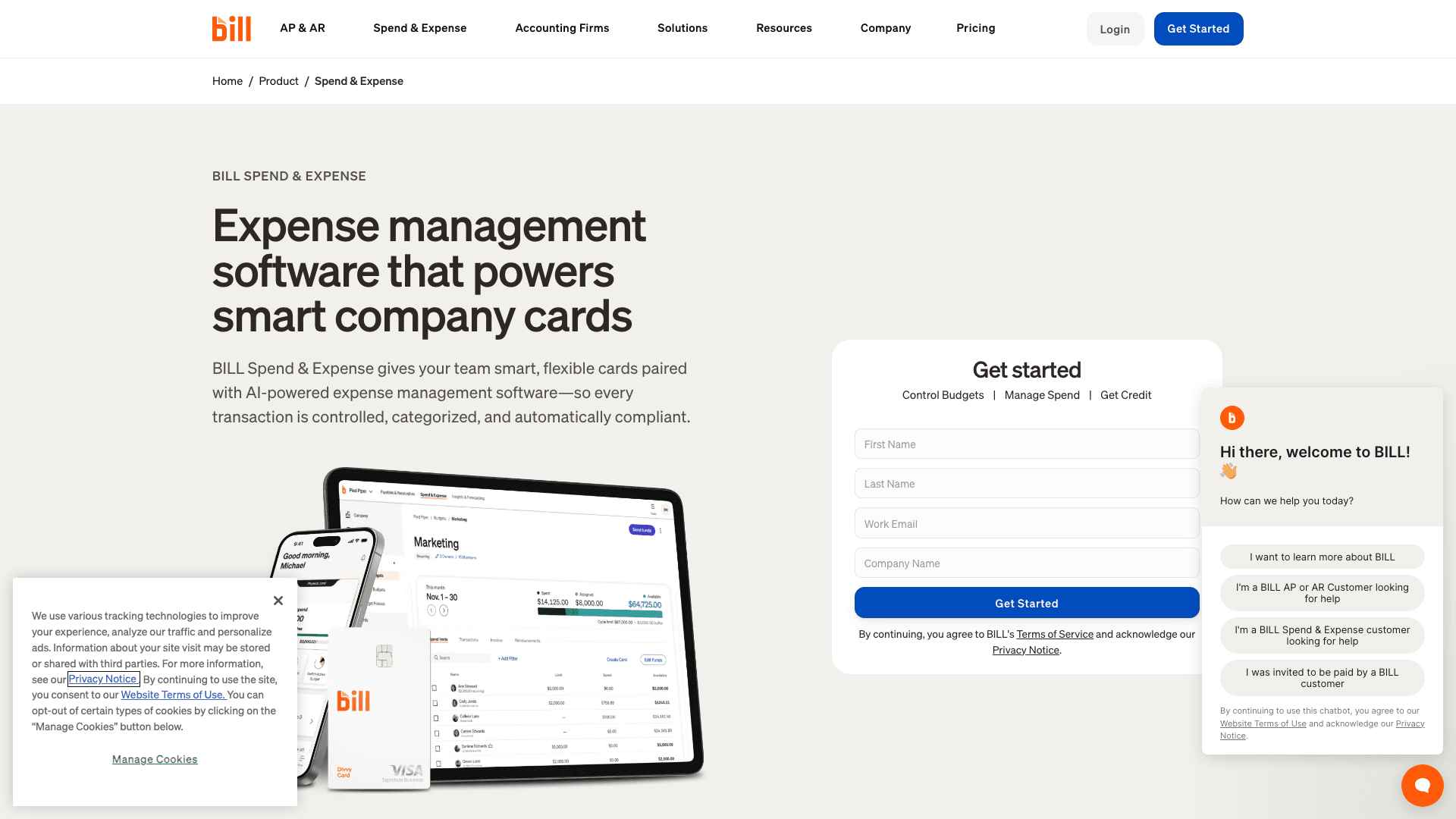
BILL Spend & Expense (the former Divvy) is the strongest 'why are we paying for this elsewhere?' product in the category. The software — budgets, virtual cards, receipt capture, approval flows, accounting sync — is entirely free, funded by interchange when your team spends on its cards. The budget-first model is the differentiator: money is allocated to budgets before anyone spends, cards draw from those budgets, and overspend is structurally impossible rather than policed after the fact. Real-time visibility replaces the month-end surprise. It plugs into the broader BILL platform (AP, AR) if you want to grow into payables automation. The trades: it's a charge card program with underwriting and credit lines (not every business qualifies or wants one), reimbursements are supported but clearly second-class next to card spend, and enterprise-grade controls, multi-entity handling, and international depth aren't the point.
Key Features
- Completely Free Software: Budgets, cards, receipt capture, approvals, and sync — funded by card interchange
- Budget-First Spend Control: Funds are allocated to budgets before spend; cards draw from budgets, making overspend structurally impossible
- Unlimited Virtual Cards: Per-vendor and per-subscription cards with individual limits
- Real-Time Dashboards: Live spend visibility by budget, team, and merchant — no waiting for statements
- BILL Platform Path: Grows into BILL's AP/AR automation when payables become the next problem
Pricing
| Plan | Monthly | Annual (per month) |
|---|---|---|
| Spend & Expense | $0 | $0 (interchange-funded) |
| BILL AP/AR (optional) | From ~$45/user | From ~$45/user/mo |
Pros
- Genuinely free — no software fees at any team size
- Budget-first model prevents overspend instead of reporting it
- Virtual cards for every vendor and subscription
- Clean upgrade path into BILL AP automation
Cons
- Requires adopting its charge card program (underwriting applies)
- Reimbursements are secondary to card workflows
- Multi-entity and international depth trail mid-market platforms
Verdict: BILL Spend & Expense is the free pick, and not a hollow one — for card-centric SMB spend it competes with paid suites. If you qualify for and want its card program, the price is unbeatable.
Visit BILL Spend & ExpenseAirbase
Best for: Mid-market companies (roughly 100-2,000 employees) that want expense, cards, AP, and procurement unified with deep ERP automation
Airbase, now a Paylocity company, is what expense management looks like when it's designed backward from the general ledger. The platform spans guided procurement intake, purchase orders, AP automation, corporate cards, and employee reimbursements — every dollar of non-payroll spend in one system with one approval engine and one audit trail. The accounting depth is the moat: multi-subsidiary NetSuite sync, amortization schedules, PO matching, and auto-categorization that controllers describe as close-changing. Expense submission is genuinely pleasant (mobile capture, Slack approvals), but the pitch is aimed at the finance team, not the employee. Since the Paylocity acquisition, the HR-data connection (headcount-driven policies, onboarding/offboarding spend access) has tightened. The trades: quote-based pricing with a real implementation project, and it's overkill for companies whose only pain is receipts and reimbursements.
Key Features
- All Non-Payroll Spend in One System: Procurement, AP, cards, and reimbursements share one approval engine and audit trail
- Deep ERP Automation: Multi-subsidiary NetSuite/Sage Intacct sync, amortization schedules, and PO matching
- Guided Procurement Intake: Employees request spend in plain language; routing, approvals, and POs generate automatically
- Corporate Cards with Pre-Approval: Physical and virtual cards tied to approved budgets and vendors
- Slack & Mobile Approvals: Approvals happen where managers already work, keeping cycle times short
Pricing
| Plan | Monthly | Annual (per month) |
|---|---|---|
| Standard | Quote-based | Quote-based |
| Premium | Quote-based | Quote-based |
| Enterprise | Custom | Custom |
Pros
- Closest thing to one system for all non-payroll spend
- Best-in-class NetSuite automation for the mid-market
- Approvals and audit trail built for controllers and auditors
- Paylocity ownership tightens the HR-data connection
Cons
- Quote-based pricing and a real implementation lift
- Overkill if your only pain is expense reports
- Employee-facing polish trails the card-first startups slightly
Related reading: Best Spend Management Software
Verdict: Airbase is the mid-market consolidation pick. When the goal shifts from 'fix expense reports' to 'control all company spend with a clean close,' it's the strongest single platform.
Visit AirbaseSAP Concur
Best for: Large and multinational enterprises that need audit-grade compliance, global tax handling, and integrated travel + expense at scale
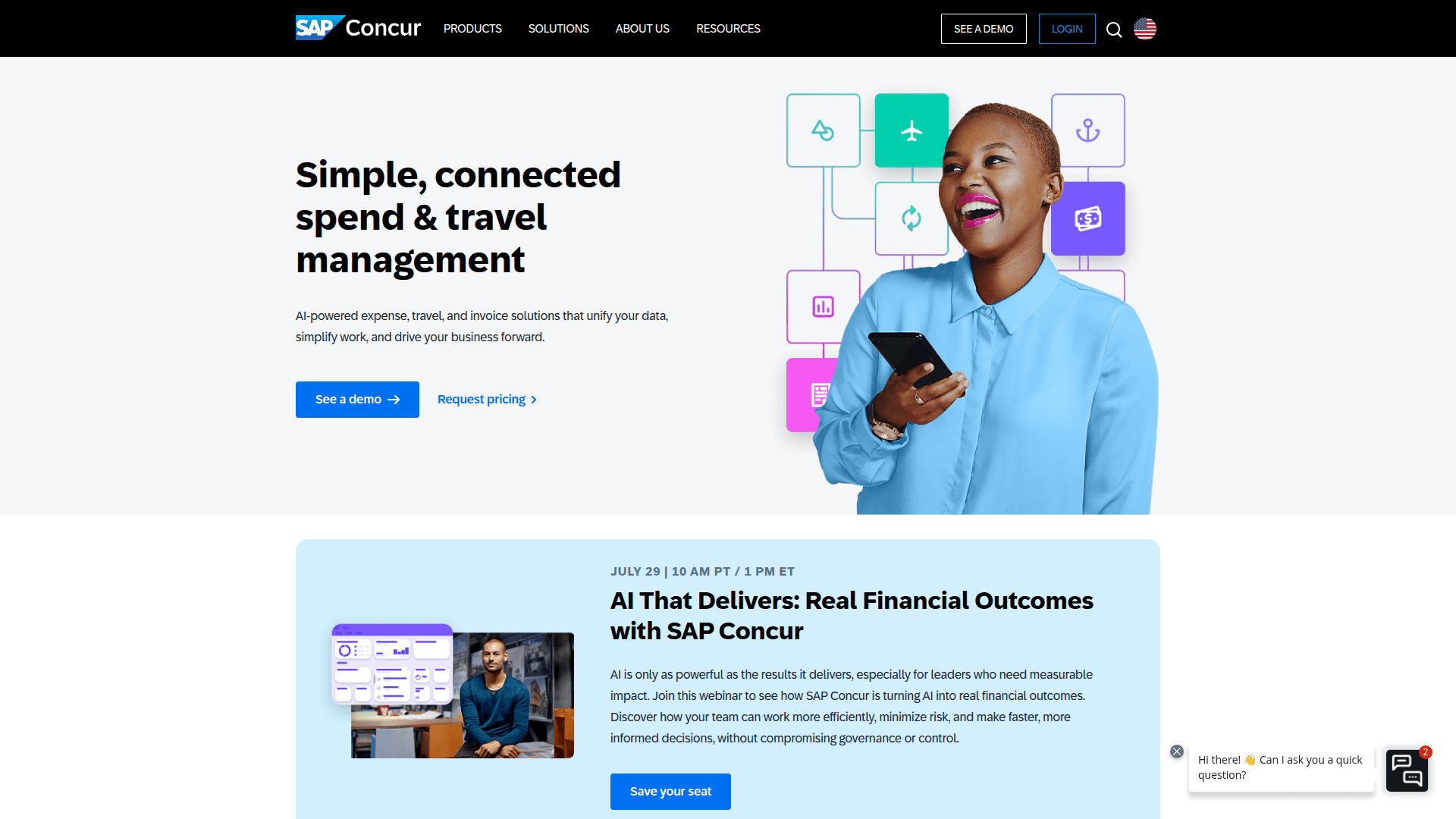
SAP Concur is the incumbent every challenger on this list measures itself against, and at true enterprise scale it's still the safest answer. Concur Expense, Travel, and Invoice form one system of record for T&E across 150+ countries: VAT reclaim, per-diem regimes, mileage rules, and audit services that satisfy the strictest compliance environments, plus an integration ecosystem — card programs, travel agencies, ERPs, HR systems — nothing else matches. E-receipts flow in from airlines, hotels, and rideshares automatically; ExpenseIt reads the rest. The verify-service layer (human plus AI receipt audit) is something mid-market tools simply don't offer. The trades are well known: the UX, though steadily modernized, still feels a generation older than the fintech challengers; implementations are measured in months; and pricing is quote-based with per-report economics that punish high-volume, low-control deployments.
Key Features
- Global Compliance Engine: VAT reclaim, statutory per diems, and country-specific rules across 150+ markets
- Integrated Travel + Expense: Concur Travel bookings flow straight into expense reports with no re-keying
- E-Receipt Network: Airlines, hotels, and rideshares push itemized receipts directly into reports
- Audit & Verify Services: AI-plus-human receipt auditing at a rigor level unique to the enterprise tier
- Unmatched Integration Ecosystem: Card feeds, TMCs, ERPs, and HR systems — decades of connectors
Pricing
| Plan | Monthly | Annual (per month) |
|---|---|---|
| Small business bundles | Quote-based | Quote-based (often per-report economics) |
| Standard / Professional | Quote-based | Quote-based |
| Enterprise | Custom | Custom |
Pros
- The global compliance and audit standard
- Travel and expense genuinely unified at scale
- Integration ecosystem nothing else matches
- Every controller and auditor already knows it
Cons
- UX still trails the fintech challengers
- Implementations take months, not weeks
- Quote pricing and per-report costs add up at volume
Verdict: SAP Concur is the enterprise pick. Below ~1,000 employees the modern platforms are faster and cheaper; above it — especially multinationally — Concur's compliance depth is still the benchmark.
Visit SAP ConcurZoho Expense
Best for: Price-sensitive SMBs and global teams that want full-featured expense management at a fraction of category pricing
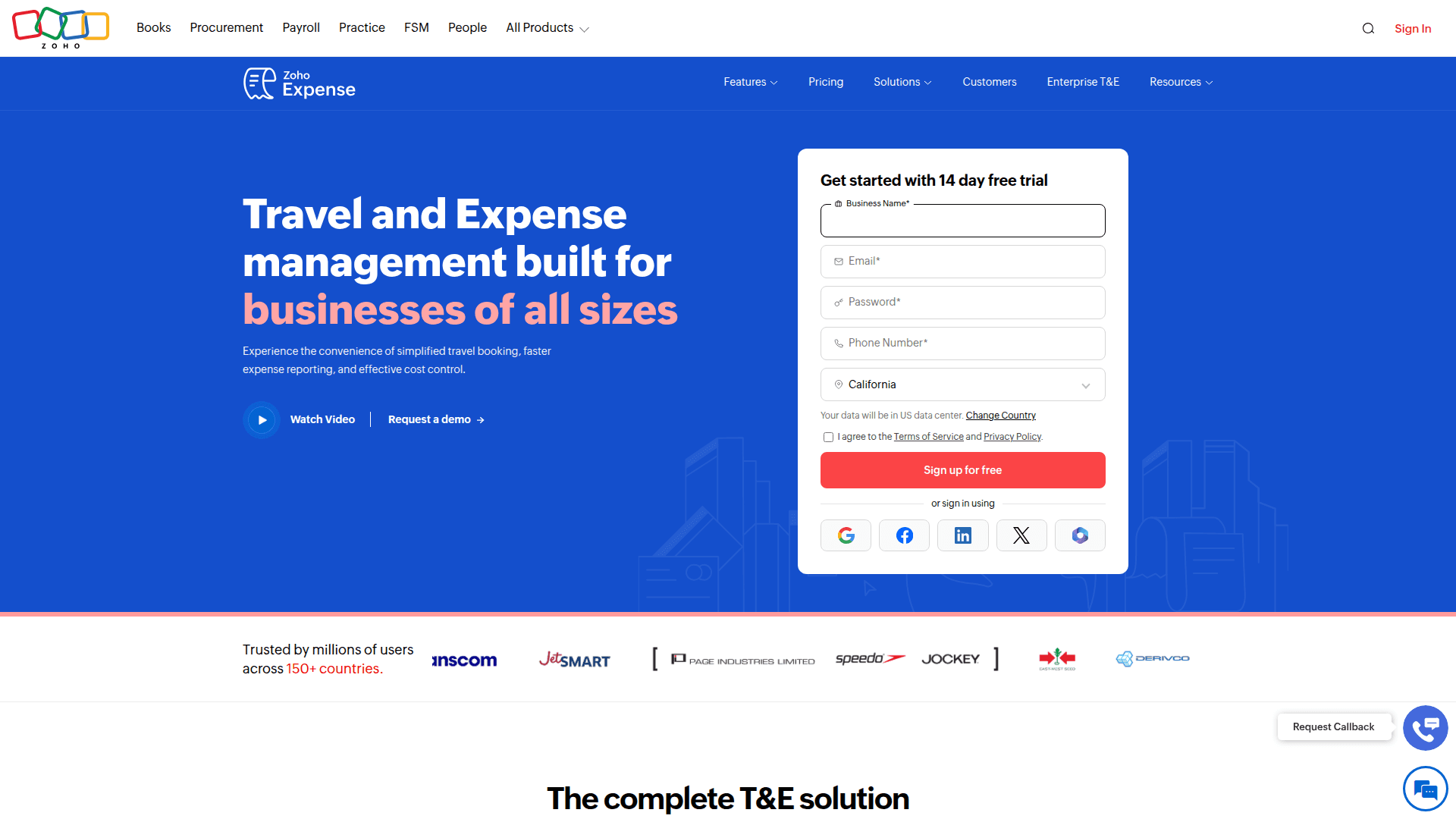
Zoho Expense is the category's persistent embarrassment to premium pricing: autoscan receipt capture in a dozen-plus languages, multi-currency expenses, statutory per-diem engines, GPS mileage, corporate card feeds, multi-level approval workflows, and audit-trail reporting — at roughly $3 per user per month on annual billing, with a free tier for three users. It punches far above its price internationally, handling per diems and mileage rules that US-centric SMB tools ignore. Inside the Zoho ecosystem (Books, Payroll, People, CRM) it's a near-automatic pick; standalone, it still wins on value with honest trade-offs: the interface is dense in the Zoho house style, deep customization takes configuration time, and premium support tiers cost extra. It lacks a native card program — it manages the cards you have rather than issuing its own — which makes it a value-priced peer of Expensify more than a Brex-style platform.
Key Features
- Autoscan Receipt OCR: Multi-language receipt extraction with automatic categorization
- Per-Diem & Mileage Engines: Statutory per-diem regimes and GPS mileage rules US-centric tools skip
- Multi-Currency & Multi-Entity: Global expense handling with per-country policies
- Custom Approval Workflows: Multi-level, condition-based approvals at a budget price point
- Zoho Ecosystem Sync: Native Books, People, and Payroll integration plus QBO/Xero support
Pricing
| Plan | Monthly | Annual (per month) |
|---|---|---|
| Free | $0 (up to 3 users) | $0 |
| Standard | ~$4/user | ~$3/user/mo |
| Premium | ~$7/user | ~$5/user/mo |
| Enterprise | ~$10/user | ~$8/user/mo |
Pros
- Category-leading price-to-depth ratio
- Genuinely global: per diems, mileage, multi-currency
- Free tier covers micro-teams
- Natural fit inside the Zoho suite
Cons
- Dense interface with a real configuration curve
- No native card program
- Priority support costs extra
Verdict: Zoho Expense is the budget pick without the usual budget compromises. For global SMBs and Zoho-suite companies, it delivers 80% of premium capability at 30% of the price.
Visit Zoho ExpenseRho
Best for: Companies that want business banking, corporate cards, AP, and expense management consolidated into one free platform
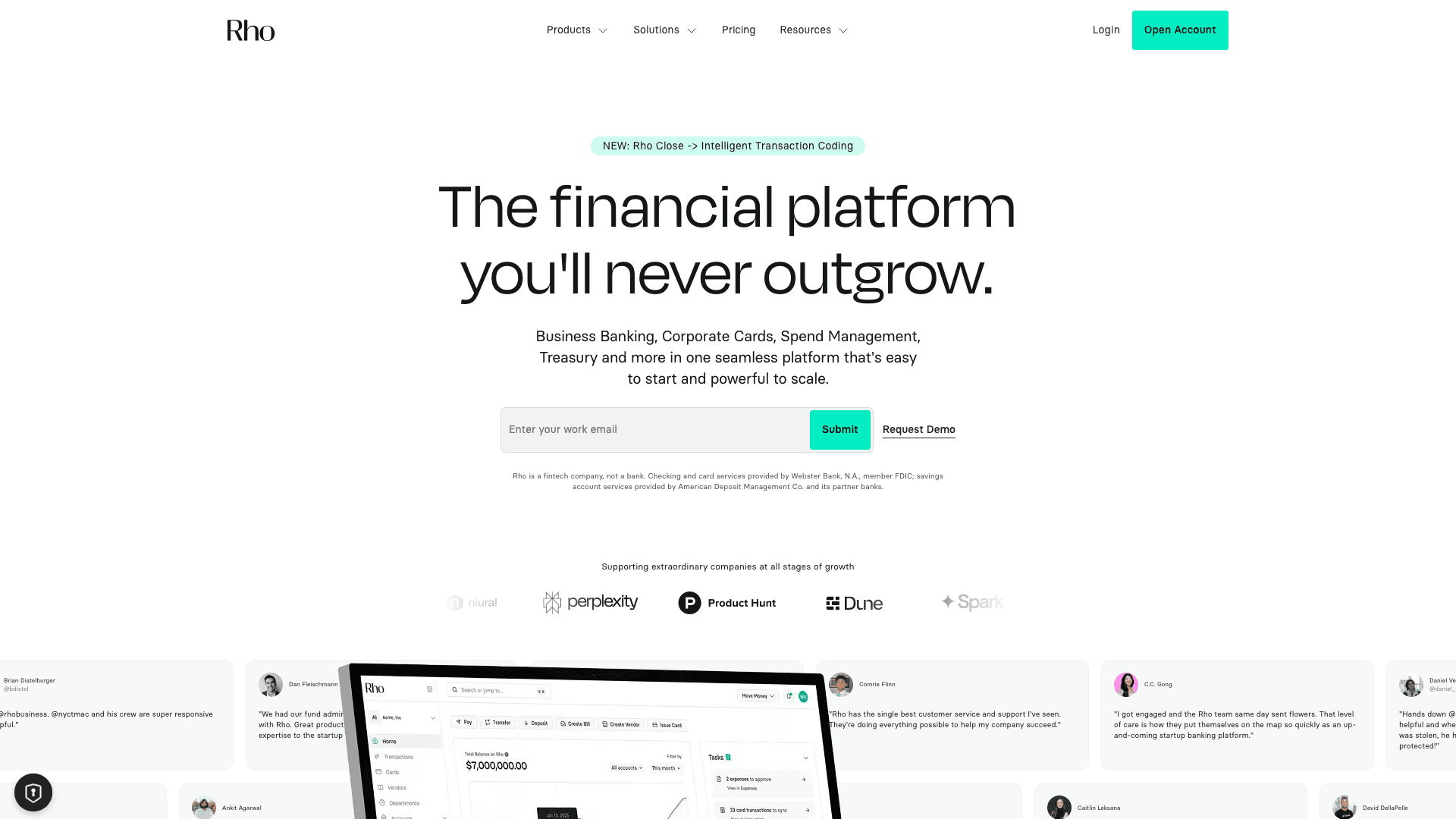
Rho's pitch is consolidation: business checking and treasury, corporate cards with ~1.25% cashback, accounts payable, and expense management in a single platform with no software fees — monetized through interchange and banking economics rather than subscriptions. For growth-stage companies tired of stitching a bank, a card program, an expense tool, and an AP tool together, Rho replaces the stack with one vendor and one support relationship (a notably white-glove one, with named account teams). Expense management rides the card rails: receipts by text, AI-suggested coding, policy limits per card, and direct ERP sync including solid NetSuite support. The banking layer — operating accounts, treasury with yield on idle cash, wires — is the anchor. The trades: it's US-centric (international teams will feel edges), full value requires moving banking and card spend over, and pure reimbursement workflows are serviceable rather than exceptional.
Key Features
- Banking + Cards + AP + Expense: One platform and support relationship replaces a four-vendor finance stack
- Zero Software Fees: Monetized via interchange and banking — the software itself is free
- Treasury with Yield: Idle cash earns via managed treasury while staying operationally accessible
- Card-Level Policy Controls: Limits, categories, and receipt rules enforced per card in real time
- ERP Sync Including NetSuite: Direct feeds keep the GL current without manual export cycles
Pricing
| Plan | Monthly | Annual (per month) |
|---|---|---|
| Platform (banking, cards, AP, expense) | $0 | $0 (interchange/banking-funded) |
| Treasury management | Included | Included |
Pros
- Whole finance stack in one free platform
- White-glove support unusual at the price (free)
- Cashback on card spend with real policy controls
- Strong NetSuite and QBO sync
Cons
- US-centric — limited international depth
- Requires migrating banking/cards for full value
- Reimbursement workflows trail card workflows
Related reading: Best Corporate Cards for Startups
Verdict: Rho is the consolidation pick. If you're willing to make it your bank and card program, you get an expense and AP platform of genuine quality for free on top.
Visit RhoPayhawk
Best for: International companies running multiple entities across Europe, the UK, and the US that need one spend system with local compliance
Payhawk, London-headquartered with deep European roots, solves the problem US-first platforms handle awkwardly: a company with entities in five countries, three currencies, and different VAT regimes that wants one expense and card system rather than five local ones. Corporate Visa cards (physical and virtual) issue across 30+ countries; expense capture, mileage, and per diems follow local rules; and multi-entity administration lets group finance see consolidated spend while each entity closes its own books to its own ERP. AP automation and procurement controls extend it beyond pure expense. It has pushed hard into the US market, but its center of gravity — and its compliance depth — remains EMEA, which is exactly why globally distributed mid-market companies pick it. The trades: quote-based pricing that starts around €299/month per entity scale, and SMBs with one entity in one country are paying for capability they don't need.
Key Features
- Multi-Entity Administration: Consolidated group visibility with per-entity books, currencies, and ERP sync
- Cards in 30+ Countries: Locally issued Visa corporate cards with central policy control
- Local Compliance Depth: VAT handling, statutory per diems, and mileage rules across European markets
- AP & Procurement Controls: Invoice processing and purchase workflows alongside expense
- ERP Integrations: NetSuite, Microsoft Dynamics, Xero, and DATEV among others
Pricing
| Plan | Monthly | Annual (per month) |
|---|---|---|
| Premium cards + expense | From ~€299 | Quote-based |
| All-in-one spend | Quote-based | Quote-based |
| Enterprise | Custom | Custom |
Pros
- Best multi-entity model in the category
- European compliance depth US-first tools lack
- Cards, expense, AP, and procurement in one system
- Scales across currencies and VAT regimes cleanly
Cons
- Quote-based pricing with meaningful entry point
- Single-entity SMBs are overbuying
- US footprint younger than its EMEA core
Verdict: Payhawk is the pick for multi-entity international companies. If your finance team consolidates across countries every month, its entity model pays for itself.
Visit PayhawkFyle
Best for: Companies that earn rewards or hold credit lines on existing business cards and want modern expense automation without switching
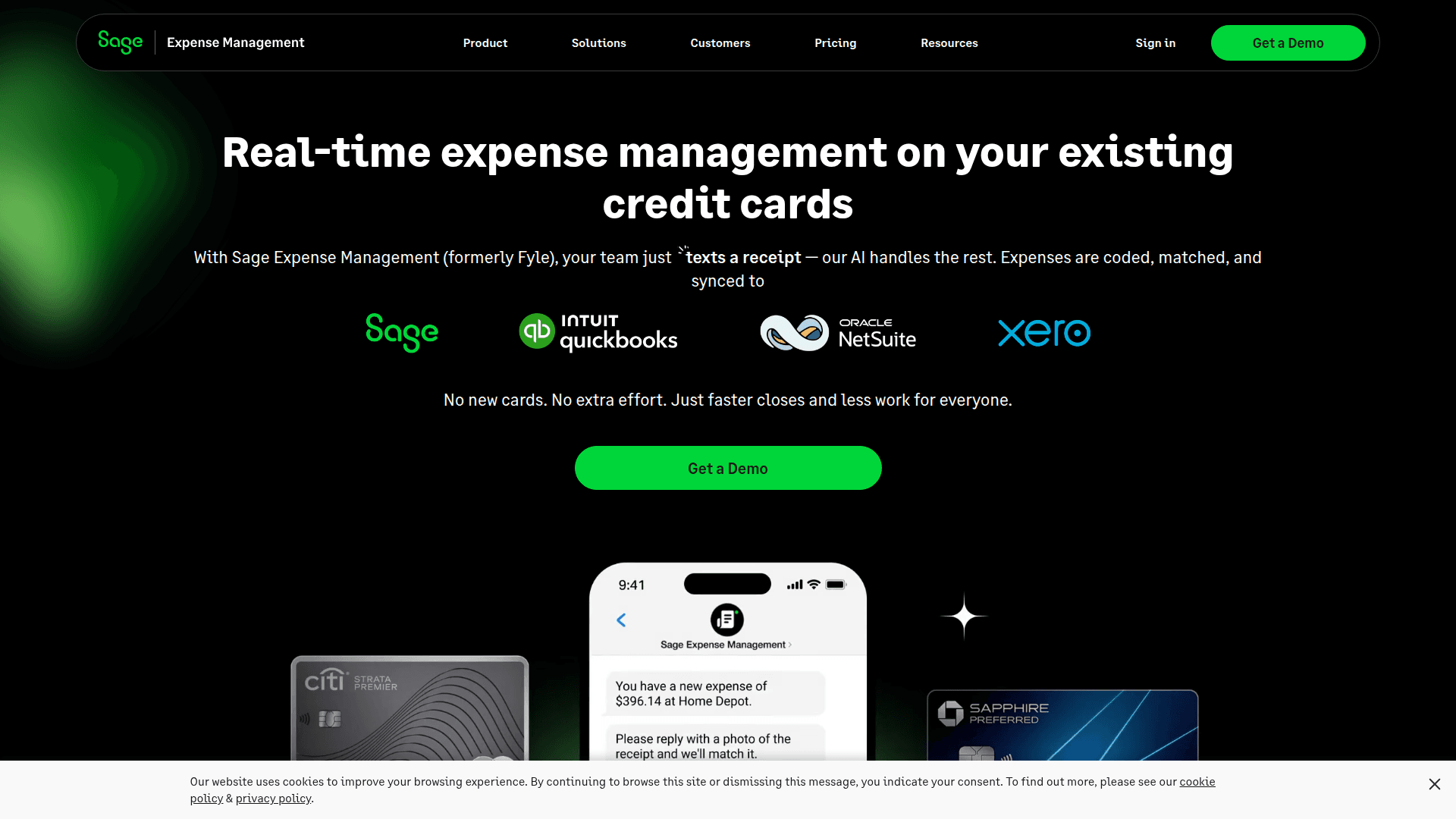
Fyle's insight is that the card-first platforms have a hidden tax: they only work if you abandon the cards you have. Fyle attacks the same real-time automation from the opposite direction — direct transaction feeds on your existing Visa, Mastercard, and American Express business cards, so a swipe triggers an instant text asking for the receipt, which the employee answers by replying with a photo. Reconciliation happens continuously instead of at statement time, on the card program you already earn rewards with. Receipt capture lives where employees already are: text message, Gmail, Outlook, Slack. Accounting sync covers QuickBooks, Xero, NetSuite, and Sage Intacct, and active-user billing means you pay only for people who actually submit expenses in a month. The trades: no native card program means no interchange-funded free tier, spend controls are observational rather than pre-emptive (you can't block a swipe on someone else's card network), and the vendor is smaller than the giants on this list.
Key Features
- Real-Time Feeds on Existing Cards: Direct Visa, Mastercard, and Amex transaction feeds — no card switch, no statement lag
- Text-Message Receipt Capture: A swipe triggers a text; employees reply with a photo and they're done
- Inbox & Slack Capture: Gmail, Outlook, and Slack plugins collect receipts where they arrive
- Active-User Billing: Pay only for users who submit expenses that month
- Four-Way Accounting Sync: QuickBooks, Xero, NetSuite, and Sage Intacct with category mapping
Pricing
| Plan | Monthly | Annual (per month) |
|---|---|---|
| Growth | ~$8.99/active user | ~$6.99/active user/mo |
| Business | ~$14.99/active user | ~$11.99/active user/mo |
| Enterprise | Custom | Custom |
Pros
- Real-time automation without giving up existing cards or rewards
- Text-message receipt flow employees genuinely use
- Active-user billing reflects real usage
- Strong mid-market accounting sync
Cons
- No native card program or interchange-funded free tier
- Controls observe spend rather than block it pre-swipe
- Smaller vendor than the category giants
Verdict: Fyle is the keep-your-cards pick. If your Amex points or bank credit line make card switching a non-starter, Fyle delivers card-first-style automation on the rails you already run.
Visit FyleRippling Spend
Best for: Companies on (or moving to) Rippling that want expense policies, cards, and reimbursements driven directly by HR system data
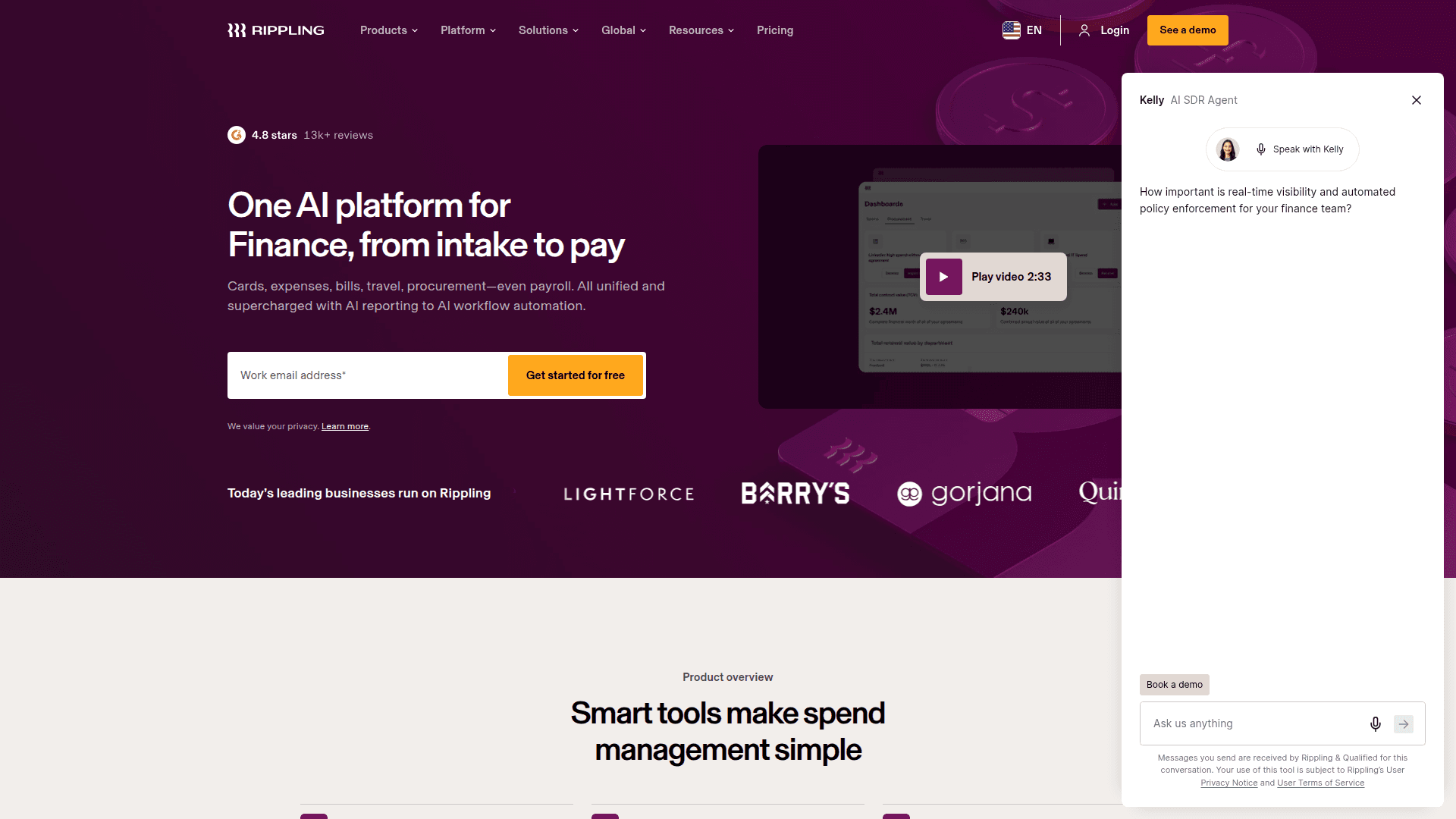
Rippling Spend's advantage is unfair rather than clever: because Rippling is the HR, payroll, and IT system of record, its expense product knows things standalone tools have to be told. Policies key off employee attributes natively — department, level, location, tenure — so 'engineers can spend $50/month on tools, directors $200, and the London office follows UK mileage rules' is configuration, not custom work. Onboarding issues cards automatically; offboarding kills them the same minute access is revoked; reimbursements ride payroll rails so they land in paychecks without a separate payment flow. Corporate cards, bill pay, and expense reporting round out a real spend suite. The trades follow from the premise: it makes sense in proportion to how much of Rippling you adopt — as a standalone expense tool it loses to specialists — and modular per-employee-per-month pricing across the Rippling platform adds up.
Key Features
- HR-Attribute Policy Engine: Rules keyed to department, level, location, and tenure straight from the HR record
- Lifecycle-Automated Cards: Cards issue on onboarding and cancel at offboarding automatically
- Payroll-Rail Reimbursements: Approved expenses land in paychecks — no separate payment flow
- Unified Spend Suite: Corporate cards, bill pay, and expense in the same platform as HR and IT
- Workflow Automations: Rippling's automation engine spans HR, IT, and finance events
Pricing
| Plan | Monthly | Annual (per month) |
|---|---|---|
| Rippling platform base | From ~$8/user | Quote-based |
| Spend module | Quote-based add-on | Quote-based |
| Enterprise | Custom | Custom |
Pros
- Policy automation from HR data no standalone tool can match
- Onboarding/offboarding card lifecycle handled automatically
- Reimbursements through payroll simplify payments
- One vendor for HR, IT, and finance operations
Cons
- Value scales with Rippling adoption — weak standalone
- Modular pricing accumulates across the platform
- Younger expense product than the category specialists
Verdict: Rippling Spend is the ecosystem pick. If Rippling runs your HR and payroll, adding Spend turns employee data into expense policy automatically — a leverage standalone tools can't replicate.
Visit Rippling SpendHow to Choose the Best Expense Management Tool for Your Business
The decision framework, by the question that actually decides it:
If you're starting fresh or willing to switch cards
Go card-first — the automation ceiling is higher and the software is free. Brex for startups and scaling companies that want banking, travel, and global cards in the same platform; BILL Spend & Expense for budget-first SMB control at zero cost; Rho if you want the bank account, cards, AP, and expense consolidated with white-glove support. For the card programs themselves, see our guide to the best corporate cards for startups.
If your existing cards are non-negotiable
Rewards balances, bank credit lines, and treasury relationships are legitimate reasons to stay put. Expensify is the polished default with the best receipt workflow and accountant ecosystem; Fyle gets you real-time feeds on existing Visa, Mastercard, and Amex cards — the closest thing to card-first automation without the switch; Zoho Expense wins when price is the constraint or the business is global.
If the real goal is controlling all company spend
When invoices, POs, and vendor payments hurt as much as expense reports, buy the consolidated platform instead of a point tool. Airbase is the mid-market pick — procurement, AP, cards, and expense with the deepest NetSuite automation; Payhawk extends the same idea across entities and countries. We cover that category in depth in our guide to the best spend management software.
If you're global, multi-entity, or heavily regulated
SAP Concur remains the compliance benchmark — VAT reclaim, statutory per diems, audit services, and integrated travel across 150+ countries. Payhawk is the modern alternative for European-centered multi-entity groups. If heavy business travel is part of the picture, pair this decision with our guide to the best corporate travel management software — travel and expense increasingly want to be one system.
If you already run Rippling or the Zoho suite
Suite leverage is real. Rippling Spend turns HR attributes into expense policy automatically and kills cards at offboarding the minute access is revoked — no standalone tool can replicate that. Zoho Expense inside the Zoho suite gets you Books, Payroll, and CRM sync at the category's lowest price. Outside their ecosystems, both lose to the specialists above.
Pro Tip
Pilot with the team that spends the most — usually sales or field ops — for one full month before rolling out company-wide. And when you do switch tools, keep read access to the old system through two closes: trailing receipts arrive for about 60 days, and finance will need the audit trail at year-end.
Frequently Asked Questions
Final Thoughts
The best expense management tool of 2026 depends on one fork and two facts: whether you'll run spend on the platform's cards, how complex your organization is, and how many people actually submit expenses. Brex is our best-overall pick because, for companies willing to adopt its cards, the expense report genuinely disappears — but Expensify is the right answer for card-locked small teams, BILL Spend & Expense for free budget-first control, Airbase for mid-market consolidation, and SAP Concur for global enterprise compliance — and each would be right.
Whatever you pick: model pricing at your real submitter count rather than your headcount, confirm the ERP connector is included rather than an add-on, and pilot with your heaviest-spending team before the company-wide rollout. Expense management is boring infrastructure when it works — pick the tool that makes it boring fastest.
Related Free SEO Tools
Content Brief Generator
Generate SERP-grounded briefs for your category content
SEO Content Grader
Score your comparison and alternative pages
Meta Tags Generator
Optimize SERP previews for landing pages
Long-Tail Keyword Generator
Find low-competition commercial queries
Keyword Search Volume
Size demand for your product category
SERP Checker
See who ranks for your target keywords today
Related Articles
Best Spend Management Software
AP, procurement, and company-wide spend control
Best Corporate Travel Management Software
The other half of T&E — booking, policy, and duty of care
Best Corporate Cards for Startups
The card programs behind card-first expense platforms
Browse All Articles
Explore our complete library of guides and tutorials
About the Author

Co-Founder & SEO Execution
Co-founder of PikaSEO. 11 years in corporate tech, then bootstrapped entrepreneur. Leads SEO execution and content-led growth for SaaS companies.