
Corporate travel software finally had its consumer moment — and then kept going. The modern platforms made booking a business trip feel like booking a vacation; the incumbents responded with deeper compliance and global service; the travel management companies rebuilt their software so agents and self-serve share one system; and underneath all of it, NDC direct-connect infrastructure started deciding who actually shows the best airfares. Meanwhile travel and expense — two categories that were always one workflow in disguise — are converging fast, with booking data flowing straight into expense reports.
The result is that “what's the best corporate travel management software?” depends on three questions. Who books — employees self-serve, or agents on their behalf? How complex are the trips — domestic point-to-point, or international multi-leg with VIPs? And what happens when travel breaks — is a chat queue enough, or do you need a human with waiver access at 2 a.m.? This guide ranks the 10 platforms we'd actually shortlist in 2026, organized by the job each wins — with honest pricing, because this category's five different pricing models rank the same vendors in opposite order at different trip volumes.
We evaluated each platform on four criteria: inventory and content depth (flights, hotels, rail, low-cost carriers, and NDC direct-connect fares legacy channels miss), true cost per trip (subscription, percent-of-booking, per-trip, and margin-funded models priced at realistic volumes), support when travel breaks (response speed, human rebooking capability, and after-hours reality), and policy and duty of care (in-line policy, approvals, traveler tracking, and risk response).
Quick Comparison: The Best Business Travel Platforms at a Glance
| Platform | Best For | Pricing Model | Support Model | Expense Built-In |
|---|---|---|---|---|
| TravelPerk | Best Overall | Free tier + %/booking; subs | 24/7 human, fast-response | Expanding (Yokoy) |
| SAP Concur | Enterprise T&E Standard | Enterprise quote | Enterprise + TMC partners | Yes (the standard) |
| Egencia (Amex GBT) | Global Enterprise TMC | Quote + transaction fees | Global agent network | Via integrations |
| Spotnana | Modern Infrastructure | Flat SaaS (quote) | 24/7 included | Via partners |
| TravelBank | Budget All-in-One T&E | ~$25/user bundles | 24/7 included | Yes |
| Engine | Hotel-Heavy Workforce | Free (margin-funded) | 24/7 member support | No (Direct Bill instead) |
| ITILITE | Value + Savings Incentives | Free options + per-trip | 24/7 with SLAs | Yes |
| Corporate Traveler | SMB Agency-Backed | Per-transaction fees | Dedicated consultant | Via integrations |
| AmTrav | US Mid-Market TMC | Per-trip or flat sub | US-based agents | Via integrations |
| Routespring | Startups / Fast Rollout | Free platform + per-trip | Responsive human support | Basic |
How We Evaluated the Best Corporate Travel Management Software
Booking demos all look great. We weighted the dimensions that separate platforms after six months of real trips:
Inventory & Content Depth
Not the property count — whether your actual routes and cities price well. We weighted low-cost carriers, rail, extended-stay properties, and NDC direct-connect fares that legacy channels increasingly miss.
True Cost Per Trip
Free-with-margins, percent-of-booking, per-trip fees, per-user subscriptions, and enterprise quotes rank the same vendors in opposite order at different volumes. We modeled 10, 50, and 200 trips per month.
Support When Travel Breaks
The category's real differentiator: response time, whether the person answering can actually rebook, waiver access, and after-hours reality. Chat-only support and agent-backed service are different products.
Policy & Duty of Care
In-line policy that guides rather than blocks, approval flows that don't stall bookings, traveler tracking, risk alerts, and emergency response paths — increasingly a compliance requirement, not a nice-to-have.
Pro Tip
Before any demo, pull three months of real trips from your card statements: routes, booking lead times, change rates, and hotel nights. Then price exactly that history on each vendor's model and re-book three representative trips in each trial. Change-heavy travel patterns quietly favor flexible-fare programs and TMC service; stable patterns favor the cheapest self-serve meter.
Pricing at a Glance
No category mixes pricing models this aggressively: Engine is free and earns on hotel margins; Routespring and ITILITE run free platforms with per-trip fees; TravelPerk starts free with a percentage per booking; the TMCs charge per transaction; TravelBank prices per user; and the enterprise platforms quote. The only honest comparison is your real trip volume priced on each meter:
The Best Corporate Travel Platforms, by Category
Before reading individual reviews, place your travel program on this map — who books, how complex the trips are, and what happens when they break narrows ten platforms to a shortlist of two or three:
Self-serve platforms (TravelPerk, TravelBank, ITILITE, Routespring) win when employees book their own straightforward trips and software support suffices. Enterprise T&E standards (SAP Concur, Egencia) win when travel and expense must be one governed system across countries. Agent-backed TMCs (Corporate Traveler, AmTrav) win when trips are complex or VIP-heavy enough that a named human beats any queue. Specialists and infrastructure (Engine for hotel-heavy workforce travel, Spotnana for NDC-native architecture) win their specific jobs outright. Many companies pair one platform from the first quadrant with Engine for field teams — the two rarely compete.
TravelPerk
Best for: SMBs through mid-market (and increasingly enterprise) teams that want the best self-serve booking experience with real human support behind it
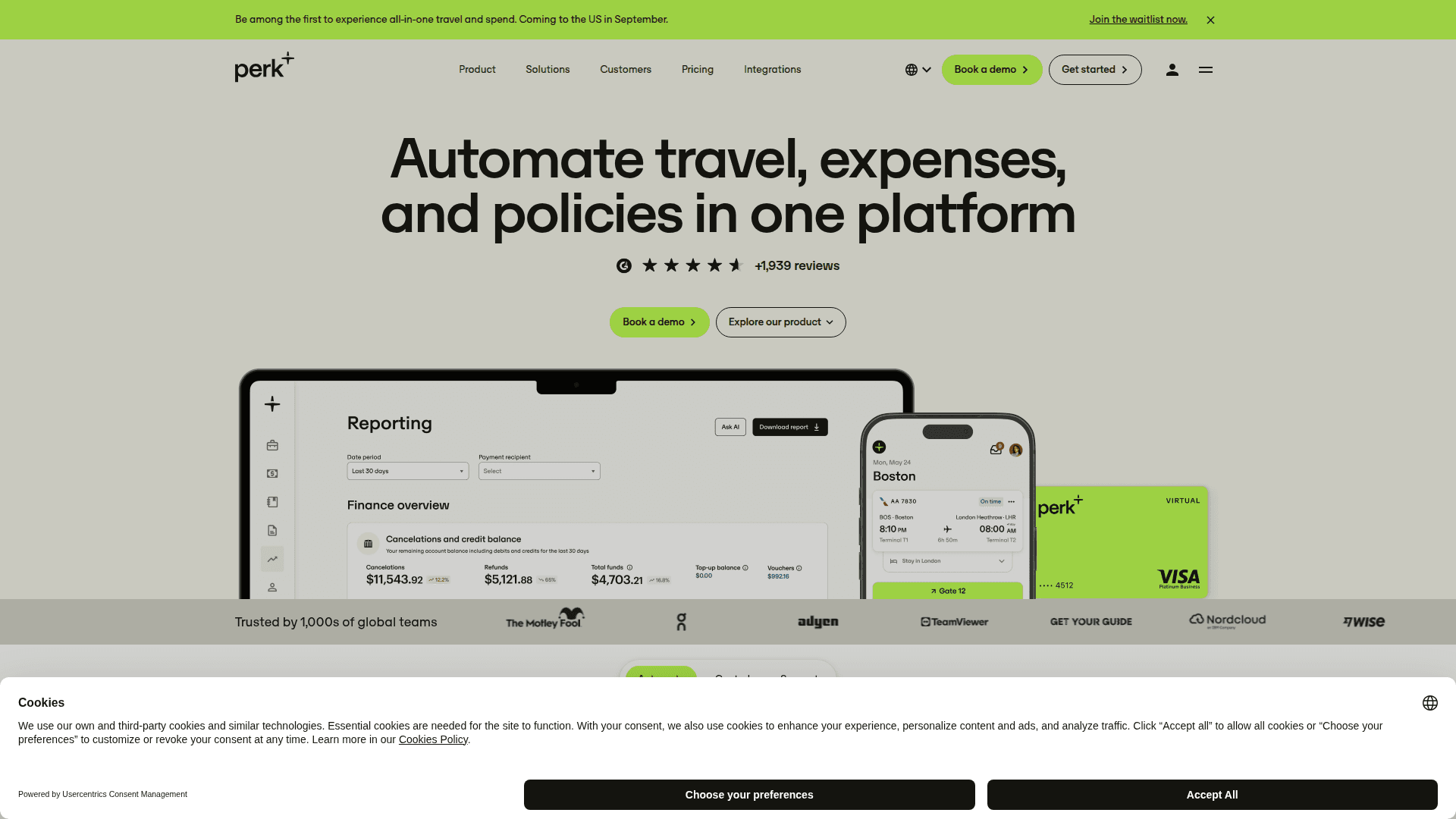
TravelPerk won the modern travel platform race by treating both sides of the transaction seriously: travelers get a consumer-grade booking experience over one of the largest bookable inventories in the industry (flights, hotels, trains, cars — including content many rivals lack), while finance gets policy controls, approvals, centralized invoicing, and clean data. FlexiPerk is the signature move — pay a premium for the ability to cancel any trip for any reason and recover most of the fare — and GreenPerk handles carbon reporting and offsetting for sustainability programs. Support is 24/7 with famously aggressive response targets, staffed by humans who can actually fix a broken itinerary. Its acquisition of AI expense platform Yokoy signals the endgame: travel and expense as one flow. Pricing scales gently — a free starter tier with per-booking fees, then subscriptions with lower fees as volume grows. The trades: per-booking percentages add up at high volume, and the deepest enterprise governance still belongs to the incumbents.
Key Features
- Industry-Leading Inventory: Flights, hotels, trains, and cars — including low-cost carriers and rail others miss
- FlexiPerk Flexible Cancellation: Cancel any trip for any reason and recover most of the fare, for a premium
- 24/7 Human Support: Fast-response human agents who rebook and fix disruptions, not just chatbots
- Policy & Approval Engine: In-line policy at booking time with approval flows that don't block travelers
- GreenPerk Sustainability: Carbon tracking, reporting, and offsetting built into the booking flow
Pricing
| Plan | Monthly | Annual (per month) |
|---|---|---|
| Starter | $0 + ~5%/booking | $0 + per-booking fee |
| Premium | ~$99 + ~3%/booking | Quote-based |
| Pro | ~$299 + lower fees | Quote-based |
| Enterprise | Custom | Custom |
Pros
- Best combination of inventory, UX, and human support
- FlexiPerk removes the unused-ticket problem for a known premium
- Free starter tier means no commitment until volume justifies it
- Travel-to-expense integration deepening after the Yokoy acquisition
Cons
- Percent-of-booking fees add up at high trip volume
- Deepest enterprise governance still trails the incumbents
- Premium support tiers and add-ons raise the real price
Verdict: TravelPerk is the best corporate travel platform for most companies in 2026. Start on the free tier, and let your trip volume decide when a subscription tier pays for itself.
Visit TravelPerkSAP Concur
Best for: Large and multinational enterprises that need travel and expense as one governed system of record with unmatched ecosystem depth
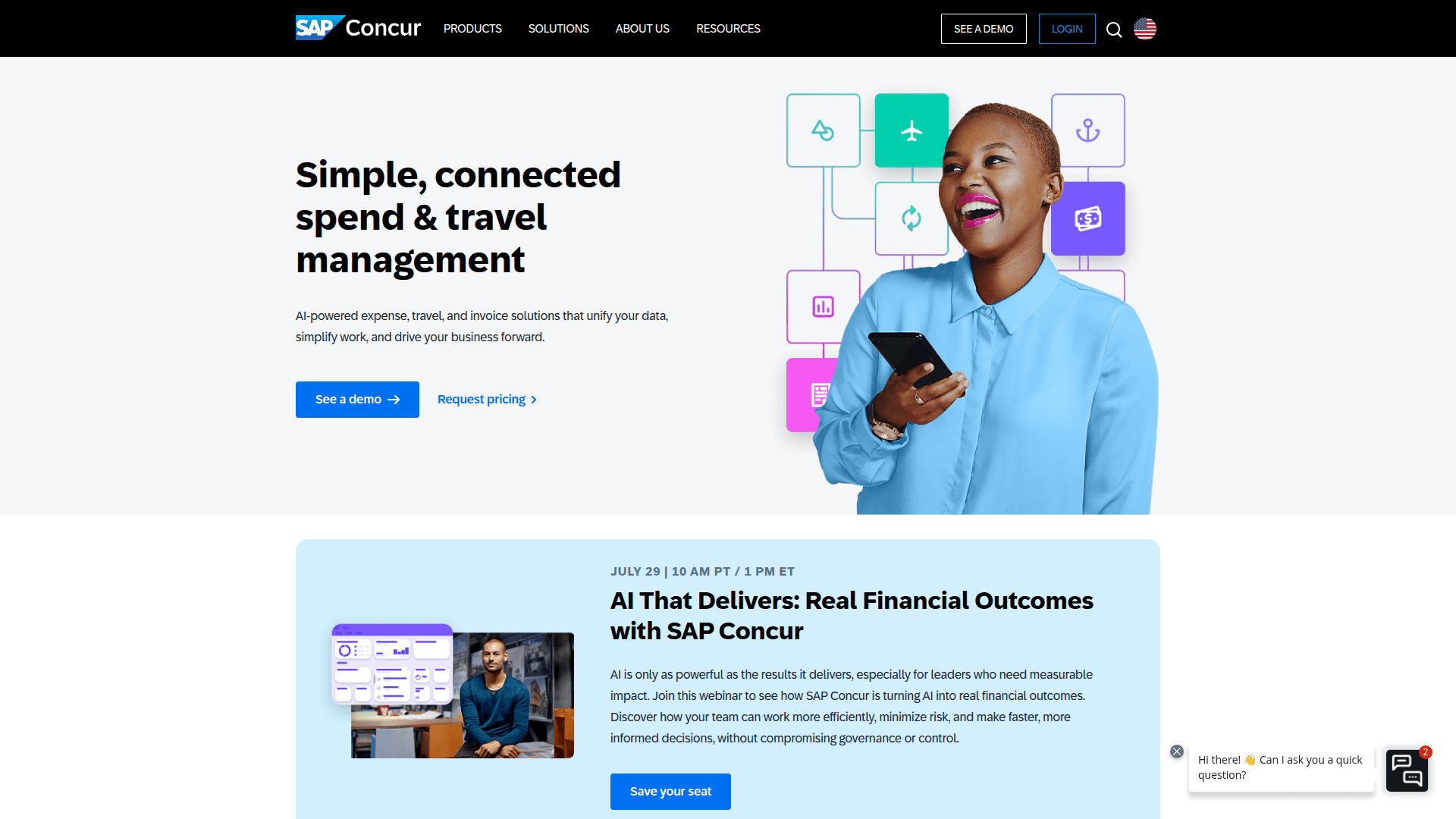
SAP Concur remains what enterprise T&E converges on when governance is the requirement. Concur Travel and Concur Expense form one system of record: bookings flow into expense reports automatically, TripLink captures direct and off-platform bookings so 'leakage' still lands in the system, and the integration ecosystem — TMCs, card programs, HR systems, ERPs, risk providers — has no real rival after two decades of accumulation. Global depth is the moat: policy regimes, VAT handling, per diems, and audit workflows across 150+ countries, which is why multinationals standardize on it even when travelers grumble about the interface. And that grumbling is the honest trade: despite steady modernization, the booking experience trails the consumer-grade platforms, implementations are measured in months, and quote-based pricing lands at enterprise levels. Below roughly a thousand employees, the modern platforms are faster and cheaper; above it, Concur's completeness is still the safe answer.
Key Features
- Travel + Expense One System: Bookings flow into expense reports automatically — the original T&E integration
- TripLink Leakage Capture: Direct airline/hotel bookings still land in the system of record
- Global Compliance Depth: Policy, VAT, per diems, and audit workflows across 150+ countries
- Unmatched Ecosystem: TMC, card, ERP, HRIS, and risk-management integrations accumulated over decades
- Enterprise Reporting: Program-level spend analytics finance and procurement teams build budgets on
Pricing
| Plan | Monthly | Annual (per month) |
|---|---|---|
| SMB bundles | Quote-based | Quote-based |
| Professional | Quote-based | Quote-based |
| Enterprise | Custom | Custom |
Pros
- The enterprise T&E standard auditors and CFOs already trust
- Best booking-to-expense data flow at global scale
- TripLink solves the off-platform booking problem
- Ecosystem depth no challenger matches
Cons
- Booking UX trails consumer-grade platforms
- Months-long implementations
- Enterprise pricing; overkill below ~1,000 employees
Related reading: Best Expense Management Tools
Verdict: SAP Concur is the enterprise pick. When travel, expense, and compliance must be one governed system across many countries, it remains the benchmark.
Visit SAP ConcurEgencia (Amex GBT)
Best for: Global enterprises that want modern self-serve software backed by American Express Global Business Travel's service network and negotiated rates
Egencia is the answer to a question large travel programs keep asking: can we have modern software and a global travel management company behind it? Now part of American Express Global Business Travel, Egencia pairs a genuinely self-serve booking platform — consistent across 60+ countries, which matters enormously for global rollouts — with GBT's agent network, negotiated rates, and duty-of-care infrastructure. Travelers book themselves in normal times; when a typhoon grounds a region or an executive needs rerouting at 2 a.m., the service layer takes over. Program management is the other differentiator: dedicated account teams mine your booking data for savings, negotiate supplier deals, and benchmark your program against GBT's client base. The trades: transaction-fee economics designed for enterprise volume, less nimbleness than the startup platforms on product velocity, and if you don't need the global service layer, you're paying for capability you won't use.
Key Features
- Consistent Global Platform: One booking experience across 60+ countries — critical for worldwide rollouts
- Amex GBT Service Network: Global agent coverage, waivers, and rebooking muscle when disruptions hit
- Negotiated Rates & Benchmarking: GBT-scale supplier deals and program benchmarks individual companies can't get
- Duty of Care: Traveler tracking, risk alerts, and emergency response backed by a real network
- Program Management: Dedicated account teams who actively optimize your travel program
Pricing
| Plan | Monthly | Annual (per month) |
|---|---|---|
| Platform + transaction fees | Quote-based | Quote-based |
| Enterprise program | Custom | Custom |
Pros
- Modern self-serve software with a global TMC behind it
- Negotiated rates and benchmarking at GBT scale
- Duty of care with genuine global response capability
- Consistency across countries global programs require
Cons
- Enterprise transaction-fee economics
- Product velocity trails the startup platforms
- Overbuilt for domestic SMB programs
Verdict: Egencia is the global enterprise TMC pick. When your program spans continents and disruptions need a network, not a chat widget, it's the strongest software-plus-service combination.
Visit Egencia (Amex GBT)Spotnana
Best for: Companies (and travel brands) that want NDC-native, fee-transparent travel infrastructure built on modern architecture rather than GDS-era plumbing
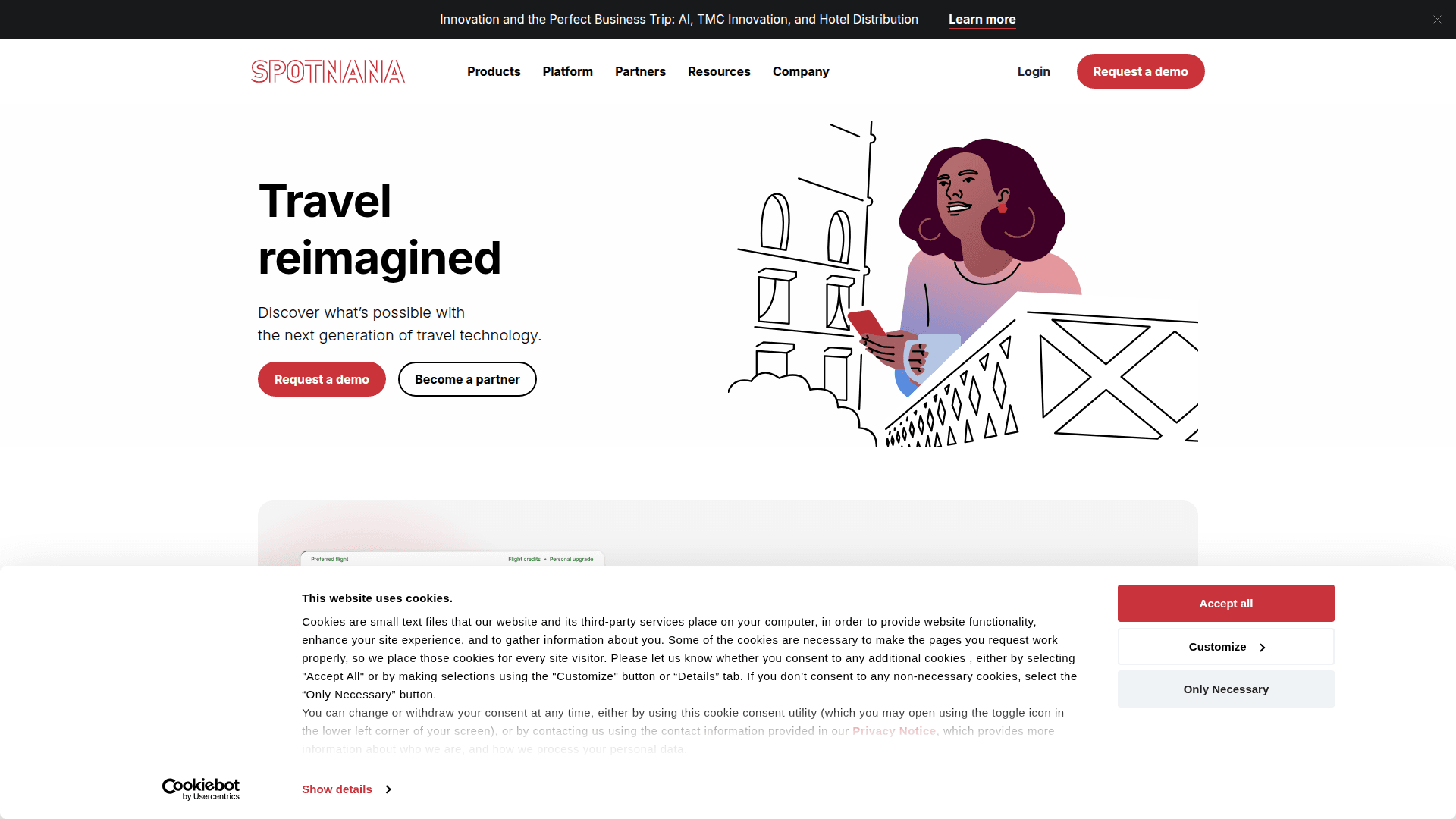
Spotnana rebuilt corporate travel's plumbing from scratch, and the industry noticed: its cloud-native 'Travel-as-a-Service' platform connects directly to airlines via NDC as a first-class design principle — not a retrofit — which means access to fares, seats, and ancillaries that legacy channels increasingly don't carry, with full servicing (changes, refunds, exchanges) on those direct connections. The same infrastructure powers Spotnana's own corporate travel product and white-labels underneath other travel brands, fintech platforms, and TMCs, which tells you how the industry rates the architecture. Pricing philosophy is the other break with tradition: flat SaaS subscriptions instead of per-transaction fees, so the vendor doesn't profit from your booking volume. The trades: it's younger than the incumbents with a program-services layer still maturing, and companies wanting a decades-deep TMC relationship are buying something different here — this is the infrastructure-forward choice.
Key Features
- NDC-Native Architecture: Direct airline connections with full servicing — changes and refunds, not just booking
- Travel-as-a-Service: The same infrastructure powers its product and white-labels under other travel brands
- Flat SaaS Pricing: Subscription economics instead of per-transaction fees that scale with your volume
- Modern Cloud Platform: Single global codebase — no regional forks or GDS-era constraints
- Full Content Spectrum: NDC, GDS, and direct hotel content unified in one search
Pricing
| Plan | Monthly | Annual (per month) |
|---|---|---|
| SaaS subscription | Quote-based | Quote-based (flat, not per-trip) |
| Enterprise / partner | Custom | Custom |
Pros
- Best NDC and direct-connect capability in the category
- Fee transparency — flat subscription, no per-booking cut
- Architecture strong enough that other travel brands build on it
- Global consistency without legacy regional forks
Cons
- Younger program-services layer than the incumbent TMCs
- Quote-based pricing requires a sales conversation
- Infrastructure-forward positioning suits some buyers more than others
Verdict: Spotnana is the modern-infrastructure pick. If NDC content, fee transparency, and clean architecture top your list — or you're a brand embedding travel — it's the forward bet.
Visit SpotnanaTravelBank
Best for: SMBs and mid-market teams that want travel booking, expense management, and savings incentives in one affordable subscription
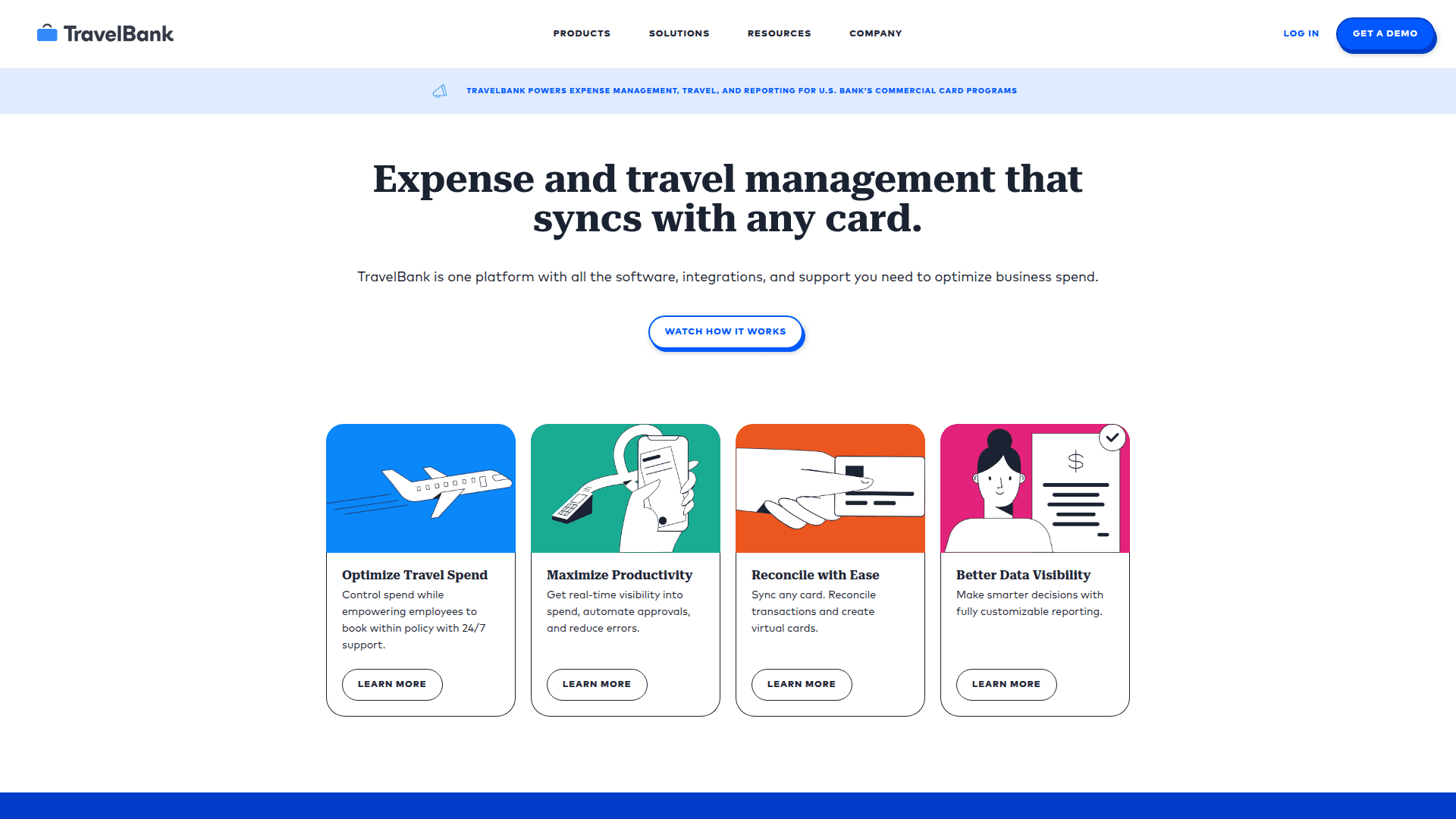
TravelBank, owned by U.S. Bank, answers the question most growing companies actually have: can we get travel and expense handled together without enterprise pricing? The platform bundles flight/hotel/car booking with expense capture and reporting in one app, priced in reach of companies that would never sit through a Concur implementation. The signature feature is behavioral: set a trip budget, and employees who book under it keep a share of the savings as rewards (gift cards and similar) — a rare policy mechanism employees actively like, which converts policy compliance from enforcement into upside. U.S. Bank ownership adds card-program integration and staying power. Support runs 24/7, and the expense side syncs to the usual accounting suspects. The trades: inventory depth and international content trail TravelPerk and the TMC-backed platforms, the rewards model matters less for teams whose travel is rigidly specified, and very complex global programs will outgrow it.
Key Features
- Travel + Expense One App: Booking and expense reports in a single subscription and mobile experience
- Under-Budget Rewards: Employees keep a share of savings when they book below trip budget
- U.S. Bank Integration: Card-program depth and the stability of a major bank owner
- 24/7 Support: Human help for disruptions included at SMB pricing
- Accounting Sync: QuickBooks, NetSuite, and the standard GL export paths
Pricing
| Plan | Monthly | Annual (per month) |
|---|---|---|
| Travel or Expense | ~$25/user (bundles vary) | Quote-based |
| Travel + Expense bundle | Quote-based | Quote-based |
| Enterprise | Custom | Custom |
Pros
- Genuine T&E consolidation at SMB-reachable pricing
- Savings-sharing rewards make policy compliance popular
- U.S. Bank backing and card integration
- Fast rollout compared to enterprise suites
Cons
- Inventory and international depth trail category leaders
- Rewards mechanism matters less for rigid travel patterns
- Complex global programs will outgrow it
Verdict: TravelBank is the budget all-in-one pick. For SMBs that want travel and expense solved together — with a rewards twist employees actually like — it's the value play.
Visit TravelBankEngine
Best for: Companies whose travel is mostly hotel nights for field teams, crews, and projects — construction, logistics, healthcare, energy — booked without contracts or fees
Engine (formerly Hotel Engine) dominates a segment the glossy platforms overlook: workforce travel, where the job is putting crews near job sites night after night, not flying executives to conferences. The platform is free — no contracts, no subscriptions, no booking fees — funded by negotiated hotel margins across a network of hundreds of thousands of properties, with rates that routinely beat public channels for exactly the extended-stay and workforce-friendly properties field teams need. Direct Bill is the operational killer feature: one consolidated invoice instead of a wallet of employee cards and folio-chasing, with project-level coding for job costing. Group bookings handle crew moves; trends and flexible cancellation options fit shifting project schedules; and flights have been added for teams that need them. The trades: it's hotel-first by design — a full T&E program with heavy air travel needs more platform — and policy/approval sophistication targets operational simplicity rather than enterprise governance.

Key Features
- Free Platform: No contracts, subscriptions, or booking fees — funded by hotel-rate margins
- Workforce-Focused Inventory: Hundreds of thousands of properties with extended-stay and job-site coverage
- Direct Bill: One consolidated invoice with project-level coding instead of folio-chasing
- Group & Crew Bookings: Multi-room, multi-week bookings for crews with schedule changes handled
- Flights Added: Air booking now included for field teams that fly
Pricing
| Plan | Monthly | Annual (per month) |
|---|---|---|
| Platform | $0 | $0 (margin-funded rates) |
| Direct Bill / premium features | Included / quote | Included / quote |
Pros
- Completely free with rates that beat public channels for its niche
- Direct Bill removes the worst part of crew travel accounting
- Built for the schedule chaos of project-based travel
- No procurement process needed to start
Cons
- Hotel-first — heavy air programs need more platform
- Policy depth targets simplicity, not enterprise governance
- Less fit for executive/international travel patterns
Verdict: Engine is the workforce-travel pick. If your travel is crews near job sites, it's free, faster than a TMC, and built for exactly that job.
Visit EngineITILITE
Best for: Cost-conscious companies that want travel and expense together with an incentive engine that pays employees to book cheaper
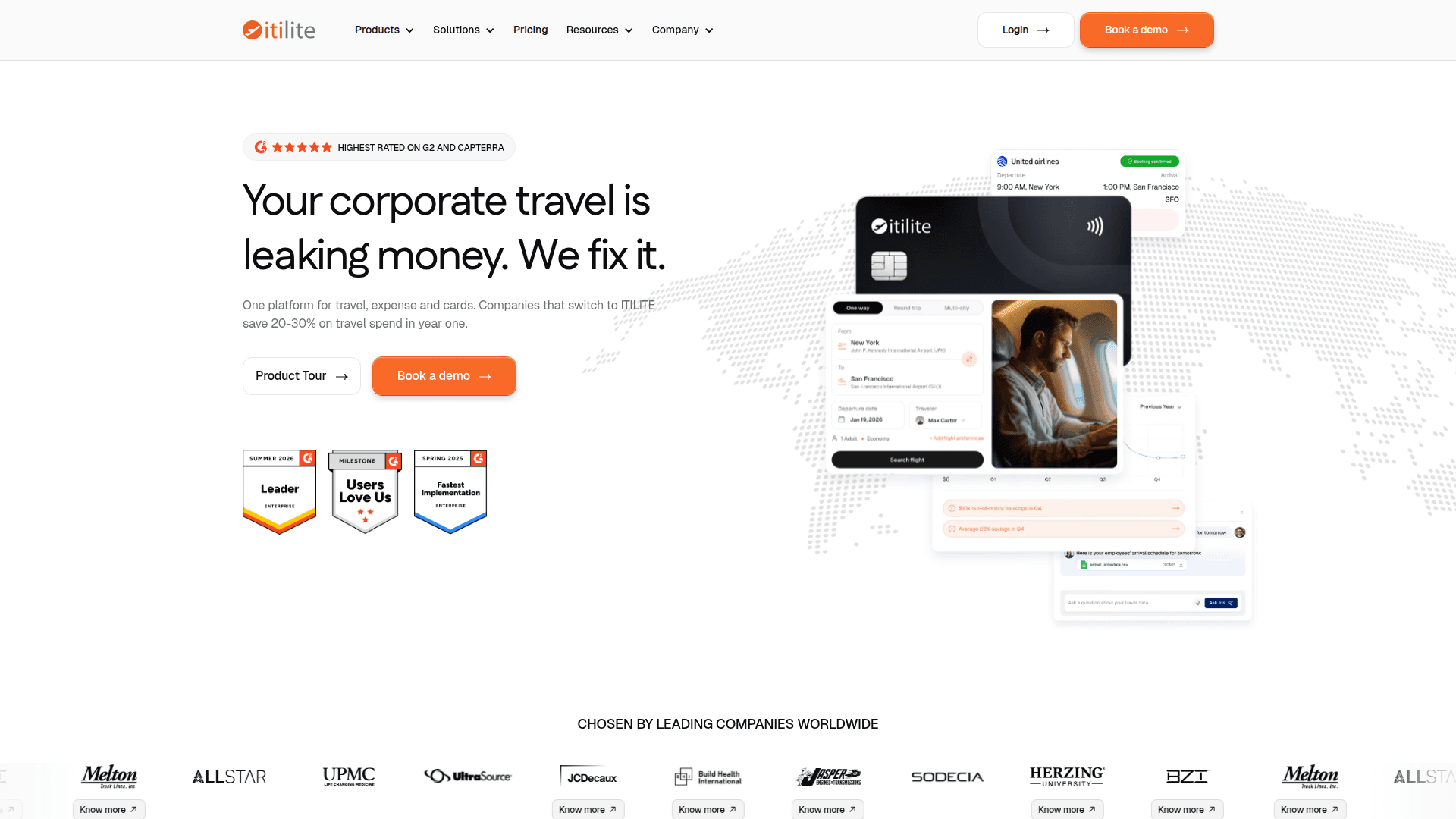
ITILITE attacks travel costs from the behavioral side: its incentive engine shares savings with employees who choose cheaper flights and hotels than their policy allows, converting every traveler into a cost optimizer — companies using it report meaningful program savings because the mechanism works with human nature instead of against it. Around that core sits a legitimate all-in-one T&E platform: booking with in-line policy, approvals, expense capture and reimbursement, GST/VAT-aware reporting (its India roots show in unusually strong tax handling), and analytics that show where the program leaks. Support runs 24/7 with aggressive SLA commitments, and pricing is famously aggressive — free-platform models with pay-per-use trip fees have been part of its go-to-market, undercutting per-user subscriptions at moderate travel volume. The trades: inventory depth in some Western markets trails the category leaders, brand recognition is still building outside its India-US strongholds, and very large enterprise governance needs point elsewhere.
Key Features
- Savings Incentive Engine: Employees keep a share of savings when booking below policy ceilings
- Travel + Expense Combined: Booking, approvals, expense capture, and reimbursement in one platform
- Aggressive Pricing Models: Free-platform, pay-per-trip options that undercut per-user subscriptions
- 24/7 SLA-Backed Support: Human support with published response commitments
- Tax-Aware Reporting: Unusually strong GST/VAT handling from its India heritage
Pricing
| Plan | Monthly | Annual (per month) |
|---|---|---|
| Platform | Free-platform options + per-trip fees | Quote-based |
| T&E bundle | Quote-based | Quote-based |
| Enterprise | Custom | Custom |
Pros
- Incentive model produces real, measurable savings
- T&E consolidation at aggressive prices
- Strong support SLAs unusual at the price point
- Excellent India and cross-border tax handling
Cons
- Western-market inventory depth trails leaders
- Brand and ecosystem still building outside core markets
- Not aimed at heavy enterprise governance
Verdict: ITILITE is the value-with-a-mechanism pick. If travel spend needs to come down and you'd rather incentivize than police, its savings-sharing engine is the standout feature.
Visit ITILITECorporate Traveler
Best for: SMBs with complex, international, or VIP-heavy travel that want a dedicated human travel consultant plus modern booking software
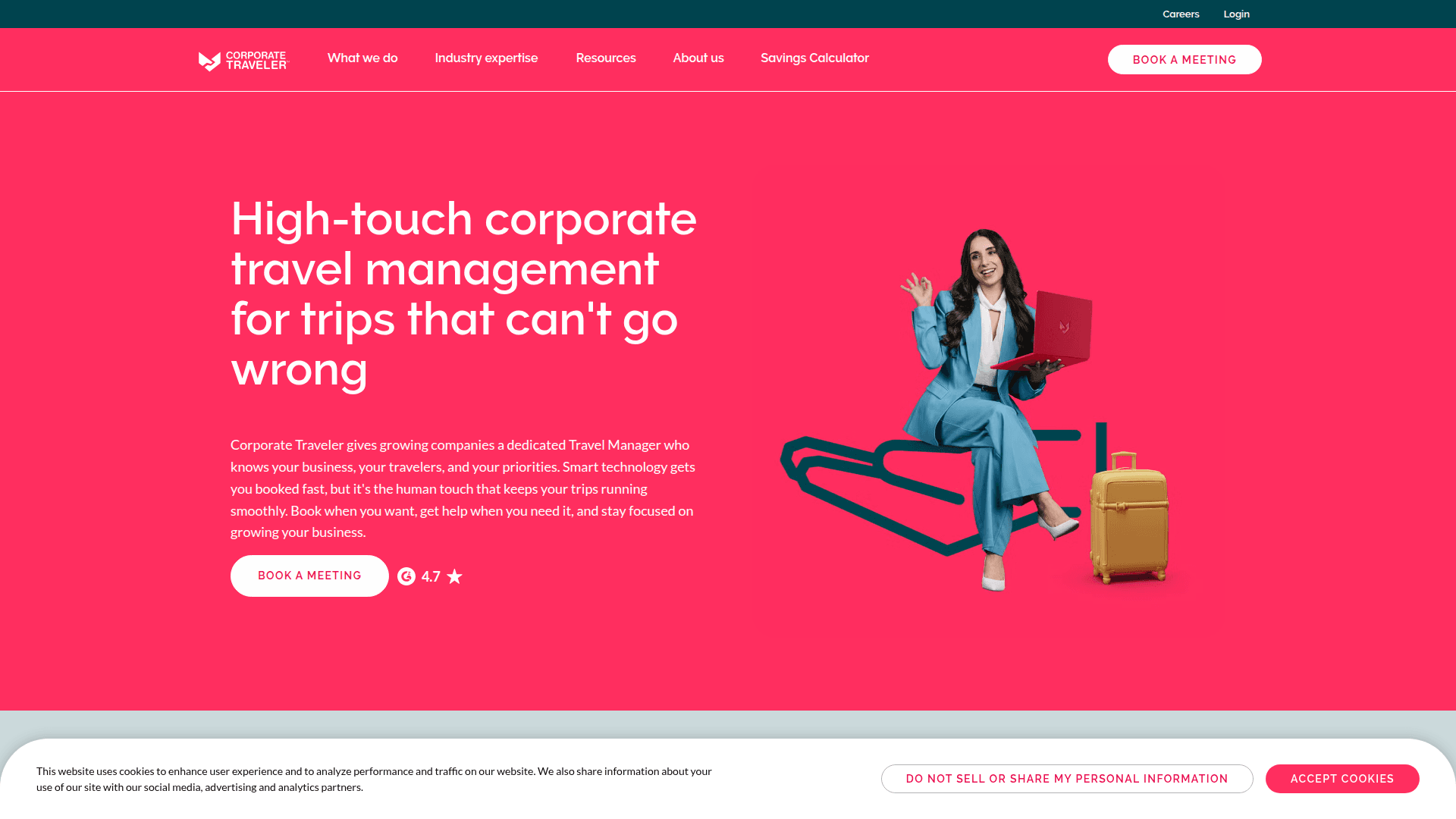
Corporate Traveler — Flight Centre Travel Group's SMB-dedicated brand — sells the thing self-serve platforms can't: a named human who knows your company, your travelers, and your preferences, backed by one of the world's largest travel groups. The Melon platform (its booking and program software) covers self-serve for simple trips with policy, approvals, and reporting; the dedicated consultant takes over for the complex ones — multi-leg international itineraries, group moves, VIP handling, and the disruptions where an agent with airline relationships and waiver access beats any chat queue. Flight Centre's buying power shows up in negotiated fares and hotel rates SMBs can't get alone, and unused-ticket tracking is handled as part of the service. Economics are TMC-style: per-transaction fees rather than subscriptions, which reads expensive next to free platforms until the first genuinely broken trip. The trades: transaction fees at volume, software that's good-but-not-the-product, and self-serve-only teams won't use what they're paying for.
Key Features
- Dedicated Travel Consultant: A named human who knows your program — not a rotating queue
- Melon Booking Platform: Self-serve booking, policy, and reporting for the simple trips
- Flight Centre Buying Power: Negotiated fares and rates from one of the world's largest travel groups
- Unused Ticket Management: Credits tracked and applied as part of the service
- 24/7 Emergency Support: After-hours agents with airline relationships and waiver access
Pricing
| Plan | Monthly | Annual (per month) |
|---|---|---|
| Per-transaction fees | Pay per booking/trip | Quote-based |
| Program services | Quote-based | Quote-based |
Pros
- Human expertise for complex and international trips
- Group-scale negotiated rates for SMB clients
- Software plus service in one relationship
- Disruption handling self-serve platforms can't match
Cons
- Per-transaction fees add up at volume
- Software is capable but not the differentiator
- Overkill for simple domestic self-serve travel
Verdict: Corporate Traveler is the agency-backed SMB pick. When trips are complex enough that a human beats a queue, its consultant-plus-platform model earns its fees.
Visit Corporate TravelerAmTrav
Best for: US mid-market companies that want TMC service and modern software as one product — with the category's best unused-ticket recapture
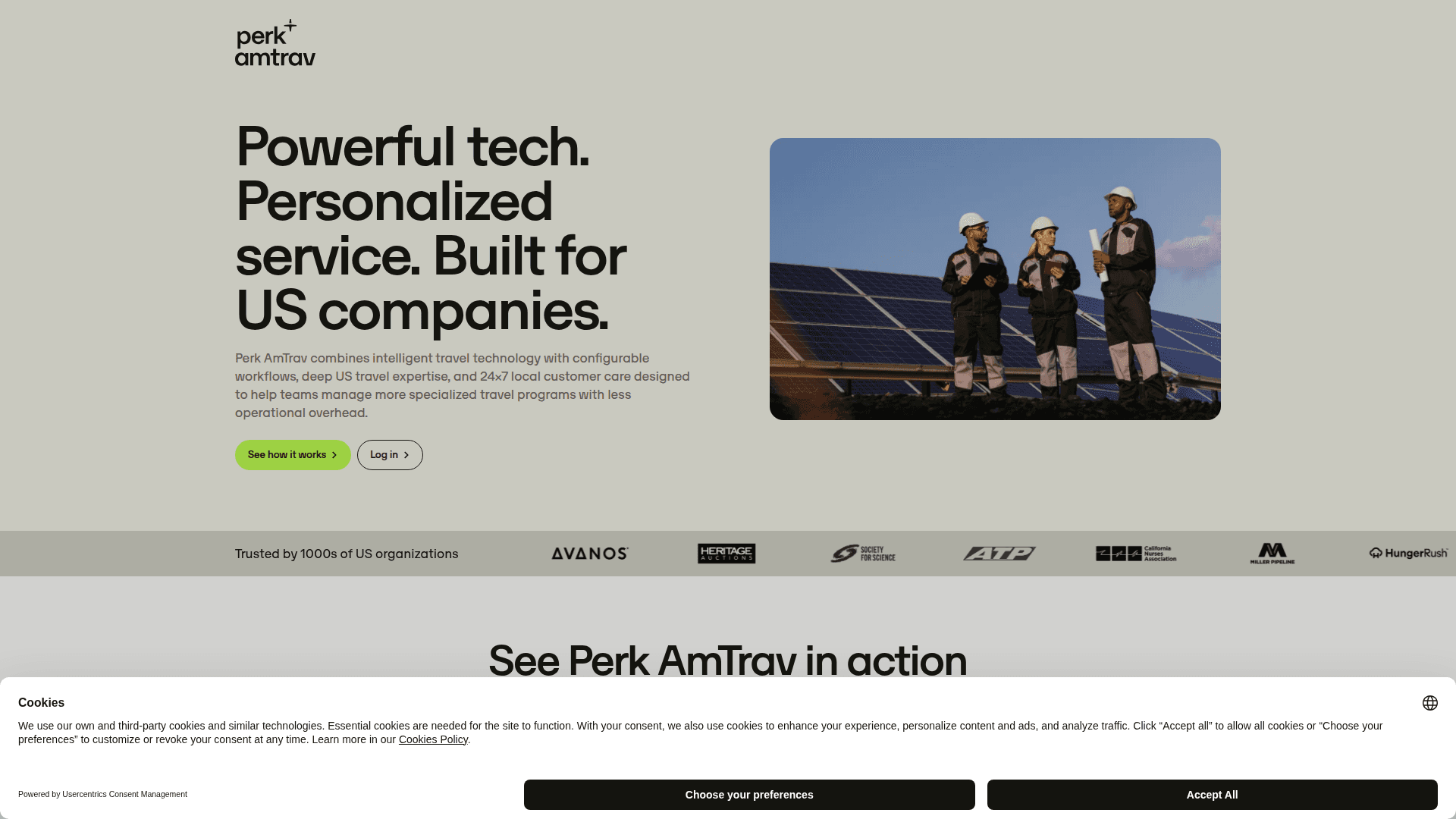
AmTrav built its reputation on a simple, verifiable claim: one connected platform where booking, servicing, reporting, and agent support genuinely share the same system — no handoffs between a booking tool and a separate agency back office, which is the seam where most TMC frustrations live. Its a2b platform covers self-serve booking with policy and approvals; its US-based agents (consistently well-reviewed for answering fast and fixing things) pick up where self-serve ends; and its unused-ticket handling is the category benchmark — credits surface automatically at booking time and get applied instead of expiring, a feature that alone can pay the fees for companies with volatile schedules. Pricing is refreshingly explicit for the TMC world: per-trip fees or flat subscription options published rather than hidden behind sales calls. The trades: US-centered strength (global programs need bigger networks), and the platform's polish is pragmatic rather than flashy next to the venture-funded design shops.
Key Features
- One Connected Platform: Booking, servicing, reporting, and agents on the same system — no handoffs
- Unused-Ticket Recapture: Credits surface at booking time and get applied — the category benchmark
- US-Based Agent Support: Fast-answering humans consistently praised in customer reviews
- Transparent Pricing: Published per-trip fees or flat subscription options — rare in the TMC world
- Policy & Reporting: In-line policy, approvals, and program reporting for mid-market needs
Pricing
| Plan | Monthly | Annual (per month) |
|---|---|---|
| Pay-per-trip | Per-trip fees | Published pricing |
| Subscription | Flat monthly options | Quote-based |
Pros
- No booking-tool/agency seam — one system throughout
- Best unused-ticket recovery in the category
- Support quality punches above its size
- Pricing transparency rare among TMCs
Cons
- US-centered — global programs need bigger networks
- Pragmatic rather than flashy product polish
- Less brand recognition than the giants
Verdict: AmTrav is the US mid-market TMC pick. If unused tickets and support seams are your pain, its one-platform model fixes exactly that.
Visit AmTravRoutespring
Best for: Startups and small teams without a travel manager that want centralized payments and a working travel program by this afternoon
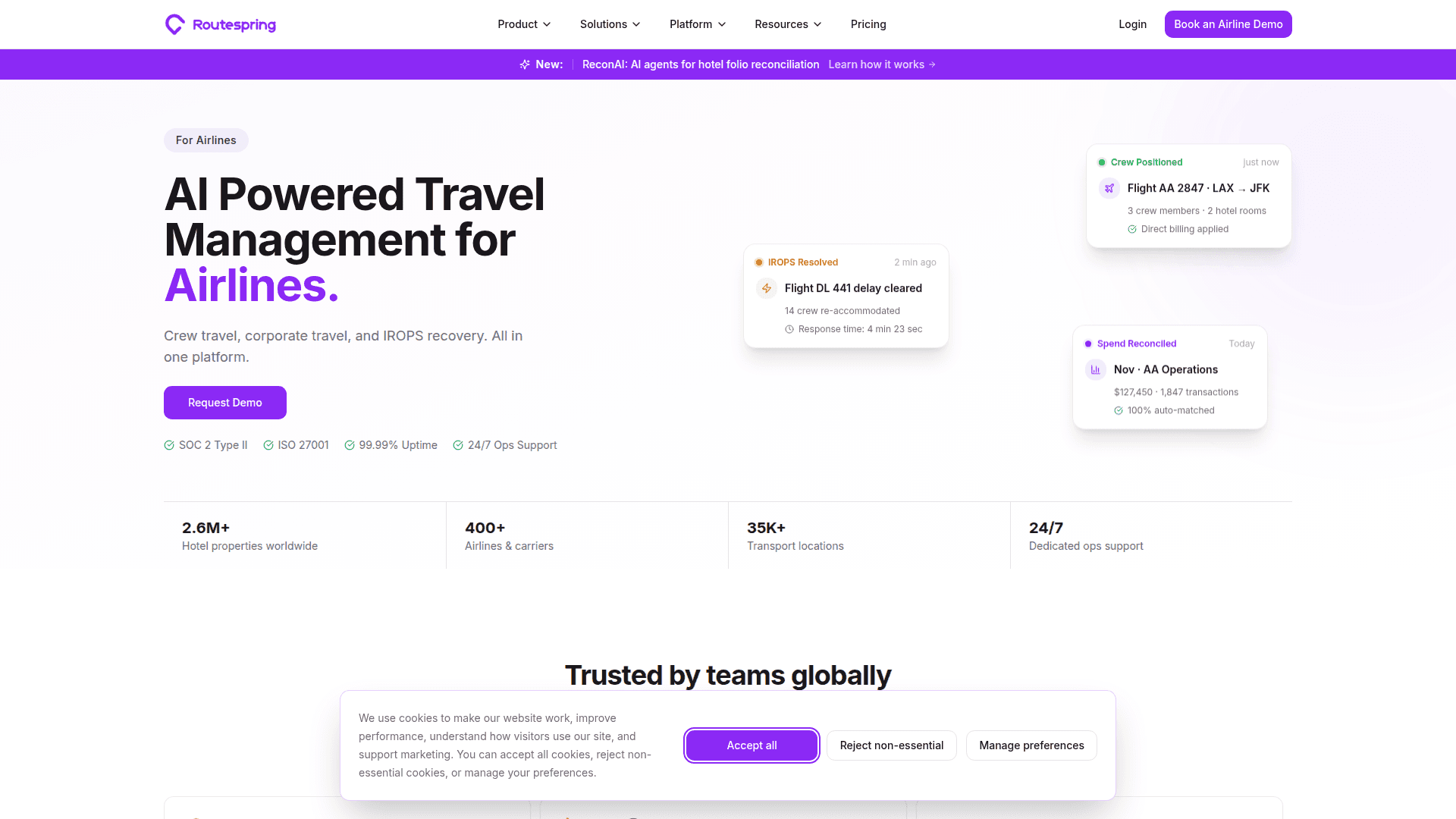
Routespring optimizes for the company that has never had a travel program and needs one working today. Setup is measured in hours: connect a payment method, invite the team, set simple policies, and employees book from decent inventory without ever fronting personal money — centralized payment is the heart of the product, killing the book-on-personal-card-and-expense-it cycle that burns startup employees. Pricing keeps the entry frictionless with free-platform options and pay-per-trip economics rather than subscriptions, so a five-person team pays nearly nothing in slow months. Policy, approvals, and reporting cover startup-grade needs without configuration ceremony, and support is responsive at a scale where the founders still notice individual complaints. The trades are the honest flip side of simplicity: inventory and international depth trail the leaders, the feature set targets straightforward domestic-plus-occasional-international patterns, and growing programs will eventually graduate to a bigger platform — by design.
Key Features
- Centralized Payments: Employees never front personal money — the company pays at booking
- Hours-Not-Weeks Setup: A working travel program the same day you sign up
- Pay-Per-Trip Economics: Free-platform options with per-trip fees — near-zero cost in slow months
- Startup-Grade Policy: Simple budgets, approvals, and reporting without configuration ceremony
- Responsive Support: Human help at a scale where every complaint gets noticed
Pricing
| Plan | Monthly | Annual (per month) |
|---|---|---|
| Platform | Free options + per-trip fees | Pay-per-use |
| Growth plans | Quote-based | Quote-based |
Pros
- Fastest zero-to-working-program in the category
- Centralized payment ends the personal-card cycle
- Costs scale to zero in low-travel months
- Right-sized simplicity for teams without a travel manager
Cons
- Inventory and international depth trail leaders
- Feature set targets simple travel patterns
- Growing programs will eventually graduate
Verdict: Routespring is the startup pick. If the goal is a working travel program by this afternoon with no one fronting money, it's the fastest path.
Visit RoutespringHow to Choose the Best Corporate Travel Management Software
The decision framework, by the question that actually decides it:
If you're an SMB or startup booking self-serve
TravelPerk is the default — best inventory and UX, free until volume justifies a subscription, and FlexiPerk covers schedule chaos. Routespring wins on speed: centralized payment and a working program the same afternoon. TravelBank wins when you want expense bundled from day one. All three roll out in days, not quarters.
If you're enterprise or globally distributed
SAP Concur when travel and expense must be one governed system of record with global compliance. Egencia when you want that scale with a global TMC's service network and negotiated rates behind it. Spotnana when NDC content, flat SaaS pricing, and modern architecture matter more than incumbent ecosystems — it's the forward bet.
If complex trips need a human agent
International multi-leg itineraries, executive travel, and group moves are where self-serve platforms strain. Corporate Traveler gives SMBs a dedicated consultant with Flight Centre's buying power; AmTrav gives US mid-market companies one connected platform with the category's best unused-ticket recapture. Per-trip fees read expensive until the first genuinely broken trip.
If your travel is crews, projects, and hotel nights
Construction, logistics, healthcare, and energy teams don't need a conference-travel platform — they need beds near job sites with clean invoicing. Engine is free, hotel-first, and its Direct Bill consolidated invoicing removes the folio-chasing that makes crew travel accounting miserable. Many companies run Engine for field teams alongside a general platform for office travel.
If travel and expense should be one system
The convergence is real: SAP Concur built its moat on it, TravelBank and ITILITE bundle both affordably, and TravelPerk is integrating its Yokoy acquisition. If you'd rather keep best-of-breed expense tooling, make sure it integrates natively with your travel pick — we ranked that side of the stack in our guide to the best expense management tools, and the broader finance platforms in our best spend management software guide.
Pro Tip
Whatever platform you choose, decide the payment architecture first: central card, virtual cards per trip, or employee cards with reimbursement. It determines how clean your reconciliation is forever — and it's much harder to change after rollout than the booking tool itself. If you're picking new cards anyway, choose ones whose transaction feeds integrate natively with both your travel and expense platforms.
Frequently Asked Questions
Final Thoughts
The best corporate travel management software of 2026 depends on who books, how complex the trips are, and what happens when they break. TravelPerk is our best-overall pick because most companies' answer is self-serve booking with real support behind it — but SAP Concur is right for governed global enterprises, Corporate Traveler and AmTrav are right when a human agent earns the fees, Engine is right for hotel-heavy field teams, and Spotnana is right for the infrastructure-minded — and each would be correct.
Whatever you pick: price your real trip history on each vendor's actual meter, test support with a genuinely broken itinerary during the trial (not a softball question), and settle the payment architecture before rollout. Travel programs succeed on adoption — the platform employees actually book through is the one whose policy and data you control.
Related Free SEO Tools
Content Brief Generator
Generate SERP-grounded briefs for your category content
SEO Content Grader
Score your comparison and alternative pages
Meta Tags Generator
Optimize SERP previews for landing pages
Long-Tail Keyword Generator
Find low-competition commercial queries
Keyword Search Volume
Size demand for your product category
SERP Checker
See who ranks for your target keywords today
Related Articles
Best Expense Management Tools
The other half of T&E — receipts, reports, and reimbursements
Best Spend Management Software
AP, procurement, and company-wide spend control
Best Corporate Cards for Startups
The payment layer under your travel program
Browse All Articles
Explore our complete library of guides and tutorials
About the Author

Co-Founder & SEO Execution
Co-founder of PikaSEO. 11 years in corporate tech, then bootstrapped entrepreneur. Leads SEO execution and content-led growth for SaaS companies.