
Treasury and cash management stopped being an enterprise-only discipline. When interest rates rose, idle corporate cash became a real asset again — and a wave of fintechs made it trivial for even a seed-stage startup to sweep operating balances into government money-market funds and Treasury bills, earn a competitive yield, and expand FDIC coverage well beyond $250,000. At the same time, machine learning turned cash forecasting from a brittle spreadsheet exercise into software that predicts your position across every bank account automatically. The result is a category that now stretches from free startup treasury accounts all the way up to six-figure enterprise treasury management systems.
That range makes “what's the best treasury software?” three different questions. Are you trying to earn safe yield on idle cash, or to see and forecast cash across many banks, or to run a full treasury function with payments, risk, and connectivity? Is your complexity in one account with a lot of runway, or in dozens of accounts across banks, entities, and currencies? And do you want a bundled banking-plus-treasury product, a dedicated layer over the banks you already use, or an enterprise system of record? This guide ranks the 10 treasury and cash management tools we'd actually shortlist in 2026, organized by the job each does best.
We evaluated each tool on four criteria: yield & safety (how much idle cash earns, and whether balances sit in insured deposits, money-market funds, or Treasuries), cash visibility & forecasting (multi-bank aggregation and how accurately the platform predicts your position), controls & workflow (approvals, policy enforcement, and audit trail), and integrations & scale (bank connectivity, ERP sync, and how far the tool grows with you).
Quick Comparison: The Best Treasury & Cash Management Software at a Glance
| Tool | Best For | Pricing Model | Type | Yield-Bearing |
|---|---|---|---|---|
| Mercury | Best Overall for Startups | Free (yield spread) | Startup treasury account | Yes (MMF/T-bills) |
| Meow | Maximizing Yield | Free (yield-based) | Startup treasury account | Yes (direct T-bills) |
| Arc | Venture-Backed Startups | Free (+ financing) | Startup treasury account | Yes (MMF/Treasury) |
| Vesto | Dedicated Treasury Platform | SaaS subscription | Treasury layer | Yes (allocation) |
| Rho | Banking + Treasury + AP | Free (interchange) | Startup treasury account | Yes (treasury) |
| Trovata | Cash Visibility & Forecasting | SaaS subscription | Forecasting platform | No |
| Kyriba | Enterprise TMS | Enterprise quote | Enterprise TMS | No (manages it) |
| GTreasury | Treasury + Risk Management | Enterprise quote | Enterprise TMS | No (manages it) |
| Tesorio | AI Cash Flow Forecasting | SaaS subscription | Forecasting / AR platform | No |
| HighRadius | Enterprise Treasury Automation | Enterprise quote | Enterprise TMS + AR | No (manages it) |
How We Evaluated the Best Treasury & Cash Management Software
Every vendor demos a clean dashboard and a headline yield number. We weighted the dimensions that separate tools once they're managing real company cash:
Yield & Safety
A headline yield means nothing without knowing where the cash sits. We scored net yield after any spread and, more importantly, the vehicle — FDIC-insured deposits, government money-market funds, or direct Treasuries — because safety of principal comes before return.
Cash Visibility & Forecasting
Can you see cash across every account in near real time, and does the platform predict your future position accurately? We weighted multi-bank aggregation and the quality of AI forecasting on real historical data — the difference between a dashboard and a decision tool.
Controls & Workflow
Managing cash is a governance problem as much as a math problem. We scored approval thresholds, permissions, policy enforcement, payment controls, and audit trails — the guardrails that let a board trust the treasury function and an auditor sign off on it.
Integrations & Scale
The right tool at seed stage is the wrong one at global scale. We weighted bank connectivity (APIs, host-to-host, SWIFT), ERP sync depth (NetSuite, SAP, Oracle), and how far each platform grows before you outgrow it and have to migrate.
Pro Tip
Before comparing tools, write down two numbers: how much idle cash you hold beyond 3-6 months of operating runway, and how many separate bank accounts you reconcile each month. A large idle balance in one or two accounts points to a yield-first treasury account; many accounts across banks and currencies points to a visibility platform or a full TMS. The gap between those two answers is your shortlist.
Pricing at a Glance
The category runs on three economic models. Startup treasury accounts (Mercury, Meow, Arc, Rho) charge nothing for software — they earn a spread on the funds under management or on banking economics, so the price shows up as a slightly lower net yield rather than an invoice. Dedicated SaaS platforms (Vesto, Trovata, Tesorio) charge a subscription, typically four to five figures a year depending on banks, entities, and forecasting depth. And enterprise treasury management systems (Kyriba, GTreasury, HighRadius) are quote-based, commonly landing in the five-to-six-figure range with an implementation project attached. Here's the field on one axis:
The Best Treasury & Cash Management Tools, by Category
Before reading individual reviews, place your company on this map — your stage and the complexity of your cash narrow ten tools to a shortlist of two or three:
Startup treasury accounts (Mercury, Meow, Arc) bundle banking with a treasury feature that sweeps idle cash into money-market funds and T-bills — free, and the right answer when cash lives in one or two places and the job is safe yield. Dedicated treasury platforms (Vesto, Rho) add a treasurer's controls: policy-driven allocation, consolidated visibility, and an audit trail over the banks you already use. Enterprise treasury management systems (Kyriba, GTreasury) earn their quotes on liquidity, payments, risk, and multi-bank connectivity at global scale. And cash forecasting and AR-driven tools (Trovata, Tesorio, HighRadius) solve a different problem — seeing and predicting cash across many banks, with AR-driven engines forecasting when customer payments will actually land.
Mercury
Best for: Startups and growth-stage companies that want operating banking, expanded FDIC coverage, and a built-in treasury product that puts idle cash to work — all in one place
Mercury earns the top spot by making treasury a feature of the bank account rather than a separate project. The operating side — checking and savings, virtual and physical cards, wires, ACH, and bill pay — is genuinely good, and Mercury Treasury layers on top: idle cash is swept into government money-market funds and U.S. Treasury bills to earn yield, while its partner-bank sweep network expands FDIC coverage well into the millions on eligible deposits. For a founder, that means runway sitting in the same dashboard as payroll, earning a competitive net yield without a broker or a spreadsheet. It's built for startups and scaling companies, not treasurers of global enterprises — there's no SWIFT connectivity, deep FX risk management, or multi-entity TMS depth. But for the vast majority of venture-backed and bootstrapped companies, it's the cleanest way to hold, see, and grow cash.

Key Features
- Banking + Treasury in One: Operating checking/savings and Mercury Treasury share a single dashboard — runway and payroll in the same place
- Yield on Idle Cash: Idle balances swept into government money-market funds and U.S. Treasury bills for a competitive net yield
- Expanded FDIC via Sweep Network: Partner-bank sweep spreads eligible deposits across banks to multiply FDIC coverage into the millions
- Cards, Wires & Bill Pay: Virtual and physical cards, free domestic wires, ACH, and integrated accounts payable
- Accounting & API Access: QuickBooks, Xero, and NetSuite sync plus a developer API for programmatic cash operations
Pricing
| Plan | Monthly | Annual (per month) |
|---|---|---|
| Banking (Mercury) | $0 | $0 |
| Mercury Treasury | $0 (yield net of a spread) | $0 |
| Mercury Plus / Pro | From ~$35 | From ~$35/mo |
Pros
- Banking and treasury in one clean dashboard
- Competitive yield on idle cash with no separate broker
- Expanded FDIC coverage through sweep networks
- Free to start — no software fee for treasury
Cons
- Built for startups, not enterprise treasurers (no SWIFT/FX depth)
- Yield is net of a spread rather than raw fund yield
- Multi-bank aggregation is lighter than dedicated platforms
Related reading: Best Business Banking for Startups
Verdict: Mercury is the best overall treasury and cash management choice for startups in 2026. If your cash lives in one place and you want it safe, visible, and earning, start here.
Visit MercuryMeow
Best for: Startups and cash-rich companies that want to squeeze the highest safe yield out of idle cash, with direct access to Treasury bills and money-market funds
Meow is the yield maximizer of the group. Where a banking-first platform bundles treasury into a broader account, Meow's whole reason to exist is putting idle corporate cash into the highest-yielding safe instruments and passing more of that yield through to you — direct U.S. Treasury bills and government money-market funds held in your company's name, with the option to ladder maturities to your liquidity needs. For a startup sitting on a fresh round, the appeal is simple: a materially better net yield than a checking-plus-treasury bundle, on assets backed by the U.S. government rather than a bank balance sheet. It has expanded toward broader business banking, but its strength remains the investment layer. The trade: it's a treasury and money-market product first, so if you want a full operating bank with deep cards and AP, you'll likely pair it with one.

Key Features
- Direct T-Bill Access: Buy U.S. Treasury bills held in your company's name, laddered to your liquidity horizon
- Government Money-Market Funds: Sweep idle cash into government MMFs for same-day liquidity at a high safe yield
- Yield-First Economics: Structured to pass through more of the underlying yield than bundled treasury products
- Maturity Laddering: Stagger T-bill maturities so cash comes due when you need it without sacrificing yield
- Business Banking Layer: Operating account features to hold and move cash alongside the investment product
Pricing
| Plan | Monthly | Annual (per month) |
|---|---|---|
| Treasury / money-market | $0 (yield-based) | $0 |
| Business banking | $0 | $0 |
| Enterprise / higher balances | Custom | Custom |
Pros
- Among the highest safe net yields on idle cash
- Direct T-bills and government MMFs held in your name
- Maturity laddering matches cash to your runway
- No software fee — economics come from the yield spread
Cons
- Treasury/investment first — lighter as a full operating bank
- Best value at larger idle-cash balances
- Fewer banking bells and whistles than all-in-one platforms
Verdict: Meow is the pick when the goal is maximizing safe yield on idle cash. Pair it with an operating account and it turns a fresh round into a well-managed, T-bill-backed reserve.
Visit MeowArc
Best for: Venture-backed startups that want treasury and yield alongside access to venture debt and financing, in a platform built around the startup capital stack
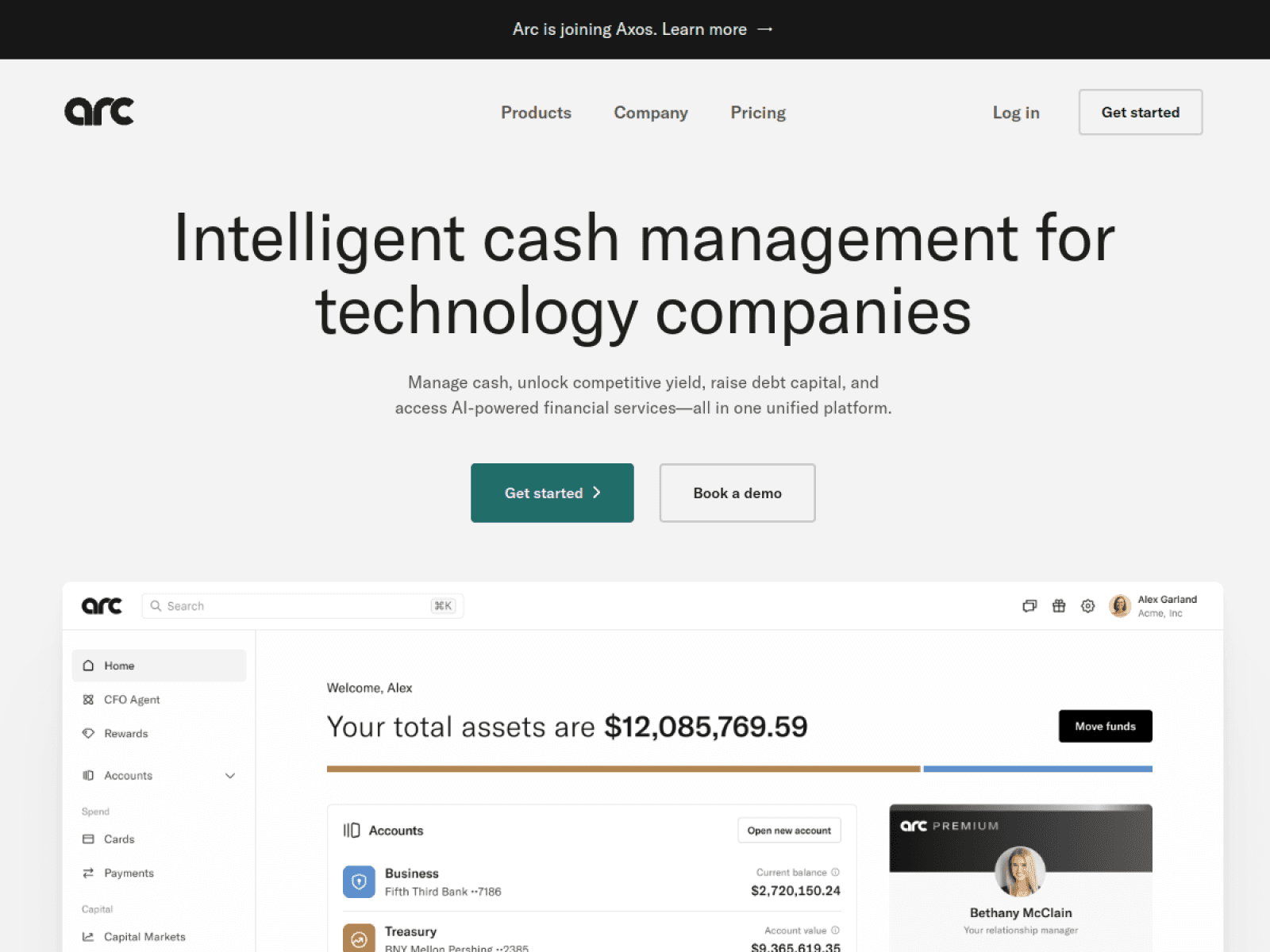
Arc treats treasury as one piece of a startup's capital stack rather than a standalone product. You get banking and a treasury layer — idle cash into money-market funds and Treasury products for yield, with expanded coverage — but the differentiator is that it sits next to financing: Arc has built its business around giving venture-backed companies access to venture debt and non-dilutive capital. For a founder, that means the same platform where runway is parked can also be where you raise a debt facility to extend it. The cash-management experience is clean and startup-friendly, with visibility into balances, yield, and spend. The honest limits: it's aimed squarely at the venture-backed segment, so bootstrapped or enterprise treasurers are less the target; and as with all startup treasury accounts, it's not a multi-bank enterprise TMS with SWIFT and FX risk tooling.
Key Features
- Treasury + Yield: Idle cash swept into money-market funds and Treasury products with expanded coverage
- Access to Venture Debt: Non-dilutive financing and venture debt facilities alongside your operating cash
- Startup Banking: Operating accounts, cards, and payments built for the venture-backed workflow
- Cash Visibility: Balances, yield, and runway in one dashboard designed for founders and their finance leads
- Capital Stack in One Place: Park runway and raise debt to extend it without leaving the platform
Pricing
| Plan | Monthly | Annual (per month) |
|---|---|---|
| Banking + treasury | $0 | $0 |
| Financing / venture debt | Rate-based (quote) | Quote-based |
| Enterprise | Custom | Custom |
Pros
- Treasury and venture financing in one platform
- Yield on idle cash with expanded coverage
- Purpose-built for the venture-backed capital stack
- Clean, founder-friendly cash visibility
Cons
- Focused on venture-backed companies specifically
- Not a multi-bank enterprise TMS
- Financing terms depend on underwriting and market conditions
Verdict: Arc is the pick for venture-backed startups that want yield on runway and a path to non-dilutive capital in the same place. If debt financing is part of your plan, it's a natural home for treasury.
Visit ArcVesto
Best for: Finance teams that want a purpose-built treasury layer over their existing bank accounts — automated allocation, visibility, and controls without switching banks
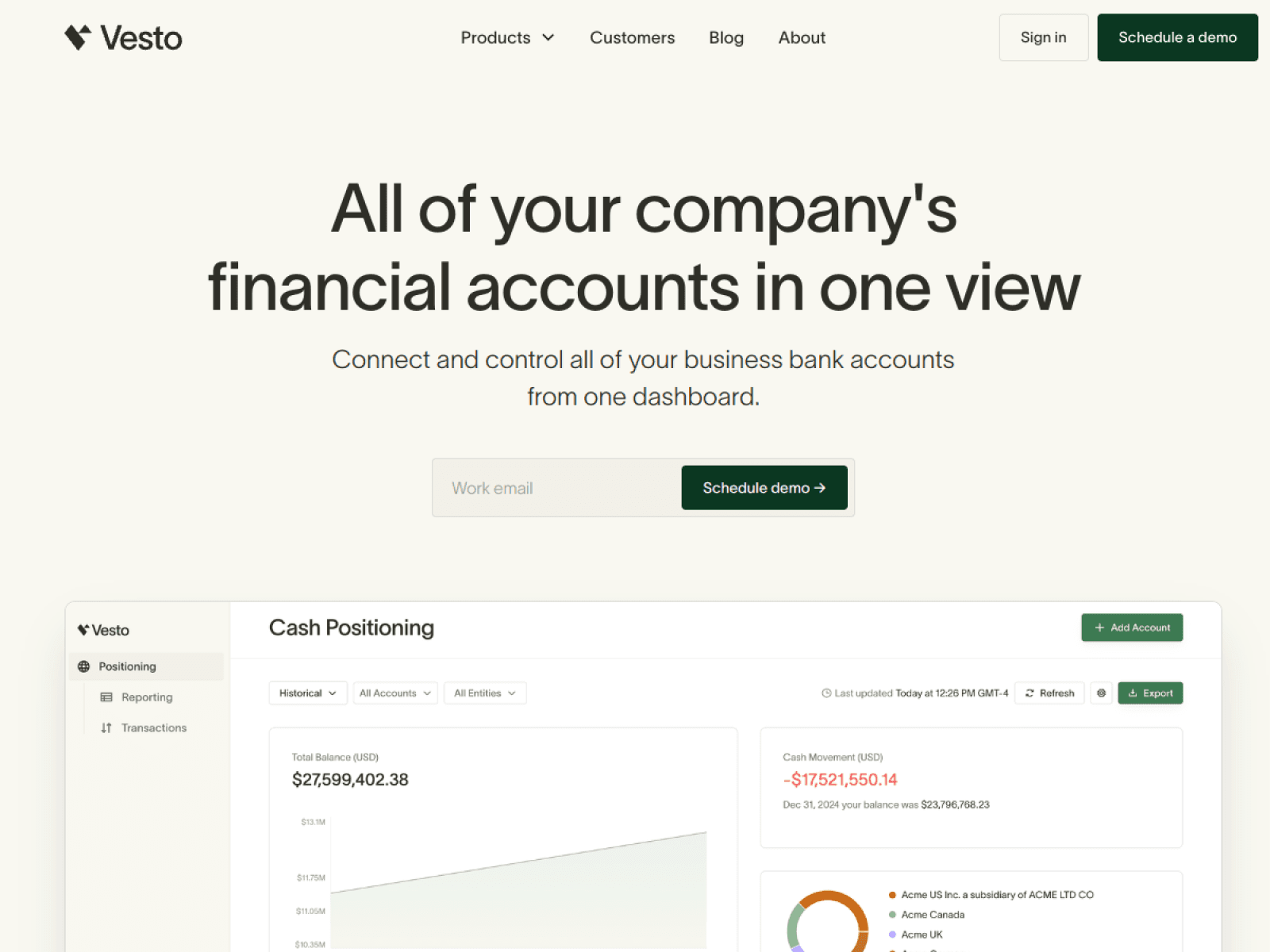
Vesto is the best answer for companies that don't want to move their money but do want to manage it like a treasurer. Rather than replacing your bank, it layers on top of the accounts you already have and automates the treasury function: allocating idle cash across government money-market funds and Treasury vehicles according to a policy you set, giving you consolidated visibility of balances and yield, and adding the approval controls and audit trail that a spreadsheet can't. For a CFO who has outgrown 'leave it in checking' but isn't ready for an enterprise TMS, it hits the gap precisely — a dedicated treasury platform with real controls at SaaS pricing. The trade-offs are the flip side of its focus: it's a treasury and cash-allocation layer, not a full operating bank or a payments/FX risk engine, and it makes the most sense once you have enough idle cash for allocation decisions to matter.
Key Features
- Layer Over Existing Banks: Works on top of your current bank accounts — automate treasury without switching providers
- Automated Cash Allocation: Policy-driven allocation across government money-market funds and Treasury vehicles
- Consolidated Visibility: One view of balances, allocations, and blended yield across accounts
- Controls & Approvals: Dual-approval thresholds, permissions, and an audit trail for every cash move
- Treasury Policy Operationalized: Turn a board-approved policy into automated, enforceable allocation rules
Pricing
| Plan | Monthly | Annual (per month) |
|---|---|---|
| Platform (SaaS) | Subscription (quote) | Quote-based |
| Growth | Quote-based | Quote-based |
| Enterprise | Custom | Custom |
Pros
- Dedicated treasury controls without switching banks
- Automated, policy-driven cash allocation
- Consolidated visibility and blended-yield reporting
- Bridges the gap between checking and an enterprise TMS
Cons
- Subscription cost where startup accounts are free
- Not an operating bank or full payments/FX engine
- Most valuable once idle-cash balances are material
Verdict: Vesto is the best dedicated treasury platform for companies that want a treasurer's controls over the banks they already use. When 'leave it in checking' stops being a strategy, it's the layer to add.
Visit VestoRho
Best for: Growth-stage companies that want business banking, corporate cards, accounts payable, and treasury yield consolidated into one free platform
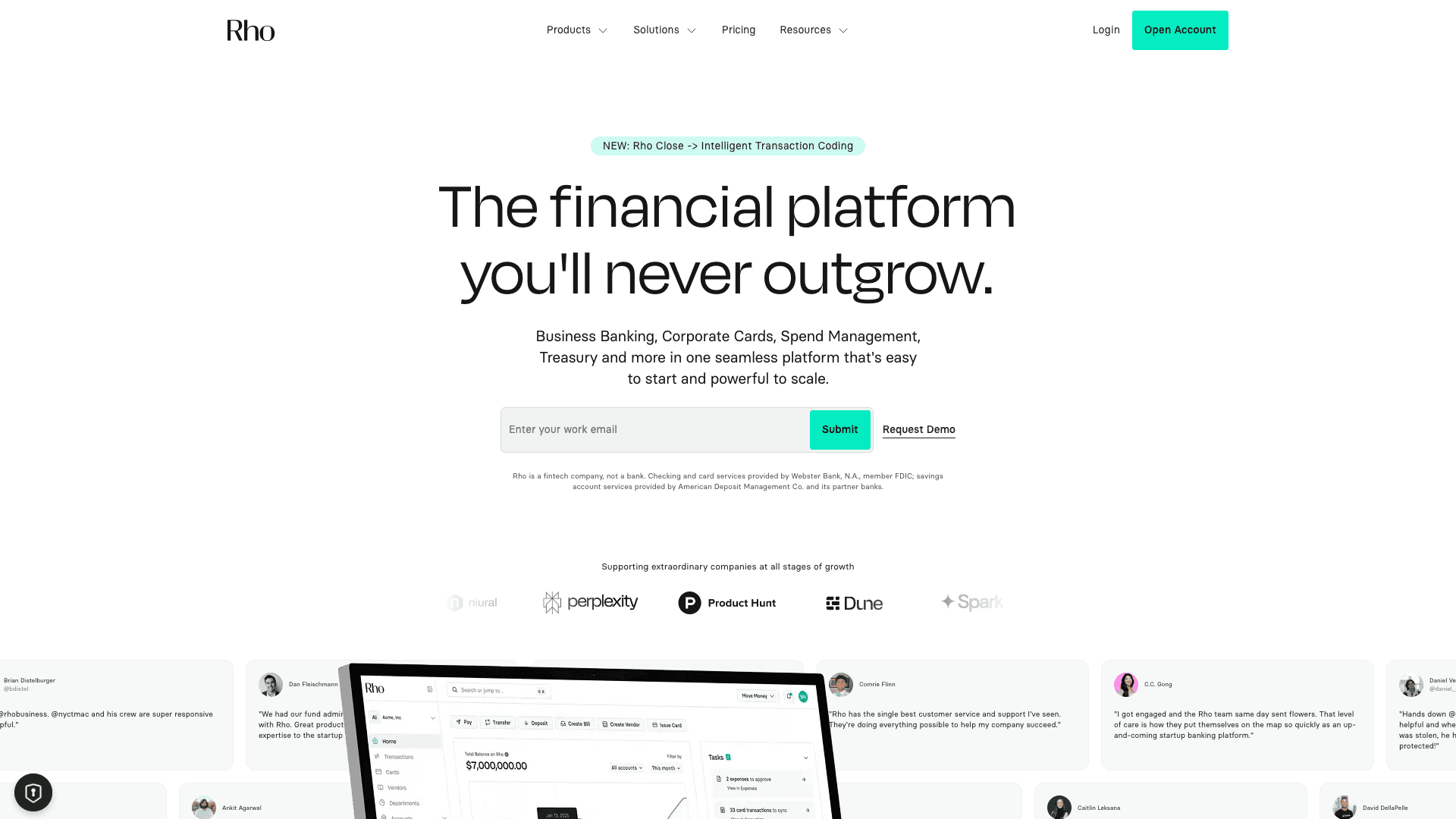
Rho's pitch is consolidation, and treasury is part of the bundle. Business checking, corporate cards with cashback, accounts payable, and a treasury product with yield on idle cash all live in one platform with no software fees — monetized through interchange and banking economics rather than subscriptions. For a growth-stage company tired of stitching together a bank, a card program, an AP tool, and a separate treasury account, Rho replaces the stack with one vendor, one dashboard, and one (notably white-glove) support relationship. On the treasury side, idle operating cash can be swept into managed treasury for yield while staying operationally accessible, so you're not choosing between earning and spending. The honest limits: it's US-centric, full value assumes you move banking and card spend over, and its treasury depth is aimed at growth-stage cash management rather than the multi-bank, multi-currency needs of an enterprise treasurer.
Key Features
- Banking + Cards + AP + Treasury: One platform and support relationship replaces a four-vendor finance stack
- Treasury with Yield: Idle operating cash swept into managed treasury for yield while staying accessible
- Zero Software Fees: Monetized via interchange and banking — the platform itself is free
- Corporate Cards with Cashback: Physical and virtual cards with cashback and real-time policy controls
- ERP Sync Including NetSuite: Direct feeds keep cash and spend current in the GL without manual export cycles
Pricing
| Plan | Monthly | Annual (per month) |
|---|---|---|
| Platform (banking, cards, AP, treasury) | $0 | $0 (interchange/banking-funded) |
| Treasury management | Included (yield net of spread) | Included |
Pros
- Banking, cards, AP, and treasury yield in one free platform
- White-glove support unusual at the price (free)
- Idle cash earns while remaining operationally accessible
- Strong NetSuite and QuickBooks sync
Cons
- US-centric — limited international/multi-currency depth
- Requires migrating banking and cards for full value
- Treasury depth trails a dedicated enterprise TMS
Related reading: Best Spend Management Software
Verdict: Rho is the consolidation pick. If you're willing to make it your bank and card program, you get treasury yield and AP automation of genuine quality for free on top.
Visit RhoTrovata
Best for: Mid-market and larger companies that need multi-bank cash visibility and automated, AI-driven cash forecasting without a heavyweight enterprise TMS
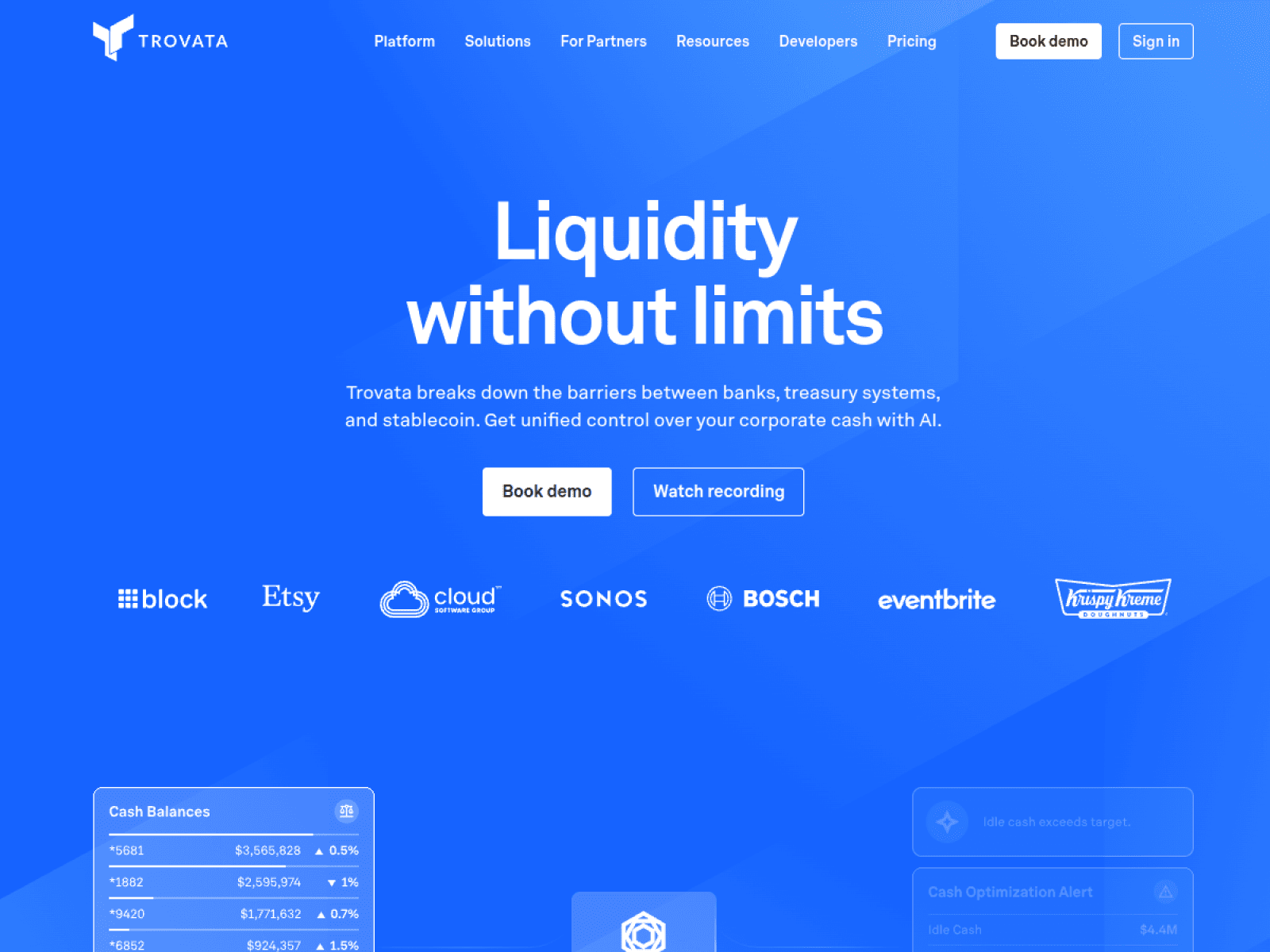
Trovata is what you buy when the problem is 'we can't see our cash' rather than 'we can't earn on it.' It connects to your banks directly through APIs, aggregates balances and transactions across all of them in near real time, and auto-categorizes the flows so you get a live, consolidated cash position without logging into a dozen bank portals or maintaining a consolidation spreadsheet. On top of that data sits its real strength: machine-learning cash forecasting that learns your inflow and outflow patterns to produce rolling daily, weekly, and monthly projections that update as new bank data lands. It's lighter-weight and faster to deploy than a full TMS, which is exactly why mid-market finance teams pick it as a bridge. The trade-offs: it's a visibility-and-forecasting platform, not a yield product or a full payments/hedging engine, and its value scales with how many banks and how much transaction history you feed it.
Key Features
- Multi-Bank Aggregation: Direct API connections pull balances and transactions from all your banks into one live view
- AI Cash Forecasting: Machine-learning models produce rolling daily, weekly, and monthly cash forecasts that self-update
- Auto-Categorized Flows: Transactions are tagged and grouped automatically for analysis and reporting
- Faster Deployment than a TMS: API-first connectivity means weeks, not months, to a live cash position
- Reporting & API: Dashboards, exportable reports, and a developer API for embedding cash data
Pricing
| Plan | Monthly | Annual (per month) |
|---|---|---|
| Platform (SaaS) | Subscription (quote) | Quote-based |
| Growth / multi-entity | Quote-based | Quote-based |
| Enterprise | Custom | Custom |
Pros
- Best-in-class multi-bank cash visibility
- Genuinely useful AI forecasting on your own data
- Faster and lighter to deploy than a full TMS
- API-first for teams that want to build on their cash data
Cons
- Visibility and forecasting, not a yield or hedging product
- Value scales with number of banks and transaction history
- Quote-based pricing above the startup free tier
Verdict: Trovata is the cash-visibility and forecasting pick for the mid-market. When the pain is seeing and predicting cash across many banks, it delivers most of a TMS's insight at a fraction of the lift.
Visit TrovataKyriba
Best for: Large and multinational enterprises that need a full treasury management system — liquidity, payments, risk, and bank connectivity at global scale
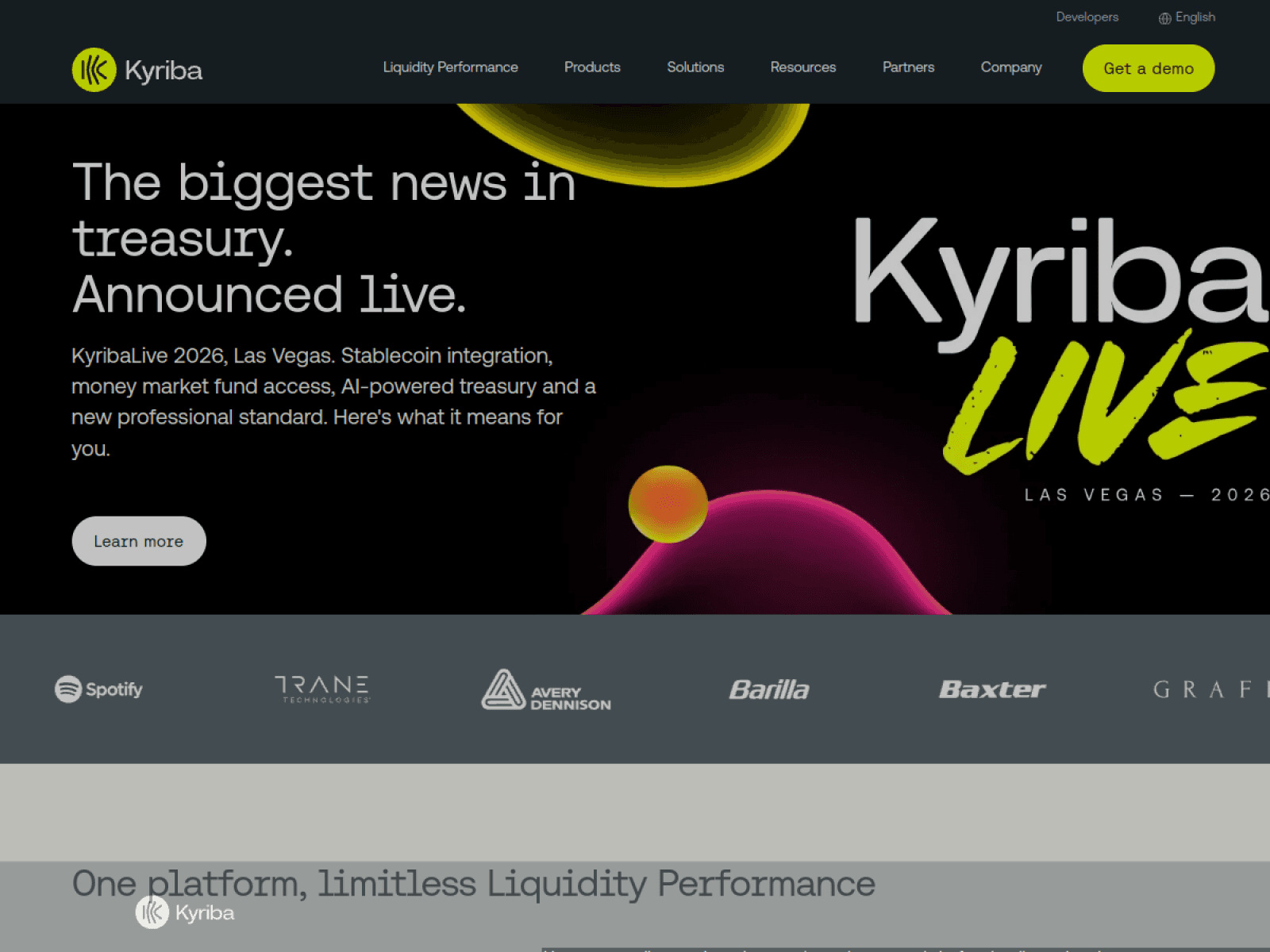
Kyriba is the market-leading enterprise treasury management system, and at true global scale it's the benchmark the others measure against. It's a cloud platform that centralizes the entire treasury function: real-time cash and liquidity across hundreds of bank accounts, an in-house payments hub with fraud screening, working-capital and supply-chain finance, and FX and interest-rate risk management — all sitting on a bank-connectivity layer (host-to-host, SWIFT, APIs) that few can match. For a corporate treasurer running many entities, currencies, and banking relationships, it replaces a sprawl of portals and spreadsheets with one system of record that ERP systems like SAP and Oracle plug into. The honest limits are the enterprise reality: pricing is quote-based and lands in the five-to-six-figure range, implementations are projects measured in months with a partner, and it's overkill — and overpriced — for a startup whose treasury is one bank account and some idle cash.
Key Features
- Global Cash & Liquidity: Real-time visibility and positioning across hundreds of accounts, banks, and currencies
- In-House Payments Hub: Centralized payments with fraud screening, sanctions checks, and format transformation
- Risk Management: FX, interest-rate, and commodity exposure tracking with hedge accounting support
- Bank Connectivity: Host-to-host, SWIFT, and API connectivity to a vast network of banks worldwide
- ERP Integration: Deep SAP, Oracle, and NetSuite integration for cash accounting and reconciliation
Pricing
| Plan | Monthly | Annual (per month) |
|---|---|---|
| Core TMS | Quote-based | Quote-based (5-6 figure) |
| Modules (payments, risk, WCM) | Quote-based add-ons | Quote-based |
| Enterprise | Custom | Custom |
Pros
- Market-leading breadth: liquidity, payments, risk, connectivity
- Unmatched multi-bank and SWIFT connectivity
- Deep ERP integration for global cash accounting
- The recognized standard for enterprise treasury
Cons
- Quote-based pricing in the 5-6 figure range
- Implementation is a multi-month project
- Far too much for startups and small treasuries
Verdict: Kyriba is the enterprise TMS benchmark. If you run global, multi-bank, multi-currency treasury, its breadth and connectivity justify the investment — below that scale, it's overkill.
Visit KyribaGTreasury
Best for: Enterprises and upper-mid-market treasuries that want strong cash management with especially deep risk, hedging, and debt/investment tooling
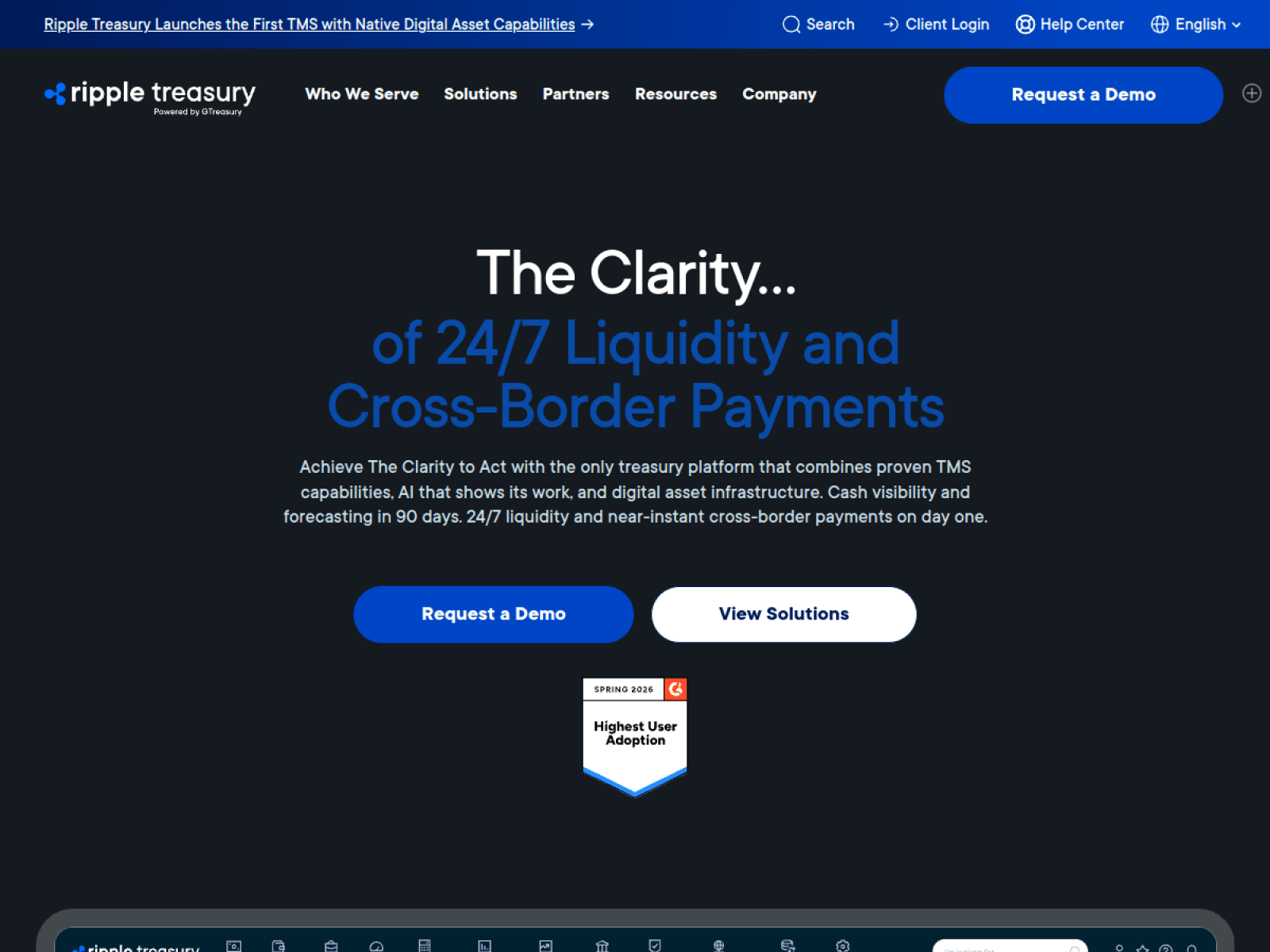
GTreasury is the enterprise TMS that treasurers reach for when risk and hedging matter as much as cash visibility. It covers the full function — cash positioning and forecasting, payments with bank connectivity, and reconciliation — but its reputation is built on depth in the risk and financial-instrument side: FX and interest-rate exposure management, hedge accounting, and detailed tracking of debt and investment portfolios. For a company with meaningful market risk or a complex capital structure, that depth is the reason to choose it over a lighter platform. It's modular, so treasuries can start with cash and layer on risk and payments as they mature, and it integrates with major ERPs. The trade-offs mirror the enterprise segment: quote-based pricing, an implementation project rather than a signup, and more capability than a startup or simple SMB treasury will ever use.
Key Features
- Cash & Liquidity Management: Multi-bank cash positioning, forecasting, and reconciliation across the enterprise
- Risk & Hedging Depth: FX and interest-rate exposure management with hedge accounting support
- Debt & Investment Tracking: Detailed management of debt facilities and investment portfolios in one system
- Payments & Connectivity: Bank-connected payments with controls, across host-to-host, SWIFT, and APIs
- Modular Platform: Start with cash and add risk and payments modules as the treasury matures
Pricing
| Plan | Monthly | Annual (per month) |
|---|---|---|
| Core cash management | Quote-based | Quote-based (5-6 figure) |
| Risk / payments modules | Quote-based add-ons | Quote-based |
| Enterprise | Custom | Custom |
Pros
- Especially strong risk, hedging, and hedge accounting
- Solid debt and investment portfolio tracking
- Modular — grow from cash into full treasury
- Established enterprise TMS with ERP integration
Cons
- Quote-based enterprise pricing
- Implementation is a project, not a signup
- Overbuilt for simple startup or SMB treasuries
Verdict: GTreasury is the pick when treasury and financial risk are inseparable. For companies managing FX, rates, debt, and investments, its risk depth makes it the strongest enterprise choice.
Visit GTreasuryTesorio
Best for: Companies whose cash-flow uncertainty lives in receivables — AR-driven forecasting and collections to predict and accelerate customer payments
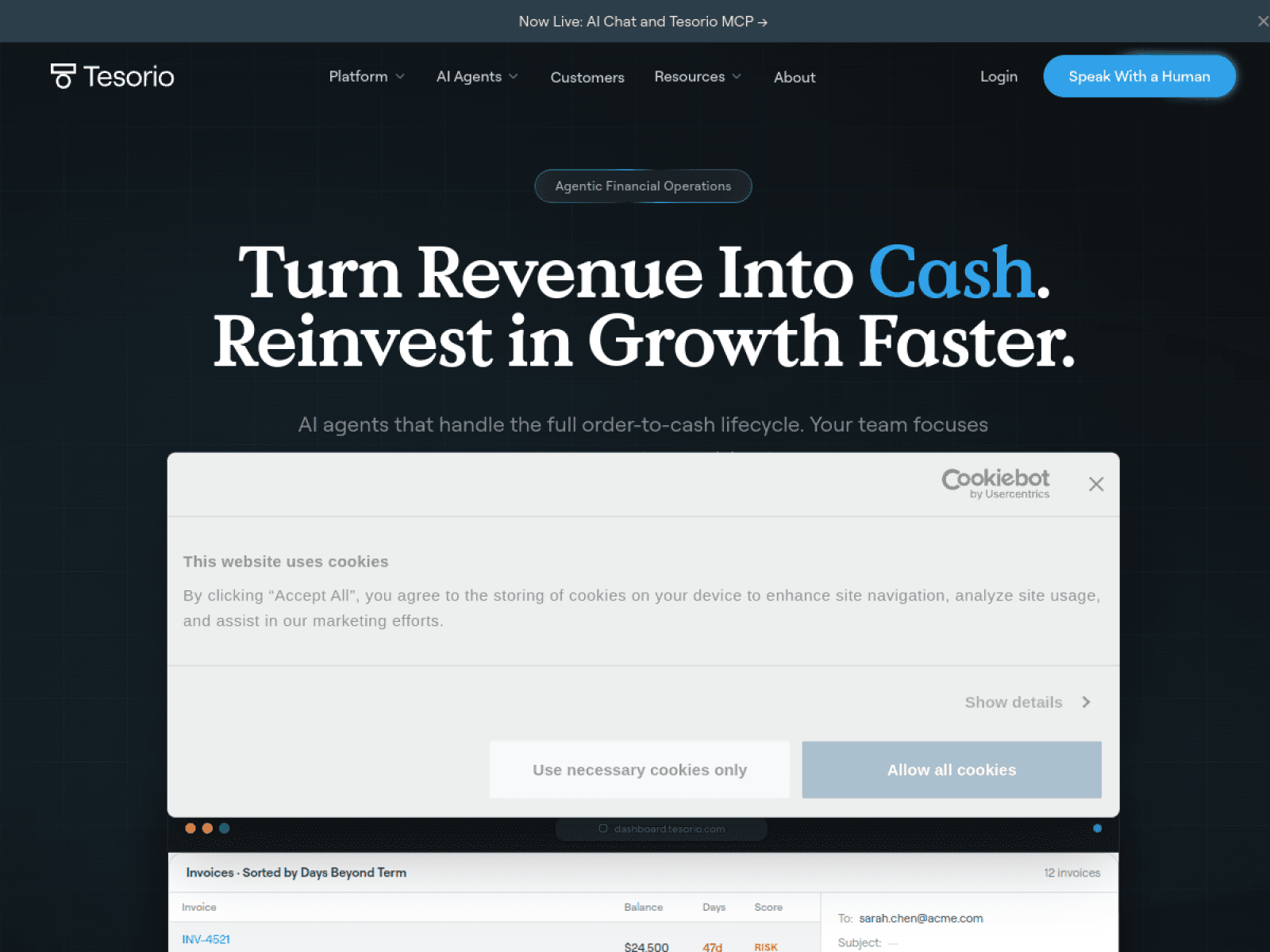
Tesorio approaches cash management from the receivables side, which is where most B2B companies' cash-flow uncertainty actually sits. Its cash-flow performance platform uses AI to predict when customers will really pay — not when invoices are due — and turns that into an accurate, continuously updated cash-flow forecast. Around the forecast it adds a collections engine: automated, prioritized customer outreach that accelerates payments and shortens DSO, so the platform doesn't just predict cash but improves it. For a finance team where 'when will that big invoice land?' is the question that drives the forecast, that AR intelligence is more valuable than another bank-aggregation dashboard. It integrates with ERPs and accounting systems to pull the AR and transaction data it learns from. The trade-offs: it's a forecasting-and-collections platform rather than a yield product or a full payments/treasury system, so companies whose complexity is multi-bank liquidity rather than receivables will get less from it.
Key Features
- AR-Driven Forecasting: AI predicts when customers will actually pay, not just when invoices are due
- Collections Automation: Prioritized, automated customer outreach that accelerates payment and cuts DSO
- Continuous Cash-Flow Forecast: A rolling forecast that updates as payment behavior and new data arrive
- ERP & Accounting Integration: Pulls AR and transaction data from NetSuite, Sage Intacct, and others
- Customer Payment Insights: Behavioral scoring that flags at-risk accounts and likely late payers
Pricing
| Plan | Monthly | Annual (per month) |
|---|---|---|
| Platform (SaaS) | Subscription (quote) | Quote-based |
| Growth | Quote-based | Quote-based |
| Enterprise | Custom | Custom |
Pros
- Best-in-class AR-driven cash-flow forecasting
- Collections engine actively improves cash, not just visibility
- Behavioral prediction of customer payment timing
- Strong ERP and accounting integration
Cons
- Receivables-focused — not a yield or multi-bank treasury tool
- Less relevant when complexity is liquidity, not AR
- Quote-based subscription pricing
Verdict: Tesorio is the pick when receivables drive your cash flow. For B2B companies chasing DSO and forecast accuracy, its AR intelligence beats any generic aggregation dashboard.
Visit TesorioHighRadius
Best for: Large enterprises that want autonomous finance — treasury and cash forecasting alongside deep accounts-receivable and order-to-cash automation at scale
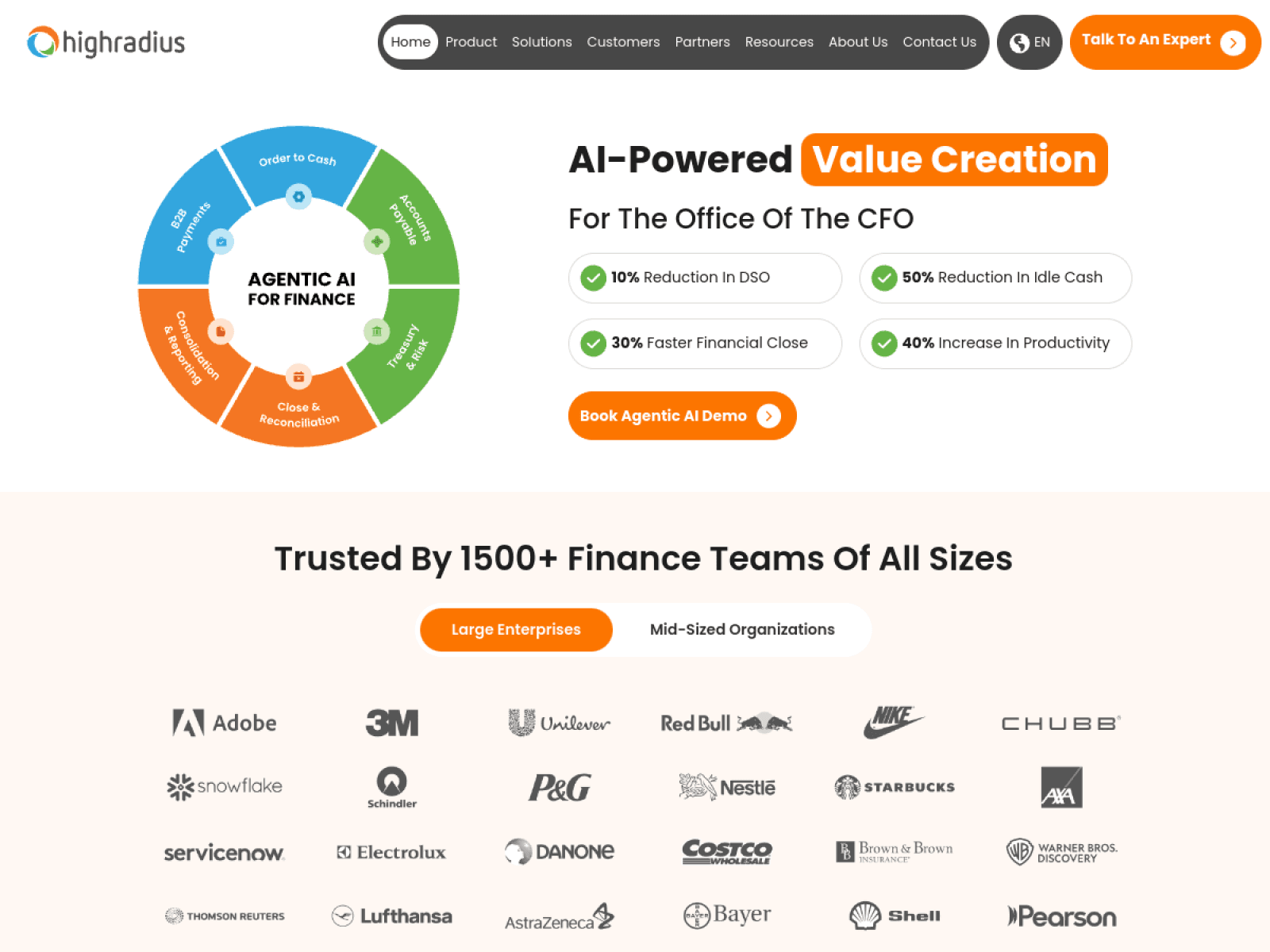
HighRadius is the enterprise pick when the goal is autonomous finance across treasury and the order-to-cash cycle, not just a treasury dashboard. Its treasury and cash-management suite delivers multi-bank cash visibility and AI-based cash forecasting at enterprise scale, but the platform's real breadth is the surrounding automation: accounts receivable, collections, cash application, credit, and deductions, all driven by machine learning that aims to remove manual work from the finance back office. For a large organization where treasury forecasting is only as good as the receivables and cash-application data feeding it, having both in one autonomous platform is the argument. It plugs into SAP, Oracle, and other enterprise ERPs. The trade-offs are squarely enterprise: it's a large, quote-priced platform with a real implementation program, and it's aimed at big finance organizations — a startup or SMB would be buying vastly more machinery than its treasury requires.
Key Features
- Enterprise Cash Forecasting: AI-based cash forecasting and multi-bank visibility built for large, complex organizations
- Autonomous Receivables: AI-driven collections, cash application, credit, and deductions across order-to-cash
- Treasury + AR in One Platform: Forecasting fed by the same automated receivables and cash-application data
- Bank & ERP Connectivity: Multi-bank connectivity and deep SAP/Oracle integration for cash accounting
- Analytics & Reporting: Enterprise dashboards and analytics across treasury and the finance back office
Pricing
| Plan | Monthly | Annual (per month) |
|---|---|---|
| Treasury / cash management | Quote-based | Quote-based (enterprise) |
| AR / order-to-cash modules | Quote-based add-ons | Quote-based |
| Enterprise | Custom | Custom |
Pros
- Treasury and autonomous receivables in one platform
- AI cash forecasting at true enterprise scale
- Deep SAP/Oracle and multi-bank connectivity
- Removes manual work across the finance back office
Cons
- Large, quote-priced enterprise platform
- Implementation is a substantial program
- Far more than a startup or SMB treasury needs
Verdict: HighRadius is the pick for enterprise treasury automation tied to receivables. When forecasting depends on order-to-cash data, one autonomous platform for both is a genuine advantage.
Visit HighRadiusHow to Choose the Best Treasury & Cash Management Tool for Your Business
The decision framework, by the stage and problem that actually decides it:
If you're a startup with runway to protect
Your job is safe yield and clear visibility, not a full TMS. Mercury is the best all-round home — banking plus treasury with expanded FDIC in one dashboard; Meow when squeezing the highest safe yield out of a fresh round matters most; Arc when you want treasury alongside access to venture debt. For the accounts underneath, see our guide to the best business banking for startups.
If you want treasury controls without switching banks
Once “leave it in checking” stops being a strategy but you're not ready for an enterprise TMS, add a dedicated layer. Vesto automates policy-driven allocation, visibility, and approvals over your existing accounts; Rho consolidates banking, cards, AP, and treasury yield into one free platform if you're willing to move your operating relationship over.
If the pain is seeing and forecasting cash
When you can't get a live, consolidated cash position across many banks, buy visibility before you buy a TMS. Trovata aggregates all your banks and adds AI forecasting that deploys in weeks; Tesorio is the pick when receivables drive your uncertainty, predicting when customers will actually pay and accelerating collections to improve the forecast, not just report it.
If you run global, multi-bank, multi-currency treasury
When you manage many accounts, entities, and currencies with real payments and market risk, you need a system of record. Kyriba is the market-leading enterprise TMS for liquidity, payments, and connectivity; GTreasury is the pick when FX, interest-rate, and debt risk are as important as cash. Pair the platform decision with tighter spend controls in our guide to the best spend management software.
If you're a large enterprise automating the back office
When treasury forecasting is only as good as the receivables and cash-application data feeding it, buy the platform that automates both. HighRadius pairs enterprise cash forecasting with autonomous accounts-receivable and order-to-cash automation, so the same AI that predicts cash also collects and applies it. It's a real program to implement, but at enterprise scale the consolidation pays off.
Pro Tip
Whichever tier you land in, write the treasury policy before you pick the product: objectives in order (safety, then liquidity, then yield), eligible investments, concentration limits, and who can move money. The policy makes the shortlist obvious — a startup policy points to a treasury account, a multi-bank policy points to a platform or TMS — and it's the document your board and auditors will actually ask for.
Frequently Asked Questions
Final Thoughts
The best treasury and cash management tool of 2026 depends on your stage and where your complexity lives. Mercury is our best-overall pick because, for the vast majority of startups and growth-stage companies, it makes cash safe, visible, and yield-earning in one place with no software fee — but Meow is the answer when yield is everything, Vesto when you want a treasurer's controls over your existing banks, Trovata when the pain is cash visibility and forecasting, and Kyriba or GTreasury when you run a full enterprise treasury — and each would be right for the company it fits.
Whatever you choose: confirm exactly where your balances sit — insured deposits, money-market funds, or Treasuries — before you chase a headline yield; write a board-approved treasury policy that puts safety and liquidity ahead of return; and make sure the tool connects to the specific banks and ERP you actually use, with production connections rather than roadmap promises. Get those three things right and treasury becomes what it should be: quiet, safe, and quietly working for you.
Related Free SEO Tools
Content Brief Generator
Generate SERP-grounded briefs for your category content
SEO Content Grader
Score your comparison and alternative pages
Meta Tags Generator
Optimize SERP previews for landing pages
Long-Tail Keyword Generator
Find low-competition commercial queries
Keyword Search Volume
Size demand for your product category
SERP Checker
See who ranks for your target keywords today
Related Articles
Best Business Banking for Startups
The operating accounts underneath your treasury
Best Spend Management Software
AP, procurement, and company-wide spend control
Best Corporate Cards for Startups
The card programs that pair with treasury accounts
Browse All Articles
Explore our complete library of guides and tutorials
About the Author

Co-Founder & SEO Execution
Co-founder of PikaSEO. 11 years in corporate tech, then bootstrapped entrepreneur. Leads SEO execution and content-led growth for SaaS companies.