
Corporate gifting grew up. What used to be a December scramble — a spreadsheet of addresses, a bulk order of branded tumblers, and no idea whether any of it mattered — is now a software category with CRM triggers, global fulfillment networks, recipient-choice mechanics, and attribution reporting that ties a gift to a booked meeting or a renewed contract. The best corporate gifting platforms of 2026 treat gifting the way marketing automation treated email two decades ago: as a channel you program, measure, and scale.
But “gifting platform” now covers three genuinely different jobs, and most tools are built for one of them. Client and prospect gifting platforms plug into Salesforce and outreach sequences so revenue teams can run gifts as ABM plays. Direct mail marketing platforms trigger physical mailers and kits from the same workflows that send email. And employee gifting platforms run onboarding kits, work anniversaries, and always-on recognition programs from the HR stack. Buying the wrong category's leader is the most common mistake in this market.
This guide ranks the 10 platforms we'd actually shortlist in 2026 across all three jobs. We evaluated each on recipient experience (do gifts get redeemed and remembered), workflow integration (CRM, marketing automation, and HRIS depth), honest total cost (platform fee plus gift spend plus shipping — and who profits from unclaimed gifts), and fulfillment reach (whether international sends actually arrive).
Quick Comparison
| Platform | Best For | Pricing Model | Free to Start |
|---|---|---|---|
| Reachdesk | Best Overall / Global ABM Gifting | Custom annual contract | No |
| Postal | Direct Mail Marketing | Custom annual contract | No |
| Goody | Effortless Client Gifting | Pay per gift; Pro ~$20/user/mo | Yes |
| Snappy | Employee Gift Moments | Pay per gift; custom plans | Yes |
| Awardco | Employee Recognition Programs | Custom, per employee | No |
| Loop & Tie | Curated Recipient-Choice Gifting | Pay per gift ($10-$1,000+ tiers) | Yes |
| &Open | Customer Gifting at Scale | Custom enterprise contract | No |
| Guusto | Budget Employee Gifting | Free plan; paid from ~$40/mo | Yes |
| Giftogram | Gift Cards at Scale | No platform fee; card face value | Yes |
| PFL | Enterprise Direct Mail | Custom contract + per piece | No |
How We Evaluated
Every vendor in this category promises “delight.” We weighted the dimensions where platforms measurably differ:
Recipient Experience
A gift that isn't redeemed influenced nothing. We favored recipient-choice mechanics (Snappy, Loop & Tie, Goody), no-address sending, and catalogs people actually comment on over promotional-products filler.
Workflow Integration
Client gifting lives or dies on CRM and sequence triggers; employee gifting on HRIS automation. We tested how each platform plugs into Salesforce, HubSpot, outreach tools, and HR systems — not just whether a logo appears on an integrations page.
Honest Total Cost
Platform fee plus gift spend plus shipping — and the fine print: reward markups, breakage on unclaimed gifts, and minimum contracts. Guusto's and Awardco's no-markup models and Goody's pay-on-acceptance pricing earned real credit here.
Fulfillment Reach
International gifting fails quietly — customs holds, surprise duties, three-week deliveries. We weighted regional warehouse networks (Reachdesk, &Open) and digital fallbacks that make global programs actually work.
Pro Tip
Before signing any annual contract, run a 20-send pilot on a free-to-start platform (Goody, Snappy, or Loop & Tie) against a control group of plain outreach. Two weeks of real redemption and reply data tells you whether gifting works for your audience — and gives you negotiating leverage on the enterprise platforms if it does.
Pricing Models at a Glance
Unlike most software categories, corporate gifting splits into three distinct pricing models — and the platform fee is often the smaller half of the bill once gift spend and shipping land on top. Here's the commitment each platform requires before your first send:
The free-to-start tier is genuinely free: Goody, Snappy, Giftogram, Loop & Tie, and Guusto all let you send real gifts today with no contract, paying only for what you send (and on Goody, only for what recipients accept). The enterprise tier — Reachdesk, Postal, Awardco, &Open, and PFL — is custom-quoted annual contracts, typically five figures per year, justified when gifting is a standing program with volume behind it. There is no shame in starting free and graduating.
Client Gifting, Direct Mail, or Employee Gifting?
“Best” depends on who receives the gifts and which team owns the budget. Before reading individual reviews, place your program on this map — it narrows the realistic shortlist to two or three platforms:
Client and prospect gifting platforms (Reachdesk, Goody, Loop & Tie) win when sales and marketing send gifts to open doors and close deals — CRM integration and attribution matter most. Direct mail marketing platforms (Postal, PFL, Reachdesk) win when physical mail is a programmed demand-gen channel. Employee gifting platforms (Snappy, Awardco, Guusto) win when HR owns the budget and the jobs are onboarding, milestones, and recognition. Scale and specialty tools (&Open, Giftogram) cover high-volume customer programs and the honest simplicity of gift cards.
Reachdesk
Best for: B2B revenue teams running gifting and direct mail as an ABM channel — especially with international prospects and customers
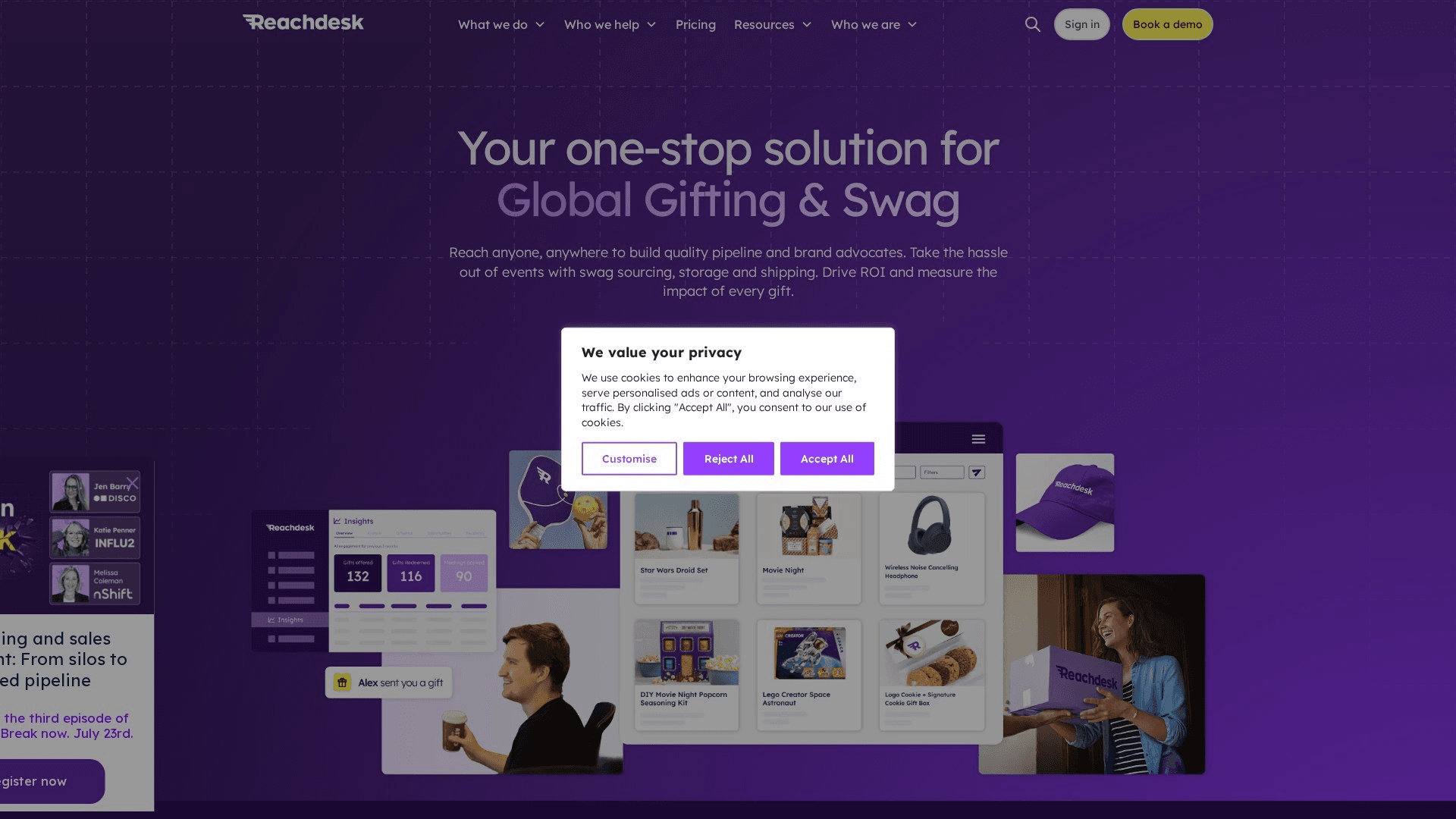
Reachdesk is the most complete corporate gifting platform of 2026 because it treats gifting as revenue infrastructure rather than a perk. The platform covers the full offline channel — physical gifts, branded swag, handwritten notes, dimensional direct mail, and e-gifts — and wires it into the systems revenue teams already run: Salesforce, HubSpot, Salesloft, Outreach, and Marketo, so sends can trigger from sequence steps, deal stages, or intent signals. Its genuine differentiator is global fulfillment: a network of regional warehouses means a gift to Frankfurt or Singapore ships locally, clearing customs and arriving in days rather than weeks. Budget controls, approval workflows, and pipeline attribution reporting round out a platform built for coordinated ABM plays. Pricing is a custom-quoted annual subscription — this is a tool that assumes a program, not an experiment.
Key Features
- Global Warehouse Network: Regional fulfillment centers ship in-market, handling customs and duties for genuinely international gifting
- Deep Revenue-Stack Integration: Triggered sends from Salesforce, HubSpot, Outreach, Salesloft, and Marketo sequences and workflows
- Full Offline Channel: Physical gifts, branded swag bundles, handwritten notes, direct mail, and e-gifts from one platform
- Budgets & Approvals: Per-team and per-rep spend limits with approval workflows that keep compliance intact
- Pipeline Attribution: Send-level reporting tied to meetings, opportunities, and revenue in your CRM
Pricing
| Plan | Price | Notes |
|---|---|---|
| Professional | Custom quote | Annual platform subscription |
| Enterprise | Custom quote | Annual contract + volume terms |
| Gift spend | Pay per gift | Gift + shipping costs on top of platform fee |
Pros
- Strongest international fulfillment in the category
- Integrations cover the full B2B revenue stack
- Attribution reporting that ties gifting to pipeline
- Handles swag, direct mail, and e-gifts alongside gifts
Cons
- Custom-quoted annual contract — real commitment, typically five figures
- Overkill for individual reps or occasional gifting
- Platform depth means a real onboarding and admin lift
Verdict: Reachdesk is the best corporate gifting platform of 2026 for teams running gifting as a revenue channel. If your prospects span countries and your plays span teams, nothing else covers as much ground.
Visit ReachdeskPostal
Best for: Demand-gen and field marketing teams that want direct mail, gifts, swag, and events managed as one programmable offline channel
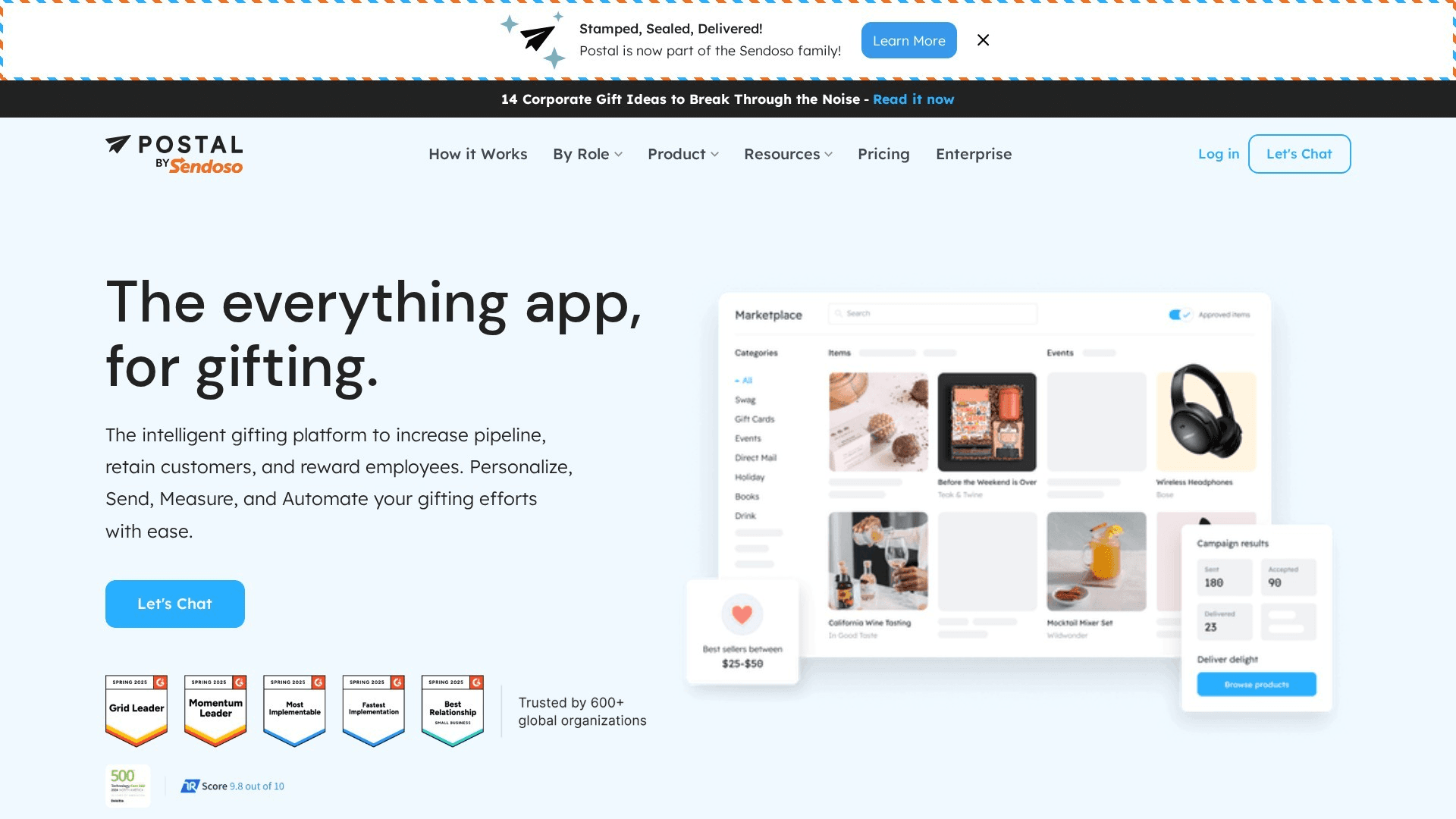
Postal is what direct mail looks like when it's rebuilt as marketing automation. The platform's frame is the offline channel as a whole: direct mail pieces, curated gifts from a large vendor marketplace, branded swag with on-demand printing and warehousing, bulk campaign sends, and event kits — all triggered from HubSpot, Salesforce, Marketo, and sales engagement tools the way an email step would be. Marketers set plays (a mailer when an account hits an intent threshold, a gift when a demo no-shows), assign budgets per team, and read attribution in the same dashboards as digital campaigns. The marketplace model keeps gift variety high, and swag management — historically a closet full of hoodies nobody tracks — becomes inventory software. Pricing is custom-quoted; Postal targets teams running programs, though it's historically been more accessible than enterprise-only rivals.
Key Features
- Offline Marketing Automation: Triggered direct mail and gift sends from HubSpot, Salesforce, Marketo, and sales engagement workflows
- Vendor Marketplace: Large curated marketplace of gifts, local vendors, and experiences beyond the usual catalog
- Swag Management: On-demand printing, warehousing, and inventory tracking for branded merchandise
- Campaign Attribution: Offline touches reported alongside digital channels with pipeline influence metrics
- Budget & Team Controls: Per-team budgets, approval flows, and spend visibility across the whole program
Pricing
| Plan | Price | Notes |
|---|---|---|
| Growth | Custom quote | Annual platform subscription |
| Enterprise | Custom quote | Annual contract + volume terms |
| Gift spend | Pay per item | Item + shipping costs on top of platform fee |
Pros
- Best-in-class direct mail automation and triggering
- Marketplace variety beats fixed-catalog rivals
- Swag warehousing solves a real operational mess
- Attribution puts offline in the same reporting as digital
Cons
- Custom-quoted pricing — budget for a platform, not a tool
- International coverage trails Reachdesk's warehouse network
- Full value assumes marketing-automation maturity
Verdict: Postal is the best direct mail marketing platform of 2026. If offline is a channel you program rather than a gesture you occasionally make, Postal is built for exactly that.
Visit PostalGoody
Best for: Sales reps, founders, and small teams that want to send great client gifts in minutes — without addresses, contracts, or a platform fee
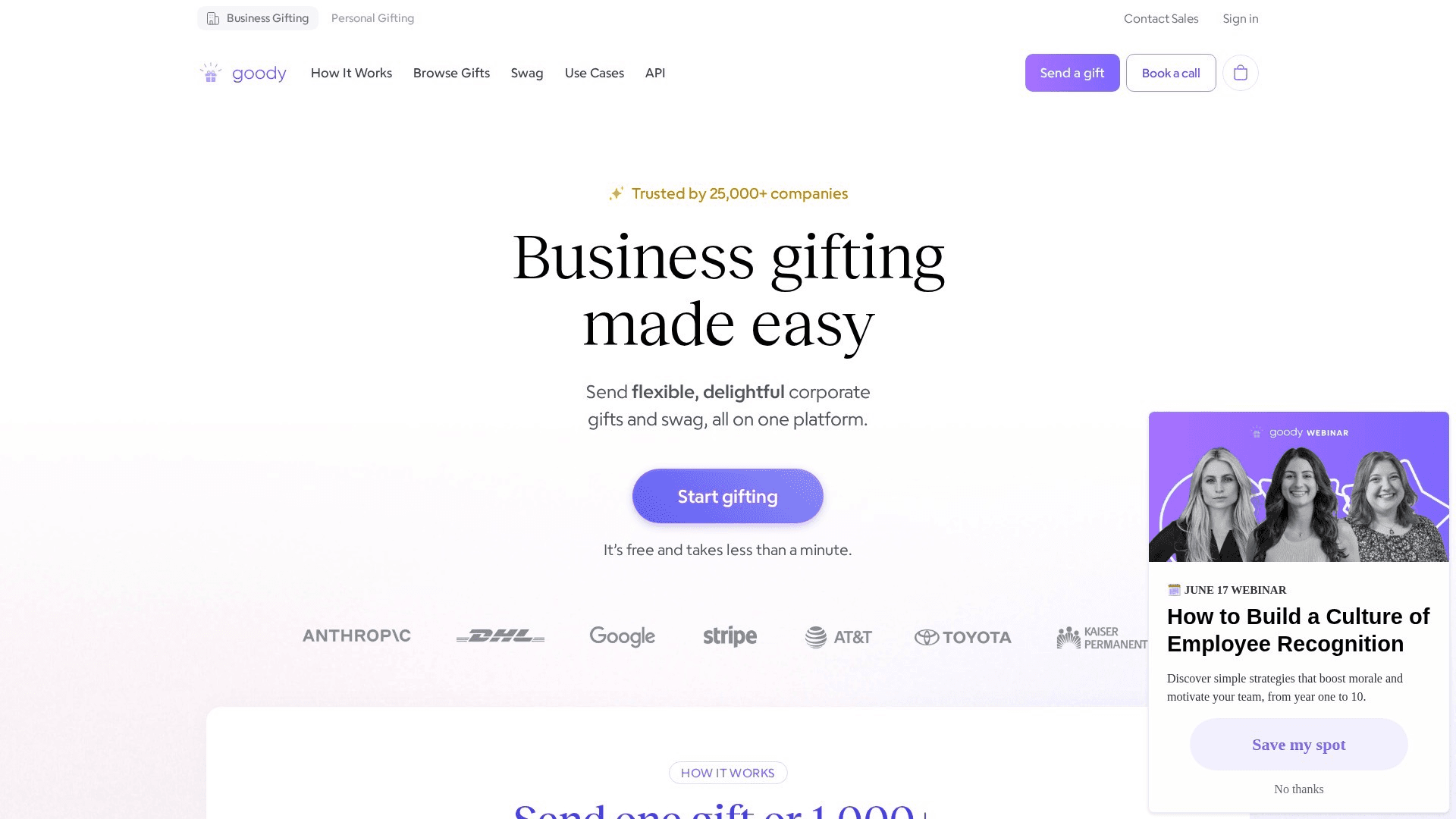
Goody removed every point of friction that makes corporate gifting stall. Senders pick a gift from a genuinely well-curated catalog (trendy DTC brands rather than corporate-catalog filler), enter the recipient's email or phone number, and send — no mailing address required. Recipients get a link, can swap the gift for something else at equal value, and enter their own address, which quietly solves both the wrong-gift problem and the data-privacy awkwardness. There's no charge to start: you pay for gifts people actually accept, with unclaimed gifts costing nothing. Paid tiers add branded gifting pages, custom swag, integrations (Salesforce, HubSpot, HRIS tools), and team budget controls. Goody is also widely used for employee gifting, making it the best consolidation play for smaller companies. It's lighter on enterprise ABM orchestration than Reachdesk or Postal — that's the trade for its speed.
Key Features
- No-Address Gifting: Send via email or phone number; recipients enter their own shipping details
- Recipient Gift Swap: Recipients can exchange for equal-value alternatives — redemption rates climb accordingly
- Modern Curated Catalog: DTC and premium brands curated like a gift guide, not a promotional-products binder
- Pay-Only-For-Accepted: Unclaimed gifts cost nothing — you pay when a recipient actually redeems
- Team & Integration Layer: Salesforce, HubSpot, and HRIS integrations, branded pages, and budgets on paid tiers
Pricing
| Plan | Price | Notes |
|---|---|---|
| Starter | $0 — pay per gift | $0 + gift costs |
| Pro | ~$20/user | Adds branding, integrations, premium catalog |
| Team / Enterprise | Custom quote | Budgets, admin controls, API access |
Pros
- Fastest path from decision to sent gift in the category
- Only pay for gifts recipients actually accept
- Catalog quality recipients genuinely comment on
- Free tier makes testing gifting risk-free
Cons
- ABM orchestration and triggered plays trail Reachdesk and Postal
- International catalog thinner than the global platforms
- Enterprise admin and compliance controls are still maturing
Verdict: Goody is the client gifting software to start with. For reps and small teams, the no-address, pay-on-acceptance model removes every excuse — and it scales further than its simplicity suggests.
Visit GoodySnappy
Best for: HR and people teams running employee gift moments — onboarding, anniversaries, holidays — where recipient choice drives the experience
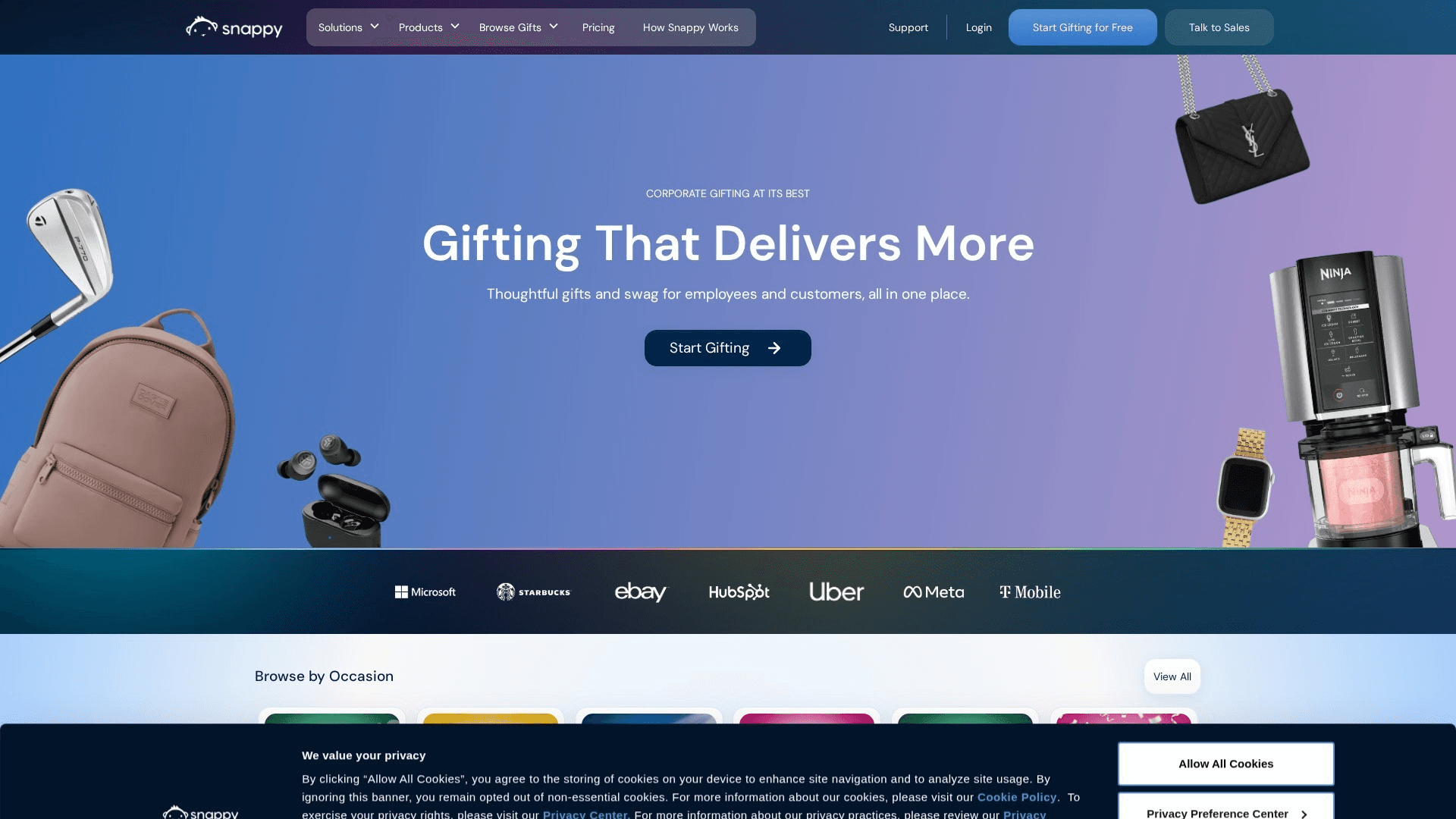
Snappy built its platform on one behavioral insight: people love choosing their own gift. Instead of shipping every employee the same branded blanket, Snappy sends a digital scratch-off reveal that opens into a curated collection at your price point — the recipient picks, Snappy fulfills. That mechanic consistently outperforms company-chosen gifts on redemption and sentiment, and it eliminated the sizing, taste, and address-collection problems in one move. The platform layer handles the programmatic side: automated birthday and work-anniversary sends synced from your HRIS, holiday campaigns at company scale, budgets and approvals, and international delivery across major markets. Snappy also serves client and prospect gifting, but its center of gravity is employee experience — the pre-built moments, HRIS syncs, and celebration flows are where it's deepest. A free tier lets small teams pay per gift; larger programs move to custom-quoted plans.
Key Features
- Recipient-Choice Collections: Employees pick from a curated collection at your budget — a reveal experience, not a form
- Automated Gift Moments: Birthdays, anniversaries, and onboarding gifts triggered from HRIS data
- Campaign-Scale Sending: Holiday and appreciation campaigns to thousands of employees in one send
- Budgets & Approvals: Per-program budgets, approval flows, and consolidated billing
- International Delivery: Fulfillment across major global markets with localized collections
Pricing
| Plan | Price | Notes |
|---|---|---|
| Essential | $0 — pay per gift | $0 + gift costs |
| Elevated / Enterprise | Custom quote | Annual subscription + gift spend |
| Gift budgets | You set per-gift price | Typical collections $25-$150 per gift |
Pros
- Recipient choice measurably beats company-chosen gifts
- HRIS-triggered moments run themselves after setup
- Scales from a 10-person team to holiday sends for thousands
- Free tier to start; pay only for gifts sent
Cons
- Deep ABM/CRM orchestration trails the revenue-focused platforms
- Curated collections limit fully custom or branded gifts
- Larger programs require custom-quoted contracts
Verdict: Snappy is the best employee gifting platform for moments that matter. The choose-your-own-gift mechanic isn't a gimmick — it's why Snappy gifts actually get redeemed and remembered.
Visit SnappyAwardco
Best for: HR teams building an always-on recognition program with points, milestones, and rewards employees actually want
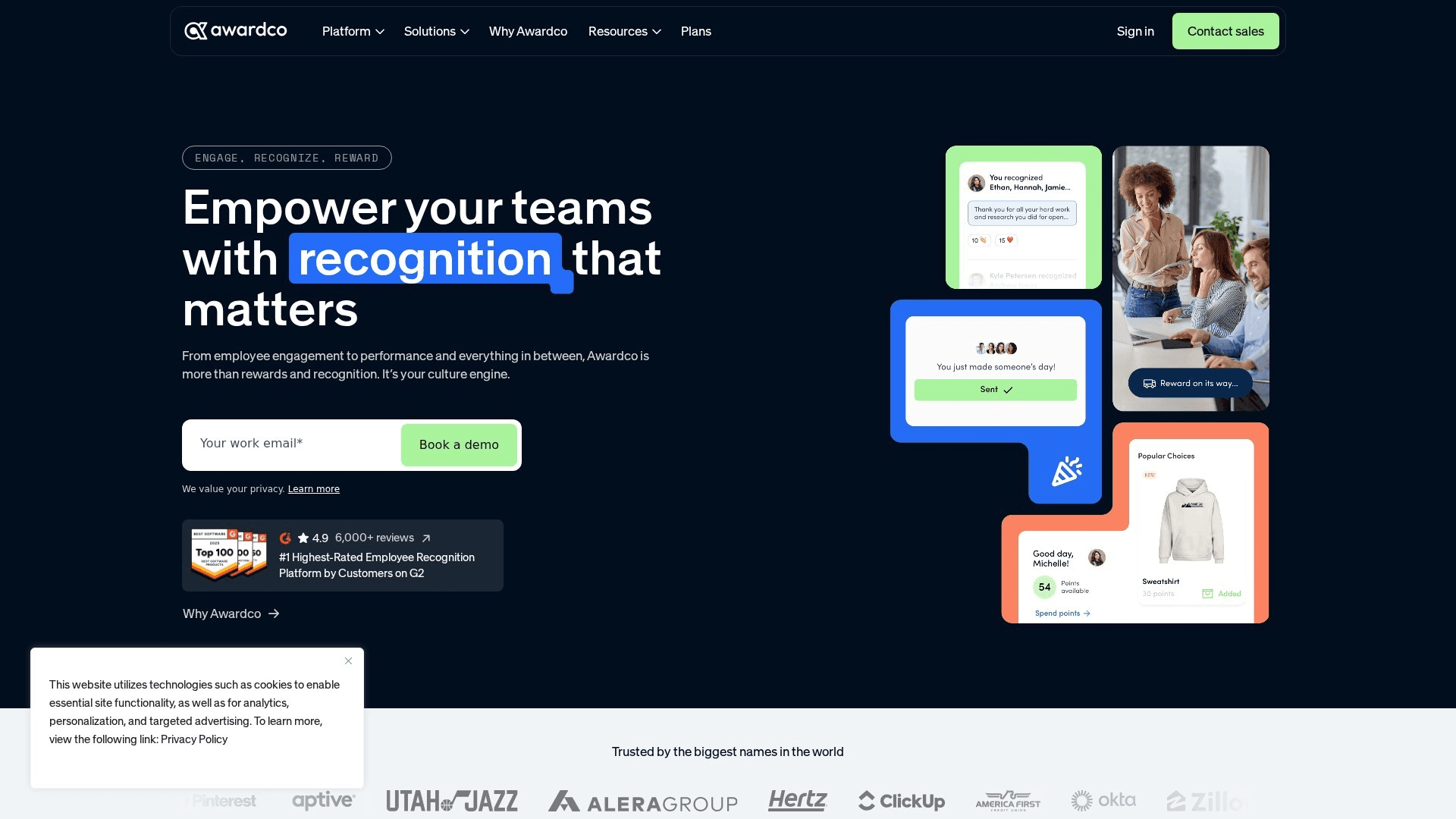
Awardco is the employee recognition platform for organizations that want a program, not just presents. Its architecture is points-based recognition — peer-to-peer shoutouts, manager awards, service milestones, wellness and safety incentives — redeemable against the largest reward network in the category: Amazon's catalog via a direct partnership, plus hotels, event tickets, gift cards, swag, and charitable donations. The economic pitch is unusual and real: no markups on rewards, so a 5,000-point redemption buys what the points are worth rather than funding the vendor's margin. HRIS integrations automate service awards and onboarding recognition, dashboards give leadership participation and budget visibility, and built-in tax handling keeps taxable rewards W-2-clean. Pricing is per-employee, custom-quoted on headcount. It's a recognition system first — for one-off client gifts or ad-hoc gifting moments, lighter tools are a better fit.
Key Features
- Amazon-Powered Rewards: Redemption against Amazon's full catalog plus hotels, tickets, gift cards, and donations
- No Reward Markups: Points buy face value — budget goes to employees, not vendor margin
- Recognition Programs: Peer-to-peer, manager-led, service milestones, and incentive campaigns in one system
- HRIS Automation: Anniversaries, onboarding, and milestones triggered from your HR system of record
- Tax & Compliance Handling: Taxable-reward reporting built in, keeping recognition W-2-compliant
Pricing
| Plan | Price | Notes |
|---|---|---|
| Platform | Per employee, custom quote | Annual contract scaled to headcount |
| Reward spend | Face value, no markup | Points funded as redeemed or upfront |
| Enterprise | Custom quote | Global programs, advanced integrations |
Pros
- Largest reward selection in the category via Amazon
- No-markup economics stretch recognition budgets meaningfully
- Automates milestones so programs run without admin toil
- Tax handling built for real compensation compliance
Cons
- Custom per-employee pricing — not a casual purchase
- Built for programs, not one-off client gifting
- Recognition culture requires internal championing to stick
Verdict: Awardco is the recognition-program pick. If you're funding employee rewards every month, its no-markup Amazon-backed model delivers more value per dollar than any rival.
Visit AwardcoLoop & Tie
Best for: Teams that want gifting to feel considered — artisan collections recipients choose from, with a sustainability story built in
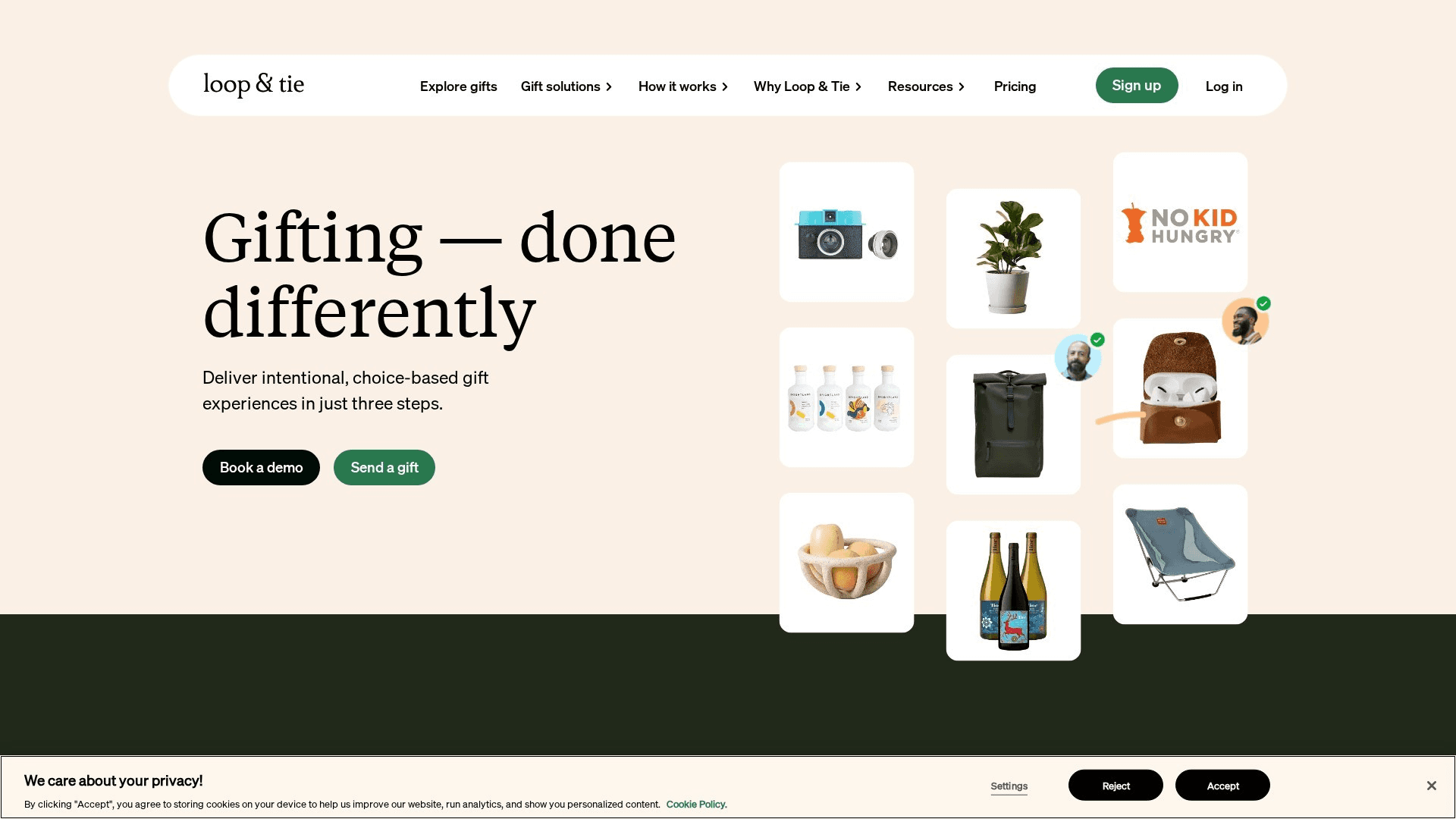
Loop & Tie pioneered choice-based gifting and still does it with the most taste. The model: you pick a price tier, the recipient receives a link to a curated collection — artisan goods, small-batch food, sustainable home items, experiences — and chooses what they want. No addresses needed upfront, no branded-mug landfill, and a carbon-offset, small-maker supply chain that gives the gift an actual story, which matters when the gift is supposed to say something about your company. Collections span roughly $10 to $1,000+ per gift, covering everything from webinar thank-yous to executive closing gifts. Integrations (Salesforce, HubSpot, API) and team management support real programs, and there's no required platform subscription for straightforward sending — you pay per gift. The catalog is deliberately curated rather than exhaustive, and swag or deep ABM orchestration aren't the point.
Key Features
- Choice-Based Collections: Recipients pick from curated tiers — the original choose-your-gift model
- Artisan & Sustainable Catalog: Small makers, sustainable goods, and carbon-offset shipping with a story to tell
- Tiered Pricing $10-$1,000+: Collections priced flat per tier, from event thank-yous to executive gifts
- No-Address Sending: Send by email; recipients provide their own shipping details
- CRM & API Integration: Salesforce, HubSpot, and API access for programmatic sending
Pricing
| Plan | Price | Notes |
|---|---|---|
| Pay per gift | $0 platform fee | Collections from ~$10 to $1,000+ per gift |
| Business plans | Custom quote | Team management, integrations, volume terms |
Pros
- Most distinctive, tasteful catalog in the category
- Recipient choice with no addresses or sizing guesswork
- Sustainability story strengthens the gesture
- Flat per-gift tiers make budgeting trivial
Cons
- Curated catalog is deliberately narrower than marketplaces
- Light on direct mail, swag, and ABM orchestration
- International reach trails the global-warehouse platforms
Verdict: Loop & Tie is the pick when the gift itself is the message. For relationship moments where taste beats logistics — closing gifts, executive thank-yous — it's unmatched.
Visit Loop & Tie&Open
Best for: Consumer and B2B brands running always-on customer gifting programs — loyalty, milestones, win-back — at thousands of sends per month
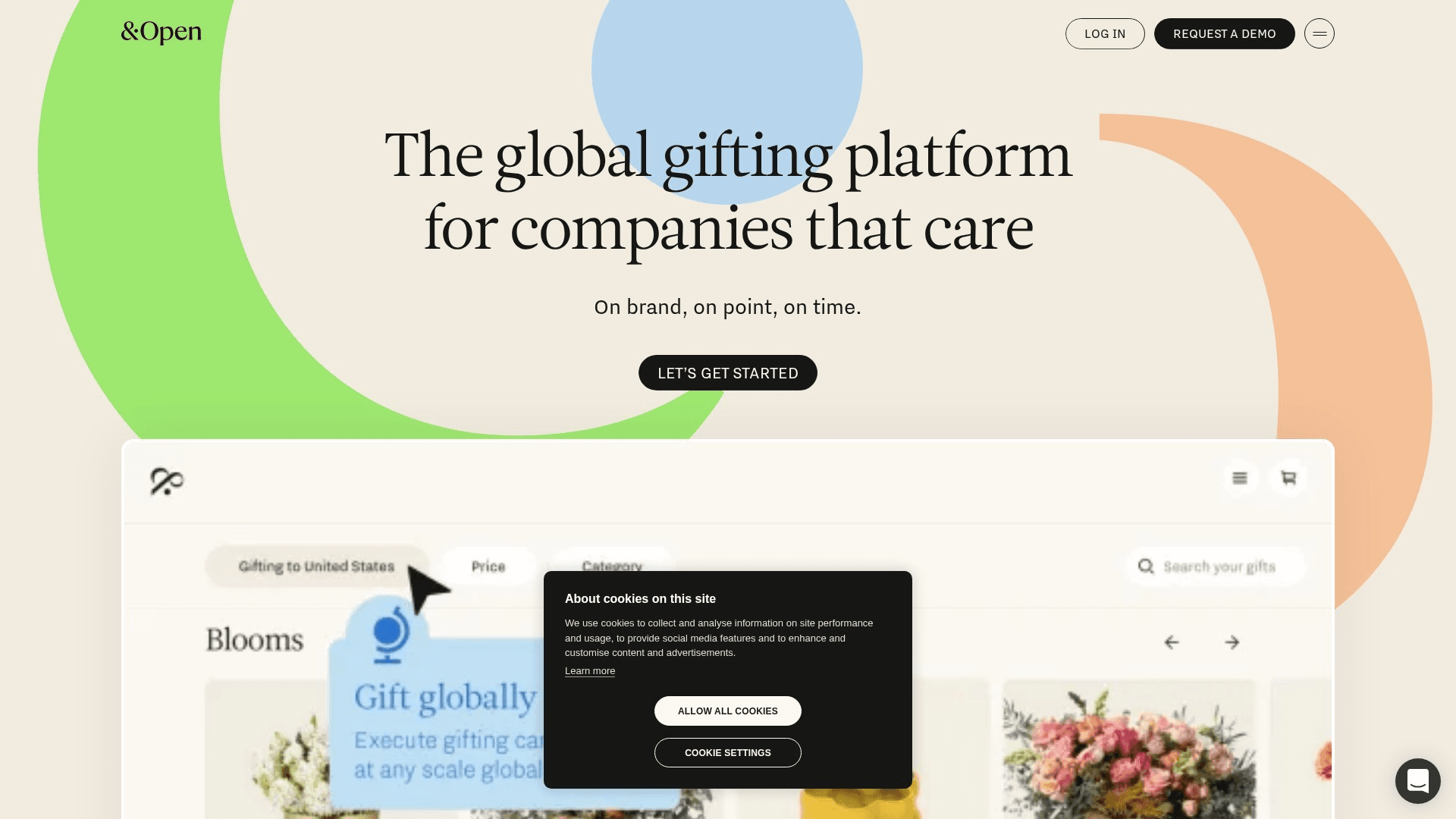
&Open (and-open) is the gifting platform big brands use when gifting becomes a standing program rather than a campaign. Built originally on work for companies like Airbnb, its platform handles high-volume, brand-led gifting: care packages for hosts and customers, loyalty and milestone gifts, apology and win-back sends — designed, warehoused, and fulfilled globally with the brand experience treated as seriously as the logistics. The product supports both physical and digital gifts, an API for triggering sends from your own systems (a churn signal, a milestone event, a support escalation), and dashboards for tracking delivery and engagement. Its global fulfillment network and design-forward packaging are genuine differentiators at scale. This is an enterprise product with custom-quoted pricing — small teams sending a dozen gifts a month should look at Goody or Loop & Tie instead.
Key Features
- Always-On Gifting Programs: Loyalty, milestone, apology, and win-back gifting run as standing programs
- API-Triggered Sends: Gifts fired from product events, support systems, or lifecycle campaigns
- Global Fulfillment: International warehousing and delivery with duties and customs handled
- Brand-Led Design: Custom packaging and gift design treated as brand experience, not an afterthought
- Engagement Tracking: Delivery, redemption, and recipient engagement reporting per program
Pricing
| Plan | Price | Notes |
|---|---|---|
| Platform | Custom quote | Annual contract for program volume |
| Gift spend | Pay per gift | Design, goods, and fulfillment costs on top |
Pros
- Built for genuine scale — thousands of sends per month
- Design and packaging quality flagship brands accept
- API triggering turns gifting into product infrastructure
- Strong international fulfillment
Cons
- Enterprise pricing excludes small teams
- Less self-serve than the rest of this list
- Overbuilt for occasional or rep-led gifting
Verdict: &Open is the customer-gifting-at-scale pick. When gifting is a permanent part of the customer experience with real volume behind it, this is the platform designed for that job.
Visit &OpenGuusto
Best for: Budget-conscious HR teams and frontline workforces that want recognition without markups, waste, or a big contract
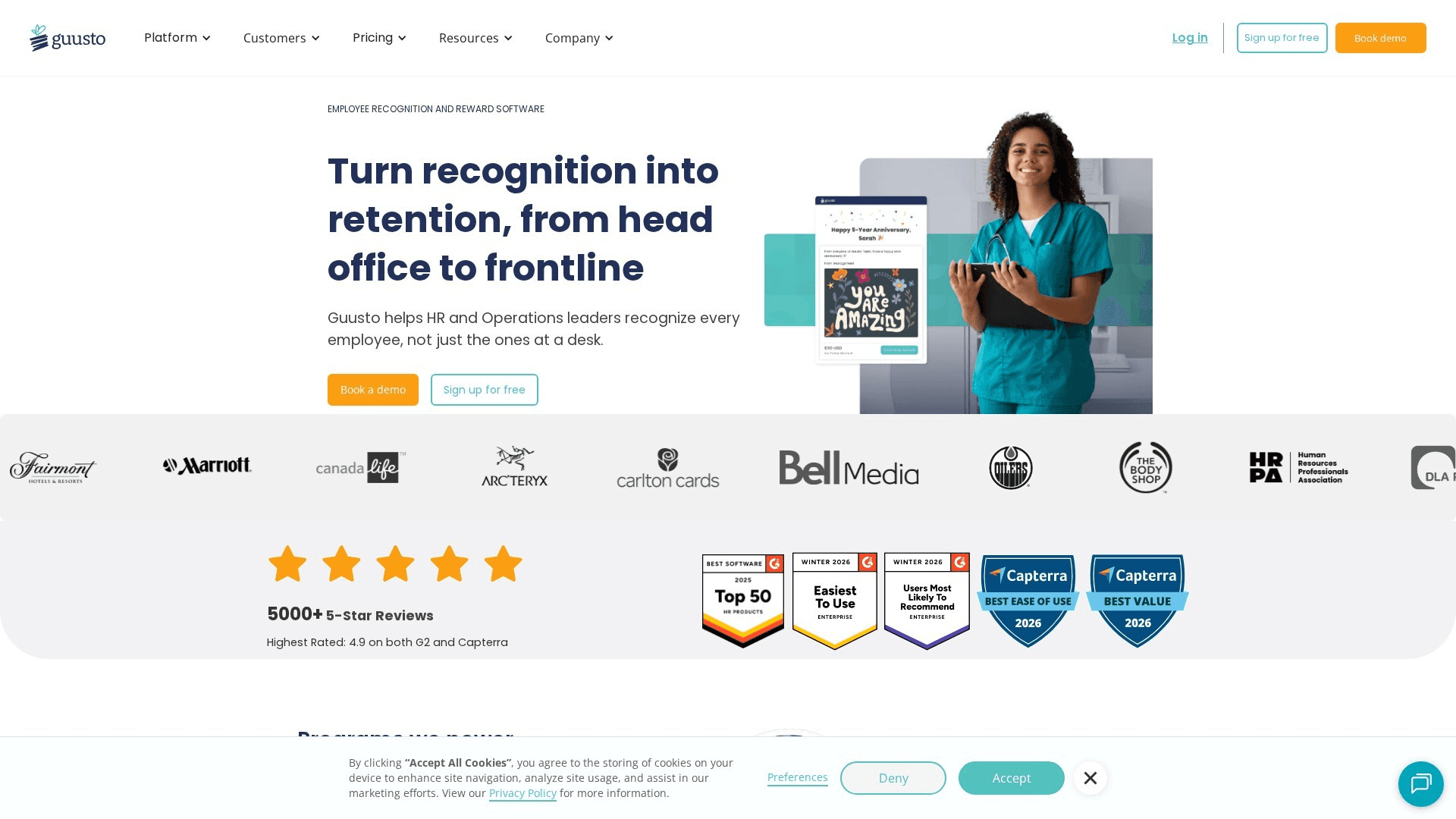
Guusto is the value pick in employee gifting, and its economics are the argument. The platform sends gift-card-based recognition redeemable at a large merchant network, with two unusual guarantees: no markups on rewards, and full credit back for anything unclaimed — so none of the budget evaporates into breakage, the quiet profit center of much of this industry. It's also built for workforces the category usually ignores: recipients don't need a corporate email (SMS and print-out delivery work), which makes it a favorite for retail, hospitality, healthcare, and manufacturing teams. A genuinely free single-user plan handles occasional gifting; paid tiers add recognition programs, milestone automation, budgets, and reporting at prices that undercut the enterprise recognition suites. The catalog is gift-card-centric rather than curated physical goods — teams wanting unboxing moments should look at Snappy.
Key Features
- No Markups, No Breakage: Rewards at face value and unclaimed gifts credited back — budget goes to people
- Frontline-Friendly Delivery: SMS, email, or printable delivery — no corporate email required
- Recognition Programs: Peer nominations, milestone automation, and manager budgets on paid tiers
- Large Merchant Network: Recipients redeem at major retailers, restaurants, and experiences
- Free Single-User Plan: Genuinely free tier for occasional sends — pay only gift value
Pricing
| Plan | Price | Notes |
|---|---|---|
| Free | $0 (1 user) | $0 + gift value |
| Lite | ~$40 | Single admin, core sending features |
| Essential / Premium | ~$120-$400 | Programs, budgets, integrations, reporting |
Pros
- Best budget economics in employee recognition
- Unclaimed-gift credits eliminate breakage losses
- Works for frontline teams without corporate email
- Free plan makes starting genuinely zero-risk
Cons
- Gift-card-centric — no curated physical unboxing moments
- Client/prospect gifting features are minimal
- Enterprise program depth trails Awardco
Verdict: Guusto is the budget employee-gifting pick. For teams that want every recognition dollar to reach an employee — especially frontline workforces — its no-markup, no-breakage model is the honest deal in the category.
Visit GuustoGiftogram
Best for: Teams that want the simplicity of gift cards — for customers, employees, or research incentives — without platform fees
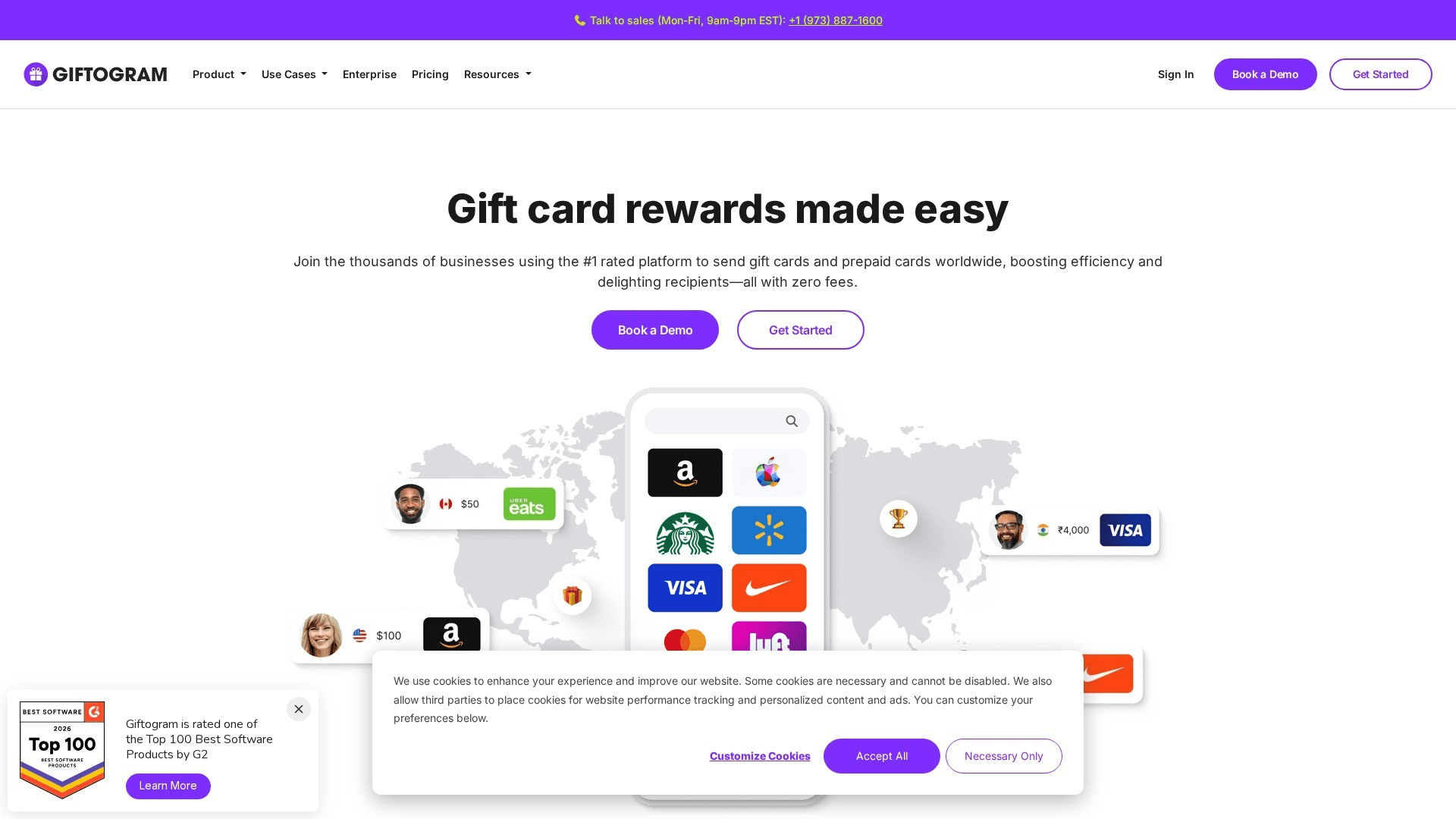
Giftogram does one thing with clean execution: branded gift cards, physical or digital, sent individually or in bulk, redeemable across hundreds of major retailers. The pitch is simplicity and economics — there's no platform subscription; you pay the face value of the cards you send, with volume programs improving the terms. Cards carry your company branding and a personal message, recipients choose where to redeem, and bulk tools handle holiday sends, survey incentives, rebate programs, and employee thank-yous at spreadsheet scale. An API supports programmatic sending for research panels and promotions. What Giftogram doesn't try to be matters equally: there's no curated physical catalog, no ABM orchestration, no recognition-program layer. For the large share of corporate gifting that is honestly just 'send $50 of thanks, reliably, at scale,' it's the cleanest tool for the job.
Key Features
- Branded Gift Cards: Physical and digital cards with your logo and message, redeemable at hundreds of retailers
- No Platform Fees: Pay face value of cards sent — no subscription to justify
- Bulk Sending: Spreadsheet-scale sends for holidays, incentives, rebates, and appreciation
- API Access: Programmatic sending for research incentives and promotions
- Recipient Choice: One card, hundreds of redemption options — no wrong gifts
Pricing
| Plan | Price | Notes |
|---|---|---|
| Standard | $0 platform fee | Pay face value of cards sent |
| Volume programs | Custom terms | Improved terms and support at scale |
Pros
- Zero platform cost — pay only for what you send
- Bulk and API sending handle real scale
- Recipient choice without catalog curation overhead
- Works equally for customers, employees, and research incentives
Cons
- Gift cards lack the impact of a curated physical gift
- No recognition programs or ABM features
- Primarily US/Canada focused — thin international story
Verdict: Giftogram is the gift-card pick. When the job is reliable, branded, at-scale appreciation without a platform contract, it's the simplest honest answer on this list.
Visit GiftogramPFL
Best for: Enterprise marketing teams running high-volume programmatic direct mail — printed pieces and dimensional mailers triggered from the martech stack
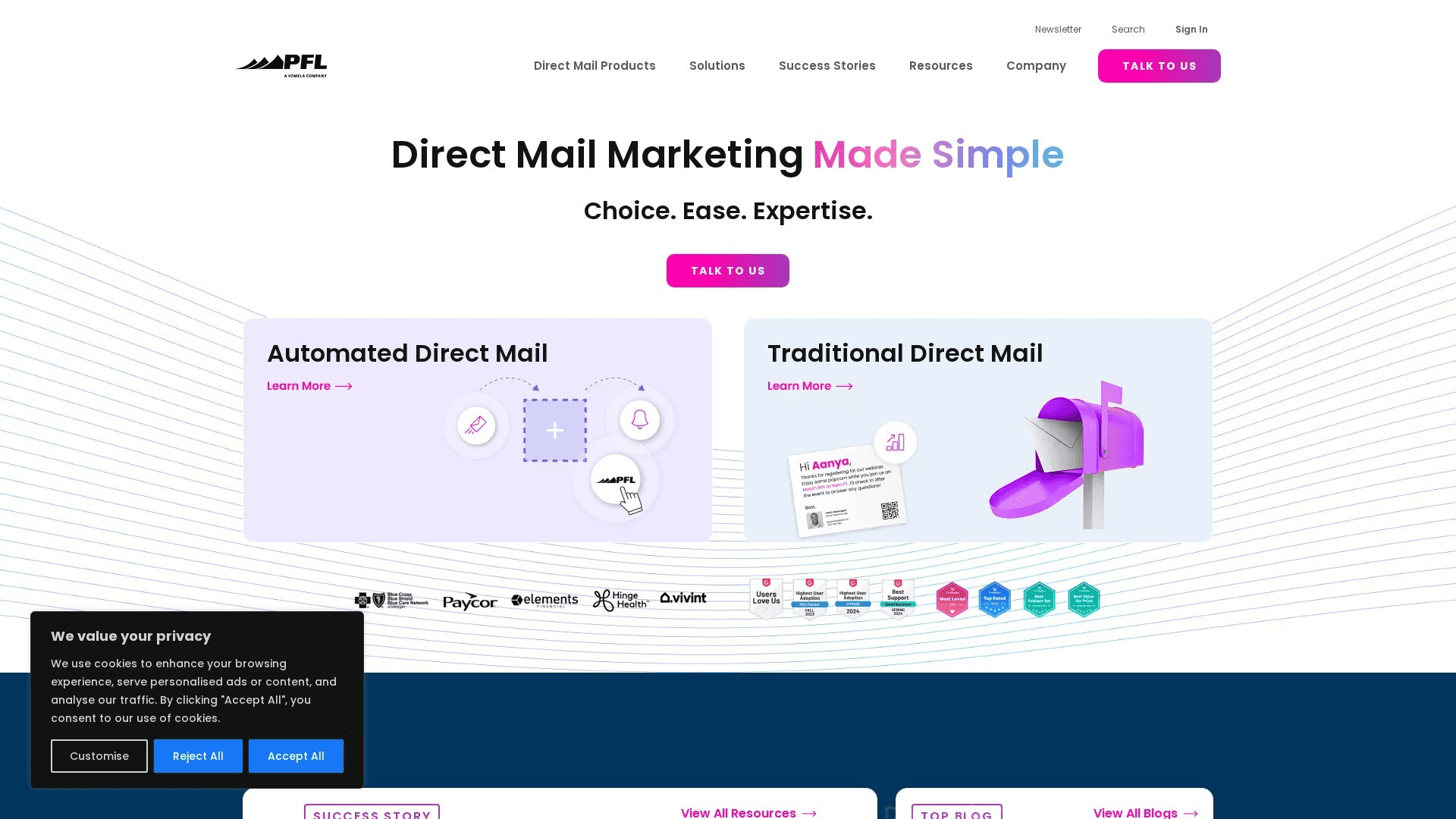
PFL is the veteran of tactile marketing — a direct mail company that became a marketing technology company, and the platform enterprises pick when direct mail volume gets serious. Its core is programmatic print: postcards, letters, branded kits, and dimensional mailers triggered from Salesforce Marketing Cloud, Marketo, HubSpot, and CDP audiences the way email sends are, with production, postage, and delivery tracking handled end to end. PFL owns its print and fulfillment operations, which shows in reliability at tens or hundreds of thousands of pieces, and its delivery-confirmation data can trigger follow-up digital touches — mail lands, sales call follows. Reporting ties mail to pipeline in the same dashboards as digital. It's custom-quoted, contract-based, and genuinely enterprise: teams sending occasional gifts don't need it, but demand-gen programs measuring direct mail in campaign volume do.
Key Features
- Programmatic Print & Mail: Postcards, letters, kits, and dimensional mailers triggered from martech workflows
- Owned Production: In-house print and fulfillment for reliability at enterprise volume
- Delivery-Triggered Follow-Up: Mail delivery events trigger sales tasks and digital touches
- Martech Integration: Salesforce Marketing Cloud, Marketo, HubSpot, and CDP audience syncing
- Pipeline Reporting: Direct mail attribution alongside digital channels
Pricing
| Plan | Price | Notes |
|---|---|---|
| Platform | Custom quote | Annual enterprise contract |
| Production | Per piece | Print, postage, and fulfillment per send |
Pros
- Enterprise-grade reliability at high mail volume
- Owned production removes third-party print risk
- Delivery events orchestrate multichannel follow-up
- Long track record with enterprise martech stacks
Cons
- Enterprise-only pricing and sales process
- Not a gifting catalog — print and kits are the product
- Overkill below tens of thousands of pieces per year
Verdict: PFL is the enterprise direct mail pick. When printed mail is a measured, high-volume channel in your demand-gen mix, PFL's owned production and martech depth are what the job requires.
Visit PFLHow to Choose the Right Gifting Platform
The decision framework, by the question that actually decides it:
If you need client gifting software for a sales team
Start with Goody — no addresses, no contract, pay only for accepted gifts — and let reps prove the motion works. Graduate to Reachdesk when you're running coordinated ABM plays with approval workflows, international accounts, and pipeline attribution requirements. Pair gifting with the account and contact data that makes targeting work — see our guide to the best sales intelligence tools for that layer of the stack.
If direct mail marketing is the channel
Postal for most B2B teams — triggered sends, marketplace variety, swag management, and attribution in one platform. PFL when volume gets genuinely enterprise (tens of thousands of printed pieces triggered from Marketo or Salesforce Marketing Cloud). Reachdesk when the mail crosses borders. In all three cases, insist on delivery-event data flowing back to your CRM — a mailer that can't trigger a follow-up call is a brochure, not a channel.
If you're building an employee gifting program
Separate the two jobs. For gift moments — onboarding, anniversaries, holidays — Snappy's recipient-choice collections are the strongest experience. For always-on recognition with points and peer-to-peer awards, Awardco's markup-free Amazon-backed rewards deliver the most value per budget dollar. For smaller teams and frontline workforces, Guusto's free tier and no-breakage economics are the honest budget answer.
If budget rules the decision
Run the whole program on pay-per-gift tools: Goody for client gifts, Guusto or Giftogram for employee appreciation, Loop & Tie when a specific relationship deserves something considered. You'll give up automation and attribution, not gift quality. And watch where the margin hides in this industry: reward markups and unclaimed-gift breakage quietly consume 10-30% of naive programs — the no-markup, credit-back vendors exist precisely because of it.
If you need to prove ROI to keep the budget
Choose a platform that logs sends to your CRM automatically (Reachdesk, Postal, PFL), define the success metric before the campaign — meeting-booked rate, pipeline influenced, deal velocity — and always run a holdout. Gifting works best as one play inside a broader outbound motion; our roundup of the best AI sales tools covers the sequencing and signal layers a gifting play should plug into.
Pro Tip
Check the compliance box before the first send, not after: set per-team spend caps inside the platform, confirm your regulated-industry prospects can accept gifts at all, and remember the IRS caps client gift deductions at $25 per recipient per year while employee gifts are generally taxable compensation. The platforms with approval workflows and tax reporting exist because someone learned this the hard way.
Frequently Asked Questions
Final Thoughts
The best corporate gifting platform of 2026 is the one built for your recipients and your workflow. Reachdesk is our best-overall pick because global, CRM-integrated, measurable gifting is what serious revenue programs actually need — but a demand-gen team running direct mail should pick Postal, a rep who wants to send a great gift today should open Goody, and an HR team building recognition should choose between Snappy, Awardco, and Guusto — and each would be right.
Whatever you pick: pilot on a free tier before signing an annual contract, model total cost as platform plus gifts plus shipping, test your top international destinations with real sends, and measure redemption — because in this category, the gift that gets claimed is the only one that ever worked.
Related Articles
About the Author

Co-Founder & SEO Execution
Co-founder of PikaSEO. 11 years in corporate tech, then bootstrapped entrepreneur. Leads SEO execution and content-led growth for SaaS companies.