iPhone Duo vs. Duolingo: What the Name Collision Means for SEO
Apple named its first foldable phone iPhone Duo. Duolingo immediately panicked about “my SEO” in public. The joke works because the collision is real—but the biggest opportunity is probably earned attention, not a rankings disaster.
Key takeaways
- Apple launched iPhone Duo on September 9, creating a direct name overlap with Duo, Duolingo's mascot.
- The overlap can reshape ambiguous searches such as Duo and Duo app, but it does not create a Google penalty or automatically damage explicit Duolingo queries.
- Duolingo converted a potential search headache into earned media by reacting quickly, in character, and with a joke only its brand could credibly make.
- The correct measurement separates query groups and tracks SERP composition, branded demand, coverage, links, and qualified visits—not likes alone.
What happened: Apple launched iPhone Duo
On September 9, 2026, Apple introduced iPhone Duo, its first foldable iPhone. Apple says the device opens to a 7.6-inch inner display, closes around a 5.4-inch outer display, starts at $1,999 in the US, and will open for pre-orders on October 16 before going on sale October 23.
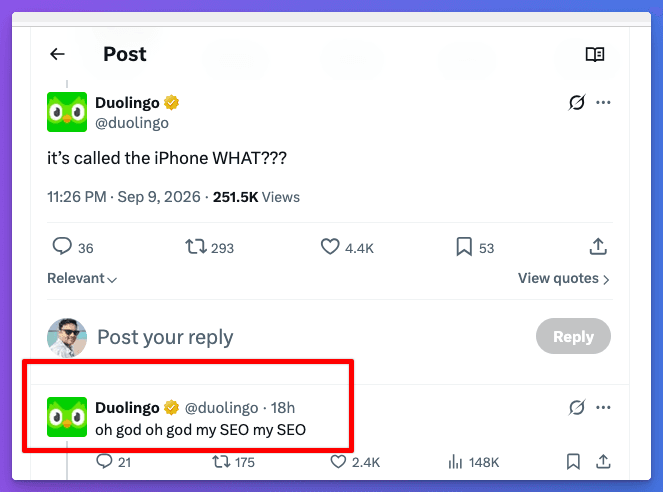
Within hours, Duolingo responded on X: “it's called the iPhone WHAT???” It followed with the line highlighted in the screenshot above: “oh god oh god my SEO my SEO.” The account kept the bit going, and launch coverage documented the reaction alongside a more product-friendly punchline about having extra screen space to complete a lesson.
This was not a random brand jumping under a popular hashtag. Duo is the name of Duolingo's green owl mascot. Duolingo's own brand guidance describes him as expressive, persistent, emotional, and “extra.” Contemporary coverage of the thread shows the account escalating exactly that character. Apple supplied the trigger; Duolingo supplied a response that was native to its established brand story.
Why the screenshot matters
The joke compresses a fairly technical problem—query ambiguity, entity disambiguation, and shifting intent—into six words anyone can understand. That makes the post both funny to consumers and legible to marketers, which is why it traveled beyond Duolingo's own audience.
What “my SEO” actually means
Search engines do not reserve a word for the first brand that makes it famous. They try to satisfy the intent behind each query. Before Apple's announcement, “Duo” was already a difficult one-word query: it is an ordinary word for a pair, the name of Cisco's authentication product, a former Google calling brand, and Duolingo's mascot. Apple has now added a high-demand consumer device to that entity set.
The immediate SEO effect, if one appears, will be a redistribution of search intent. News stories, Apple pages, retailer listings, reviews, videos, and product panels can enter results that contain “Duo.” Searchers themselves also teach the market which modifiers matter: price, case, pre-order, foldable, owl, lesson, app, login, and language.
That is different from a ranking penalty. Google does not need to decide that Duolingo became less trustworthy. It may simply decide that a larger share of people typing a short query now want Apple's device. The old result can hold the same quality signals and still receive fewer impressions or clicks because the query's dominant intent changed around it.
Duolingo's “my SEO” is therefore directionally correct and deliberately overstated. The full brand “Duolingo” remains distinctive. “Duo” is the vulnerable asset—and even that vulnerability is limited to searches where the owl is not made explicit.
The collision happens at the query level
Treating every mention of Duo as one keyword would produce a misleading case study. The useful unit is the query cluster: what words surround Duo, which entity the searcher means, and what result format satisfies that need.
| Query group | Examples | Likely effect | Why |
|---|---|---|---|
| Protected brand | duolingo, duolingo app, duolingo login | Low | The full company name makes the intended entity obvious. |
| Mascot-qualified | Duo owl, Duolingo Duo, green owl app | Low to moderate | The qualifier preserves Duolingo intent, though news may enter the SERP. |
| Ambiguous shorthand | Duo, Duo app, Duo on iPhone | High volatility | Apple joins a query already shared with a dictionary meaning and Cisco Duo. |
| Apple-qualified | iPhone Duo, Apple Duo, Duo price | Not Duolingo traffic | The launch creates clear device-shopping intent that Duolingo should not chase. |
| Collision curiosity | iPhone Duo Duolingo, Duo SEO tweet | Short-term upside | Duolingo can own analysis and earned coverage around the overlap itself. |
This is an analytical forecast, not measured Duolingo performance data. Google's guidance for site names explains that Search uses homepage content and references across the web to identify a source, and recommends unique, consistent naming. That protects “Duolingo” as the site identity; it cannot make the generic word “Duo” exclusive.
How the iPhone Duo launch could impact Duolingo's SEO
1. More volatile “Duo” SERPs
Apple coverage will dominate queries with device intent and may spill into short ambiguous queries while the launch remains newsworthy.
Duolingo can lose share of voice on those results without losing any position for “Duolingo.” Query mix, not domain health, is the first suspect.
2. Autocomplete learns new modifiers
As people search for iPhone Duo price, release date, cases, reviews, and pre-orders, Apple-oriented completions can crowd out older interpretations.
This matters because autocomplete changes how a vague intention becomes a specific query before the results page even loads.
3. Earned-media upside
The reaction has already become a story. Each relevant article can create a link, a referral path, or a co-mention of Apple, iPhone Duo, Duolingo, and Duo.
Not every mention will link and not every link will change rankings, but the attention creates assets a silent defensive response would never produce.
4. Clearer entity association
Coverage repeatedly explaining that Duo is Duolingo's mascot supplies disambiguating context around the owl entity.
Google says Organization markup can help disambiguate an organization, but the wider web also matters. Consistent descriptions, official profiles, and coverage reinforce the same relationship.
5. New branded demand—if curiosity crosses channels
People who see the exchange may search for the Duolingo tweet, Duo the owl, or Duolingo itself. That is the most valuable upside: Apple's launch can create incremental demand for the smaller brand.
But social views are not equivalent to Google searches. The path must be observed through query data, Trends, referral traffic, coverage, and app acquisition rather than assumed from a viral counter.
What probably will not happen
Duolingo is unlikely to lose its navigational demand because Apple launched a product with a related name. Someone typing “Duolingo login,” “Duolingo Spanish,” or “Duolingo app” has declared an intent that an Apple product page cannot satisfy. Search systems have abundant brand, link, usage, content, and entity context to distinguish the company from the device.
Nor does the overlap justify a technical panic. Changing the company name, rewriting every title tag to repeat Duo, or publishing thin iPhone pages would trade a hypothetical risk for real inconsistency. Google's site-name guidance recommends a unique, commonly recognized, consistent name. Duolingo already has one: Duolingo.
Do not confuse three channels
Google web search, Apple App Store search, and paid search auctions are separate systems. The iPhone name may affect each differently. An App Store autocomplete change is ASO; a higher ad bid is SEM; a changed organic results page is SEO. Report them separately.
Why this is unusually good trend jacking
Most trend-jacking posts fail because any brand could have written them. This one has what we can call semantic permission: Duolingo is genuinely part of the story. Apple used the mascot's name, and “SEO” is the exact discipline that studies what happens when two meanings compete for a query.
The response was also fast, compact, and continuous with Duo's voice. Duolingo did not pause to publish a polished corporate statement. It dramatized the social-media manager discovering the name in real time. The subsequent posts extended the same premise instead of changing tone when the first message performed.
That operating style is not accidental. Duolingo tells investors that creative marketing and strong brand identity support organic growth, and that most of its growth over the past decade has come through word of mouth. In a public filing, the company described using entertaining rather than promotional social content to participate in viral trends. The iPhone Duo thread is that strategy in miniature: find the overlap, enter as the character, let the audience and press carry it.
Relevance
The name collision makes Duolingo a participant, not an intruder.
Distinctiveness
The anxious SEO joke sounds like Duo's account, not a generic brand voice.
Extensibility
The premise supports replies, memes, product jokes, press headlines, and an evergreen case study.
How Duolingo—or any brand—should measure the impact
The honest case study starts now and finishes after the launch cycle. Google's Search Console documentation says the query dimension can surface expected and unexpected queries, while regular-expression filters can group variations. It also warns that anonymized queries and data truncation make filtered totals incomplete. Use the data directionally and keep the groups mutually intelligible.
Freeze a baseline
Save the 7- and 28-day pre-launch clicks, impressions, CTR, and average position. Do not wait until the news cycle fades and then guess what normal looked like.
Separate query intent
Build four filters: full-brand, mascot-qualified, ambiguous Duo, and Apple-qualified terms. A blended branded-traffic line will hide the exact collision you are trying to detect.
Capture the SERP
Record mobile and desktop results in priority countries for Duo, Duo app, Duo owl, and iPhone Duo. Note result types, autocomplete, news modules, knowledge panels, and which entity wins above the fold.
Track the second-order gains
Monitor new referring domains, editorial mentions, referral traffic, Discover or News visibility, and searches for Duolingo plus iPhone Duo. Those are more credible SEO outcomes than social impressions alone.
Recheck after the launch spike
Compare the first 72 hours, first seven days, and the period around October 16 pre-orders and October 23 availability. Temporary news intent and durable product intent are different phenomena.
Suggested Search Console query groups
Full brand: ^(duolingo|duo lingo)( .*)?$
Mascot: ^(duo owl|duolingo duo|green duolingo owl)( .*)?$
Ambiguous: ^(duo|duo app|duo on iphone)$
Collision: ^(iphone duo duolingo|duolingo iphone duo|duo seo tweet)( .*)?$
In Google Trends, compare both exact search terms and available topics. Google's Trends documentation explains why: a term measures literal wording, while a topic groups searches around a real-world concept. With an ambiguous word like Duo, confusing the two can manufacture a conclusion.
A practical name-collision playbook for brands
Few brands will wake up to find Apple using the name of their mascot. Many will face a smaller version: a new product, creator, show, feature, or AI tool begins attracting demand around a term they use. The response should combine brand defense with selective participation.
Defend the entity
- Use the full brand name consistently in site names, titles, official profiles, and About copy.
- Keep Organization markup current with the canonical name, URL, logo, and relevant
sameAsprofiles. - Create a stable first-party page that explains the named product, character, or feature in unambiguous language.
- Monitor which page Google shows for each clarified query before changing templates site-wide.
Earn the moment
- Respond only when the overlap is real enough that the audience understands why your brand belongs.
- Use a recognizable character or point of view; speed without distinctiveness creates forgettable engagement.
- Give journalists and creators a clean premise they can explain in one sentence.
- Extend the moment with one useful owned asset, then stop before the joke becomes a content farm.
Google says Organization structured data can help disambiguate an organization and recommends relevant identity properties such as its name, URL, logo, and online profiles. Markup is support, not ownership. It helps a search engine understand who you are; it does not grant your brand every query containing a shared word.
The PikaSEO verdict
Apple probably did not damage Duolingo's core SEO. It changed the economics of one ambiguous word. Duolingo's response is smart because it does two jobs at once: it teaches the audience that Duo belongs to Duolingo while borrowing the reach of the year's biggest phone launch.
The winning move is not to defend every impression for “Duo.” It is to strengthen the searches that identify the owl, capture the collision story while it is relevant, and convert borrowed attention into remembered brand demand.
Sources and evidence standard
This article distinguishes confirmed facts from analysis. The product name, announcement date, specifications, price, pre-order date, and availability date come from Apple. The post wording and point-in-time engagement come from the supplied screenshot, with independent coverage used to verify the broader exchange. SEO effects are forecasts until first-party query and traffic data exist.
- Apple Newsroom: iPhone Duo announcement
- Yahoo Finance: Duolingo's launch-day reaction
- Gadgets Now: the wider Duolingo thread
- Duolingo Investor Relations: brand recognition and organic growth
- Duolingo filing: entertaining content and viral trends
- Google Search Central: site-name guidance
- Google Search Central: Organization structured data
- Google Search Console: query data and limitations
- Google Search Console: regex filtering and comparisons
Frequently asked questions
The one-line lesson
A bigger brand can take over a word. A faster, more distinctive brand can still take over the story.
About the Author

Co-Founder & SEO Execution
Co-founder of PikaSEO. 11 years in corporate tech, then bootstrapped entrepreneur. Leads SEO execution and content-led growth for SaaS companies.