Tool review
Promptwatch Review 2026: Features, Pricing, Accuracy, and Limits
Promptwatch goes beyond prompt tracking. It brings together live answer samples, citations, crawler requests, visitor outcomes, and content workflows. After a week using it, here is where that breadth pays off, what each plan includes, and what the data cannot prove.
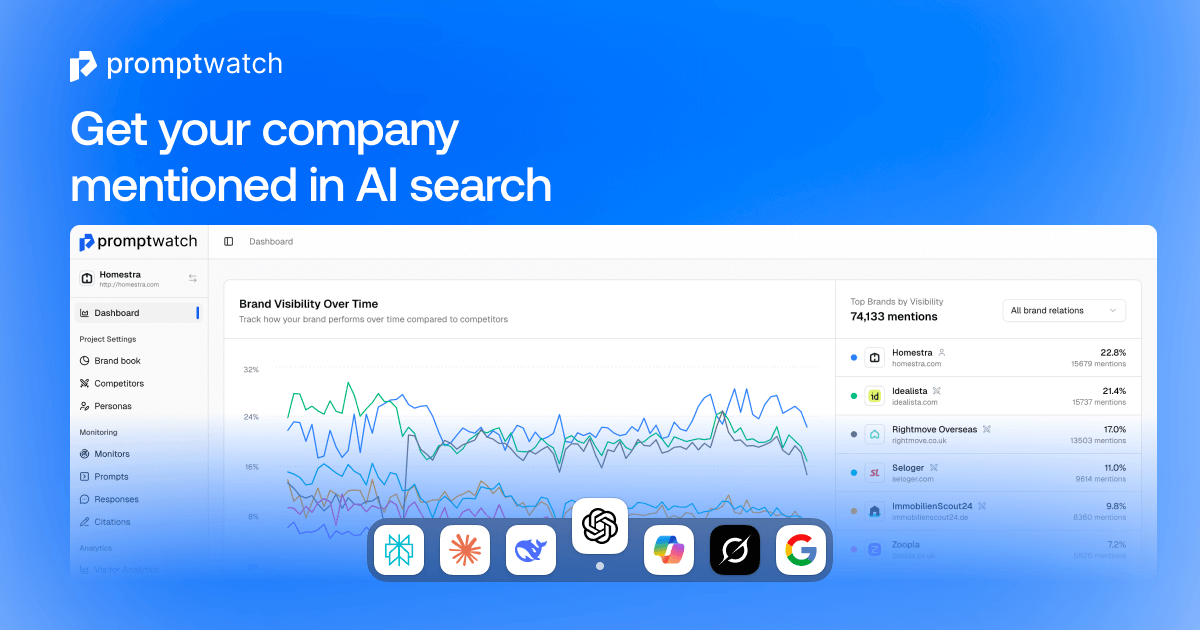
Promotional platform image; interface details may differ by plan.
At a glance
- Best for
- SEO, GEO, and agency teams tying AI citations to site activity
- Starting price
- $95/month for Essential; steep for casual users
- Standout capability
- Answer, crawler, citation, visitor, and content data in one workflow
- Main trade-off
- Four tracked models per project; advanced features and pricing favor committed teams
Our verdict: a strong fit for teams that need to act on AI visibility
Promptwatch is one of the more complete platforms to consider when a mention count is not enough. The useful idea is the chain it lets a team investigate: Which answer appeared? Which page was cited? Did an AI bot reach that page? Did a human visit and convert afterward? That makes it especially compelling for a brand with an established content program and someone responsible for turning GEO reporting into decisions.
Four signals, one investigation
The Promptwatch workflowWhat appeared for the prompt?
Which page supported it?
Could the bot reach the page?
Did a visitor act afterward?
Its breadth impressed us more than its simplicity. Pricing is steep if you only want basic ChatGPT mention alerts. Crawler-log analysis is a Professional or Business workflow, and a CDN connection may need IT approval. Content drafts also need editorial review. Those trade-offs are reasonable for a serious GEO program, but hard to justify for an indie hacker who is only casually exploring AI visibility.
Recommendation: shortlist Promptwatch if you will use at least two of its deeper workflows: citation and crawler analysis, AI-referred conversion measurement, competitive source research, or content gap execution. If your site still has unresolved indexing, crawlability, content quality, or conversion-tracking issues, address those SEO foundations first. You will get more value from AI visibility analysis when there is a healthy site and content program to improve.
Explore PromptwatchWhat a week with Promptwatch showed us
We used Promptwatch for a week before writing this review. The strongest part of the experience was having answer visibility, cited sources, competitor context, and next-step research in one place. That is more useful in a working SEO program than a standalone mention chart. We also checked current plan limits and integrations on October 4, 2026, because those can change independently of the product experience.
What is Promptwatch, and who is it for?
Promptwatch is an AI visibility and GEO platform. You define a brand, competitors, target prompts, and markets. It then collects answers from AI products, records whether and how your brand appears, and maps the cited sources. Unlike a narrow rank tracker, it also offers crawler-log analysis, visitor and conversion tracking, content research, and an agent that can draft articles.
The clearest fit is an in-house SEO or content lead asked to explain AI search performance beyond screenshots. Agencies can use multiple projects and reporting integrations, although one project on Essential and two on Professional may be restrictive across clients. Ecommerce teams should examine Business because Shopping Insights and Ads Radar sit there. Teams doing classic social listening or backlink alerts still need to compare dedicated tools; Promptwatch's center of gravity is AI answers and the sources behind them.
An established SEO or GEO team that will act on citation, crawler, visitor, and content evidence.
A casual indie project or a site still working through indexing, crawlability, core content, or conversion tracking.
AI answer visibility: coverage, location, and score
Promptwatch samples the consumer-facing AI interfaces, including ChatGPT, Gemini, Perplexity, and Google AI Overviews, rather than treating a model API as identical to the app a buyer uses. That is a meaningful design choice: an API answer can differ from a search-enabled, cited, or location-specific consumer answer. It still does not guarantee that every buyer will see the same response. AI answers can change with time, location, account state, personalization, and platform experiments.
Promptwatch supports 11 platforms, with four models tracked per project on its current brand plans. The broad platform roster is a menu rather than simultaneous tracking of all 11 within one project. Essential and Professional include country-level tracking; Business adds state and city detail. That matters for local, multi-market, or franchise brands where a single national sample would hide variation.
supported platforms
Choose the engines your buyers use
- ChatGPT
- Perplexity
- AI Overviews
- AI Mode
- Claude
- Gemini
- Llama
- DeepSeek
- Grok
- OpenCode
- Claude Code
Location detail: country on Essential and Professional; state and city on Business.
Beyond mention presence, Promptwatch reports citations, sentiment, competitors, and a 0–100 Visibility Score. The score weights answer position and context, reduces the result for competitor presence, and assigns zero when the brand is absent. This is more informative than a raw mention total, but it is still an index of the prompts and samples you chose. Track a stable prompt set over time and read the underlying answers before treating a few score points as a business outcome.
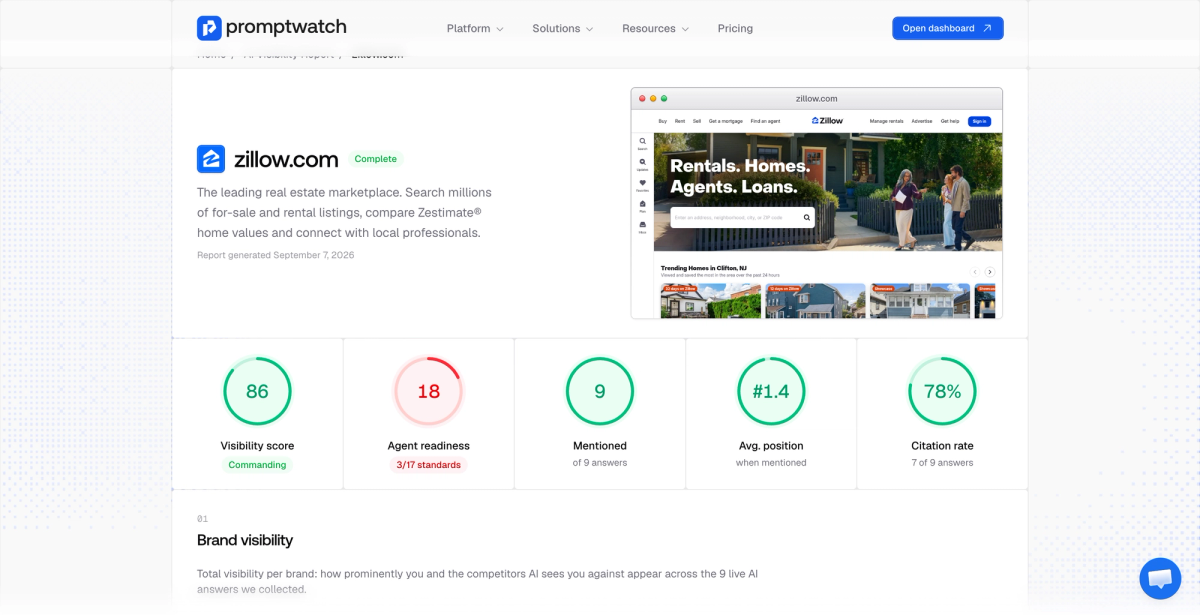
AI crawler logs joined to citation analysis
The feature that most clearly separates Promptwatch from a simple prompt tracker is its ability to show requests from bots such as GPTBot, ClaudeBot, and PerplexityBot alongside cited pages. A content team can identify a page bots request but answers rarely cite, or find important pages returning 403 or 404 to crawlers. That creates a practical technical SEO queue: access, status codes, page coverage, and source quality.
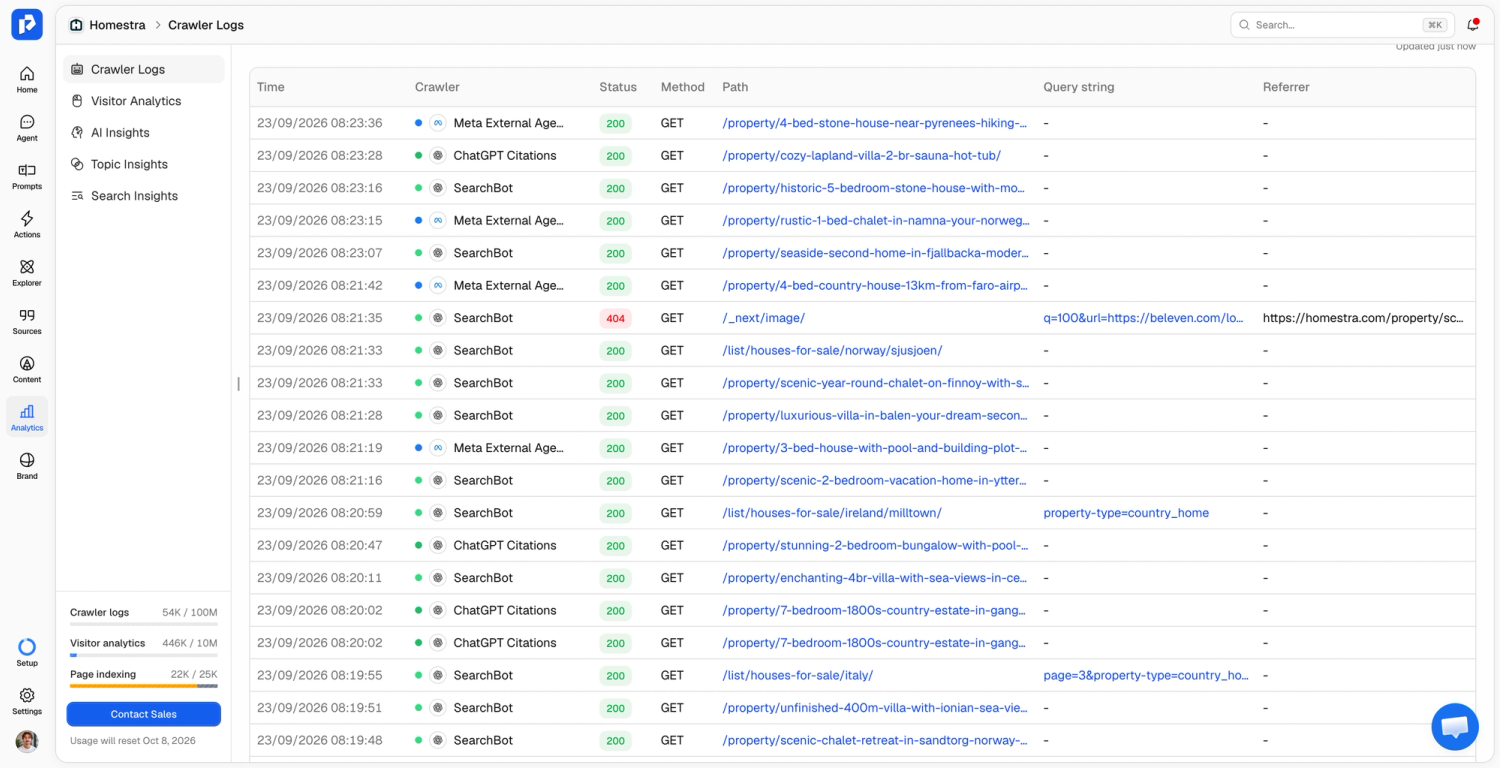
Promptwatch supports log connections for Cloudflare, AWS CloudFront, Fastly, Vercel, Netlify, Akamai, Google Cloud CDN, WordPress, and custom HTTP. It stores ten fields for known bot requests; human requests, page bodies, and cookies are dropped from that log pipeline. Some bots are verified against published IP ranges. Client IP and full query strings are among retained fields, so security teams should review the field list, especially if site URLs contain identifiers.
A bot visit and a later citation are useful evidence, but they do not prove the visit caused the citation. Models may already know the page, cite another source, or use several retrieval paths. Use the combined view to decide what to investigate, then judge any change against a baseline.
AI-referred visitors and conversions
Promptwatch separates crawler traffic from human AI-referred visits. That distinction prevents a bot surge from looking like customer demand. It also tracks conversions, giving marketers a way to ask whether growth in answer presence coincides with visits and completed actions.
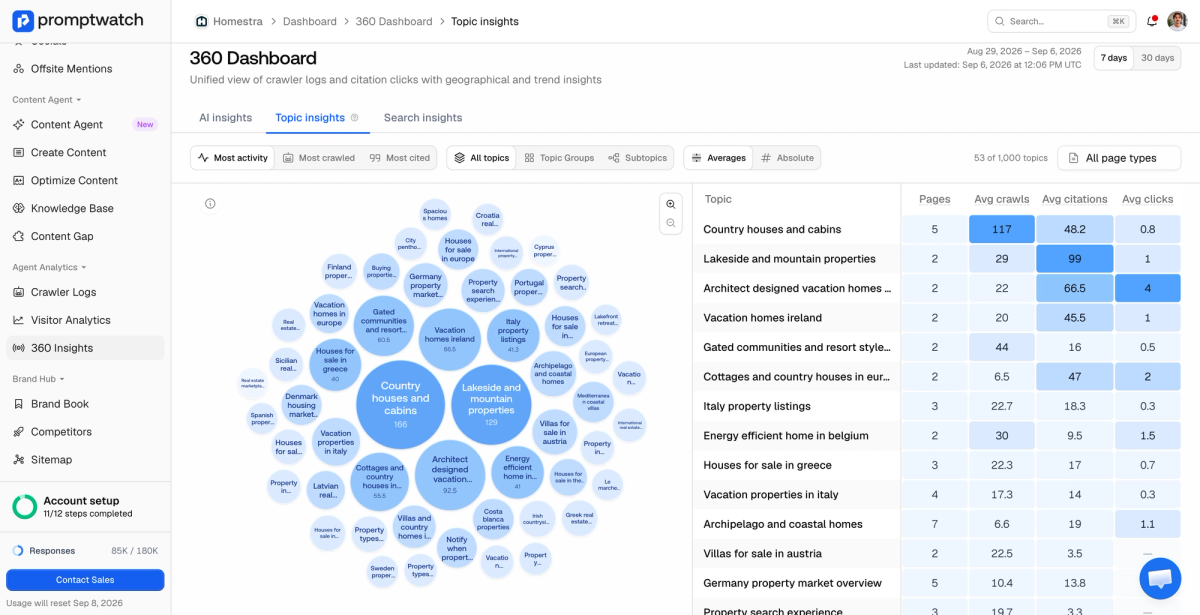
The caveat is attribution. A user may read an AI answer, then visit directly or search for the brand later; an AI referral report may miss that influence. Conversely, a measured conversion after an AI referral does not show that the monitoring tool itself generated revenue. We would use Promptwatch here as a stronger reporting layer, paired with analytics and a clear pre-change baseline, rather than as a single-source ROI proof.
Off-site mentions, Reddit, and YouTube citations
AI answers often cite third-party pages instead of a brand's own site. Promptwatch's off-site mention view and dedicated Reddit and YouTube source feeds are useful for seeing which articles, discussions, reviews, threads, and videos the sampled answers cite. This can surface a practical PR or community task: correct a stale review, answer a genuine question, or improve the page that AI engines repeatedly reference.

Those feeds are more targeted than a generic mention inbox because they focus on sources appearing in AI answers. They are not a complete social-listening replacement, and a cited Reddit thread is not an instruction to manufacture a mention. The useful question is whether a source accurately answers the buyer's question and whether your brand should contribute something better.
Prompt demand, query fan-outs, and content gaps
Promptwatch combines tracked prompts with demand and difficulty signals, then examines the sub-queries an AI system uses when forming an answer. Its content gap workflow asks whether your own site covers the ideas appearing in those fan-outs and cited sources. This is a more actionable route from “we were absent” to “what should we improve?” than a dashboard that ends at the visibility chart.

Treat prompt volume and difficulty as prioritization estimates, not exact counts of private questions asked inside AI products. Validate the opportunity with your customer language, conventional search data, conversions, and the cited source set. A good workflow is to group similar prompts by buyer task, inspect the answers and fan-outs, then update or create a page that genuinely resolves the missing question.
Content Agent, article credits, and CMS publishing
Promptwatch's Content Agent can turn citation and gap findings into article drafts. Essential includes no AEO articles, Professional includes five per month, and Business includes ten, along with monthly agent credits. That is attractive if your team already has an editor and wants research and drafting in the same system as monitoring.
Current CMS integrations include Webflow, Framer, and WordPress. Publishing includes review controls and scheduling. If you publish elsewhere, plan on export or an API workflow. Review generated claims, examples, product details, links, and tone before release. The agent can speed up a brief and first draft; it does not replace subject expertise or editorial ownership.
ChatGPT Shopping Insights and Ads Radar
For ecommerce, Shopping Insights adds product-level visibility rather than stopping at the brand name. Ads Radar tracks advertisers, creative, and landing domains appearing in sampled ChatGPT answers. These can help a merchandising or paid media team compare organic recommendation visibility with paid placements and competitor activity.
Both are listed on Business, not the lower brand-plan cards. The value depends on whether your catalog and category prompts actually trigger shopping results or ads in the markets you care about. Test a representative prompt set before paying for Business primarily for these features.
Promptwatch pricing: which plan makes sense?
Promptwatch's pricing is on the steep side for a team that only wants AI mention alerts. Its monthly brand plans and seven-day trial are shown on the pricing page. The figures below were current on October 4, 2026; checkout terms and annual discounts can change.
Focused starting point
50 tracked prompts · 1 project
Answer visibility and citations
For active GEO teams
150 tracked prompts · 2 projects
Crawler logs and five AEO articles
For larger programs
350 tracked prompts · 5 projects
City, Shopping, Ads Radar
All three plans track four models per project. Essential includes 6,000 responses and 500 agent credits monthly; Professional 18,000 and 1,500; Business 42,000 and 2,500. Project, response, and prompt limits matter as much as the headline price if you manage multiple markets or clients.
Check one discrepancy before purchase: the crawler-log guide places brand-plan crawler logs on Professional and Business, while the pricing table also shows a small Essential crawler-log figure. Confirm the Essential entitlement before budgeting around crawler analysis.
Integrations, reporting, and data handling
Promptwatch's integration catalog covers CDN and server log inputs, CMS publishing, Google Search Console, Bing Webmaster Tools, Looker Studio, Slack, an API, and MCP access for assistants. This is a practical advantage for teams that need to bring AI visibility into existing reporting rather than asking stakeholders to learn another dashboard. Confirm the exact connector, permissions, and plan availability you need during the trial.
Stored bot records currently have no retention cutoff under Promptwatch's crawler-log policy, while a single query or export is limited to 90 days. That is a useful distinction for long-running analysis. Large organizations should also review the ten retained fields and log-routing path with IT. WordPress plugin collection can miss requests served by a cache or CDN before WordPress runs, so CDN-level collection may give a fuller crawler picture.
Scheduled reporting is useful for agencies. If weekly versus daily PDF delivery or custom schedules matter to your client workflow, check those options in the trial before committing to a plan.
Where Promptwatch is less convincing
- Steep entry cost and plan gates: $95/month is a meaningful commitment for a small prompt set; crawler logs, content articles, city tracking, shopping, and ads require higher plans or confirmation.
- Not a first SEO investment: teams still fixing indexing, crawlability, core content, or conversion tracking should solve those issues before adding an AI visibility platform.
- Poor fit for casual indie projects: an indie hacker who is not serious about AI visibility is unlikely to use enough of the platform to justify its price.
- Four-model selection: the 11-platform menu sounds expansive, but the current brand-plan cards limit a project to four tracked models at once.
- Infrastructure work: useful crawler analysis depends on connecting logs, and larger sites may need a security review before that happens.
- Sampling limits: even live-interface responses are snapshots of selected prompts and locations, not a complete census of private user conversations.
- Causality and attribution: crawl, citation, referral, and conversion views make a strong investigative timeline, but they cannot prove each step caused the next.
- Publishing coverage: direct CMS publishing supports Webflow, Framer, and WordPress. Other CMS teams need an export or custom workflow, and all generated drafts need review.
Promptwatch alternatives: when another tool may fit better
OtterlyAI is worth considering if you mainly want a smaller, lower-cost prompt-monitoring program. OnCited emphasizes execution alongside monitoring. Goodie AI is another GEO suite to compare for teams that want a different workflow. Enterprise buyers should also evaluate Profound for their governance and reporting requirements.
Run the same category prompts, markets, and engines in each trial. Compare the actual answer evidence, citation detail, export needs, and total cost for your project count. Promptwatch's strongest case is when you will use the connected crawler, visitor, and content workflow rather than just its visibility chart.
A seven-day trial plan that answers the real buying questions
- Choose a representative prompt set. Include branded, category, competitor, and purchase-stage questions; keep the set stable for comparison.
- Test your locations and models. Select the four engines that matter most, then check whether country or city differences affect your decisions.
- Audit five answer records. Open the cited sources, inspect sentiment and position, and compare the recorded response with what you can reproduce.
- Validate the data path. Confirm your CDN or WordPress integration, bot verification, AI-referral identification, and conversion event setup.
- Create one action. Use a cited competitor source or content gap to improve a real page, then define what you will measure over the next month.
- Check the contract fit. Ask about crawler-log access, response limits, project count, reporting cadence, retention, and security documentation before upgrading.
If those steps produce a credible action list, Promptwatch's higher price is easier to justify. If your SEO foundations are still shaky, fix those first. If you only want a periodic mention count, a smaller tracker is likely enough.
Frequently asked questions
What is Promptwatch?
Promptwatch is an AI search visibility platform for brands, SEO teams, and agencies. It monitors how selected prompts are answered across AI platforms, records mentions and citations, and connects that evidence to crawler activity, AI-referred visitors, conversions, and content opportunities.
Does Promptwatch use the live ChatGPT interface or an API?
Promptwatch collects responses from the consumer-facing AI interfaces rather than relying only on model APIs. That makes the sampled answer closer to what a user in the selected market can see, though AI answers still vary by time, account, personalization, and location.
Which AI platforms does Promptwatch track?
Promptwatch supports 11 platforms, including ChatGPT, Perplexity, Google AI Overviews, Google AI Mode, Claude, Gemini, Llama, DeepSeek, Grok, OpenCode, and Claude Code. Current brand plans track four models per project at one time. Confirm the exact selection and cadence for your project during a trial.
How much does Promptwatch cost?
The monthly brand plans are Essential at $95, Professional at $245, and Business at $579, with a seven-day trial. That is steep if all you need is occasional mention tracking. Limits vary by projects, prompts, responses, agent credits, content articles, and advanced features. Verify the current checkout price and any annual discount before buying.
Can I use AI crawler logs on Essential?
Promptwatch's detailed crawler-log guide places brand-plan crawler logs on Professional, with a 25 million log allowance, and Business, with 100 million. Its pricing table presents an Essential crawler-log figure too, so confirm this specific entitlement before purchasing Essential for that workflow.
How does Promptwatch measure AI visibility?
It samples selected prompts and reports mentions, citations, sentiment, competitors, and a 0–100 Visibility Score. The score combines position and context, with competitor presence reducing the result; an answer without the brand scores zero. It is a directional metric for the tracked prompt set, not a census of every AI answer.
Can Promptwatch prove that a crawler visit caused a citation or sale?
No single dashboard can establish that causal chain from observational data. Promptwatch can show crawler hits, later citations, AI-referred visits, and tracked conversions in one workflow, which is useful for investigation and prioritization. Treat those links as evidence of association, then validate changes against a baseline and other channels.
Does Promptwatch track human visits separately from bots?
Yes. Crawler analytics stores known bot requests and drops human requests from those CDN logs. AI-referred human traffic is measured separately in visitor analytics, where conversion tracking can connect visits to outcomes.
Does Promptwatch monitor Reddit, YouTube, and third-party mentions?
Yes. Its off-site mention and citation views identify third-party sources, including Reddit threads and YouTube videos, that AI answers cite. This helps teams find publications and conversations to investigate, although a mention or citation alone does not prove that the source caused a ranking change.
Does Promptwatch support ChatGPT Shopping and ads?
Business includes Shopping Insights and Ads Radar. These features are most relevant to ecommerce teams and brands monitoring advertisers in ChatGPT answers. They are not included in Essential or Professional.
Can Promptwatch generate and publish content?
Its agent can use citation and content-gap research to draft AEO articles. Professional includes five AEO articles per month and Business includes ten; Essential includes none. Direct CMS publishing currently supports Webflow, Framer, and WordPress, with review controls. Other CMS workflows require export or a custom integration.
What integrations does Promptwatch offer?
Promptwatch integrates with Cloudflare, CloudFront, Fastly, Vercel, Netlify, Akamai, Google Cloud CDN, and custom HTTP for crawler logs. It also supports Webflow, Framer, WordPress, Google Search Console, Bing Webmaster Tools, Looker Studio, Slack, REST API, and MCP integrations.
How long does Promptwatch keep crawler-log data?
Crawler-log records currently have no retention cutoff under Promptwatch's September 2026 data policy. A single query or export is limited to a 90-day window, so longer histories must be retrieved in chunks. Confirm retention and contractual terms for your own account during procurement.
Who should buy Promptwatch?
It is strongest for SEO and GEO teams that need to connect AI answers to citations, crawler access, human traffic, and content work. Agencies with multiple clients and ecommerce teams assessing Shopping and Ads Radar may also benefit. It is a poor fit for casual indie projects and teams that have not yet addressed basic SEO issues such as indexing, crawlability, content quality, and conversion measurement.
Is Promptwatch worth it for indie hackers?
Usually only if AI visibility is already a serious acquisition priority. Promptwatch starts at $95 per month and its deeper workflows take time to use well. Indie hackers who only want an occasional brand-mention check will get more value from a simpler, cheaper tracker or manual spot checks.
Should I fix traditional SEO before buying Promptwatch?
Yes. If important pages are not indexed, AI and search crawlers cannot reliably access them, your core content does not answer buyer questions, or conversions are not measured, fix those foundations first. Promptwatch is most useful when there is already a sound site and content program to analyze and improve.
What are good Promptwatch alternatives?
OtterlyAI is a lower-cost choice for focused prompt monitoring, while Profound is a broader enterprise-oriented AI visibility option. OnCited and Goodie AI are also worth comparing depending on whether execution or a simpler GEO workflow matters most. Compare plans using the same prompts, locations, and reporting needs.
Sources and update notes
Product details updated October 4, 2026. Sources: pricing and platform coverage, integrations, Visibility Score calculation, crawler-log data and retention, and CMS publishing. Prices and feature gates may change. The crawler-log entitlement discrepancy is highlighted above.
Ready to compare it with your stack?
Start with the prompts and markets that already matter to your team, then test whether the citation, crawler, and visitor views give you actions you can use.
Visit PromptwatchAbout the Author

Co-Founder & SEO Execution
Co-founder of PikaSEO. 11 years in corporate tech, then bootstrapped entrepreneur. Leads SEO execution and content-led growth for SaaS companies.