
SEO news · November 2026
Ahrefs DR4 Explained: Why Your Domain Rating May Change
Ahrefs announced DR4 on November 5, with the standard interface switch scheduled for December 1. Preview your score now, preserve your old baseline, and check which version your reports use. Read the announcement.

Co-Founder & SEO Execution
· 6 min read
Sources checked November 12, 2026. Rollout details and availability may change.
What changes with DR4?
The DR4 transition
- November 5, 2026AnnouncementAhrefs introduces the new model and comparison preview.
- Preview periodCompare both versionsRecord your exact host, DR3, DR4, and lookup date.
- December 1 · scheduledInterface switchReview the first export from each tool you use.
Three changes to understand
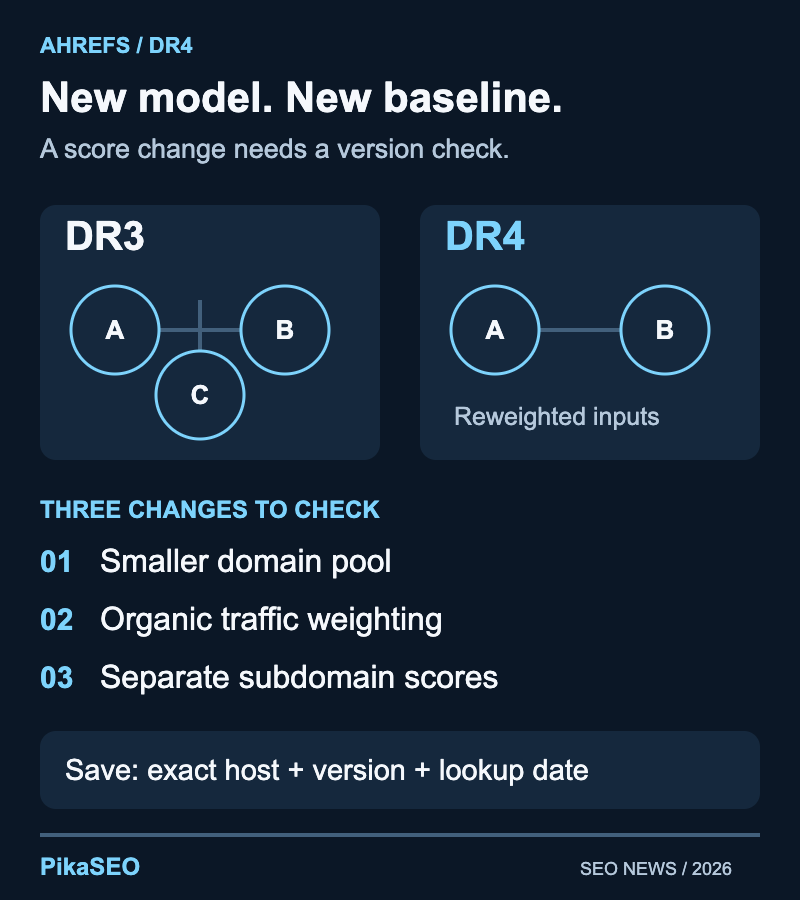
- A smaller domain pool: fewer domains influence the calculation.
- Organic traffic weighting: more weight goes to sites with estimated organic traffic.
- Separate subdomain scores: evaluate a hosted blog on its own hostname, rather than substituting its parent platform.
Ahrefs reports stronger ranking correlation across its combined host sample, but weaker correlation for root domains alone. The headline does not describe every subgroup. See the methodology.
What the number still means
Domain Rating is a relative, logarithmic backlink-strength metric. It is not a percentage of site quality or a Google ranking score. A five-point move near the top of the scale is not equivalent to one near the bottom.
Check your score in five steps
- Pick a small sample: your main site, key subdomains, three close competitors, and five current link prospects.
- Open the official comparison preview. Enter the precise domain or subdomain.
- Save both results: use separate DR3 and DR4 columns, plus hostname, date, and source.
- Compare like with like: collect competitors on the same date under the same model.
- Keep missing data explicit: record “unavailable” when a lookup fails; do not replace it with zero.
If you use an API or dashboard
- The Ahrefs free endpoint documents
version=dr3andversion=dr4; its documented default at our source check is DR3. - Ask your dashboard provider which model it returns, when it will switch, and whether historical values will change.
- PikaSEO’s DR checker does not explicitly request DR4 as of November 12. Use the official preview for this comparison.
Update reporting before changing targets
| Reporting choice | Avoid | Use instead |
|---|---|---|
| Metric label | Authority score | Ahrefs DR3 or Ahrefs DR4 |
| Measured entity | Parent domain for every URL | Exact hostname + original URL |
| Historical series | Silently replacing old values | Preserved DR3 + labeled DR4 baseline |
| Outreach threshold | Lowering every cutoff | A reviewed sample of accepted and rejected prospects |
Run a short audit
- Search client decks, supplier briefs, and qualification sheets for DR thresholds.
- Assign an owner to each rule and save the report already shared with stakeholders.
- Collect both versions during the overlap period; annotate the new series’ starting date.
- Agree on revised targets before an agency renewal or performance review.
Keep Moz’s Domain Authority in a separate column. Our DR versus DA guide explains why these labels are not interchangeable.
Review the placement, not just its score
Before approving a new prospect
- Audience: name one recent article that would interest your actual customer.
- Contribution: explain which finding, example, or resource your team can add.
- Destination: confirm your linked page delivers what the pitch promises.
For an existing placement
- Open the referring page and confirm the link is still present.
- Check its destination and context. Use the redirect checker if the URL has moved.
- Report a missing link as a missing link, separately from a model change.
Compare publishers within a relevant peer group. See what counts as a good DR for that context.
Explain a score change with evidence
A client note you can adapt
If search traffic also falls, investigate the affected pages separately. The November Google core update and Ahrefs’ model change concern different systems.
Frequently asked questions
When does Ahrefs DR4 launch?
Ahrefs announced the preview on November 5, 2026, and scheduled its standard interface rollout for December 1. Check the announcement for changes to that schedule before preparing a client report.
How can I check my DR4 score now?
Use the DR3-versus-DR4 comparison page on Detailed, or the documented Ahrefs Domain Rating API with version=dr4. Save the exact hostname and the collection date with both scores so your comparison is reproducible.
Does a lower DR4 mean Google penalized my website?
No. A changed vendor metric is not evidence of a Google penalty. Investigate ranking changes, lost links, and manual actions separately. Do not label a model transition as lost traffic without checking actual search performance.
Should I compare a DR3 score with a competitor’s DR4?
Use the same version for both sites. Comparing across models mixes a competitive difference with a measurement change. Recheck the whole comparison set before changing a prospecting threshold or a performance target.
Does PikaSEO’s Domain Rating checker show the DR4 preview?
As of November 12, our Ahrefs integration does not explicitly request the DR4 preview. Use the official preview options linked in this article for a version-specific comparison, and retain the data-source label when saving any third-party score.
Should I remove links because a referring domain’s score fell?
A score change alone is not a sufficient reason. Review the actual linking page, its relevance, editorial context, and whether the link still exists. Keep a useful referral relationship separate from a vendor score used to shortlist prospects.
About the Author
Co-Founder & SEO Execution
Co-founder of PikaSEO. 11 years in corporate tech, then bootstrapped entrepreneur. Leads SEO execution and content-led growth for SaaS companies.