
Semrush Local vs BrightLocal: Which Should You Buy?
Semrush Local vs BrightLocal comes down to where local SEO sits in your stack. Semrush Local brings Google Business Profile work, listings, reviews, and map tracking into the Semrush ecosystem. BrightLocal is a dedicated local SEO platform with audits, citation analysis, rank tracking, listings, and reputation tiers. Compare the actual plan you would buy, because the entry prices cover different jobs.
Quick verdict
Start with Semrush Local if your team already works in Semrush and wants local tasks in that ecosystem, but check whether Base or Pro includes the listing and review features you need. Choose BrightLocal if local SEO is a core service and you value its audits, citation tools, and reporting workflow. At one location, a lower headline price does not prove lower total cost: plan limits and other subscriptions change the equation.
Semrush Local
Existing Semrush teams adding local presence work
BrightLocal
Teams whose main job is recurring local SEO diagnosis and delivery
Semrush Local vs BrightLocal: quick comparison
Swipe the table sideways to see both tools.
| Decision factor | Semrush Local | BrightLocal |
|---|---|---|
| Best fit | Existing Semrush teams adding local presence work | Teams whose main job is recurring local SEO diagnosis and delivery |
| Published pricing | Base from $30/month per location billed annually; Pro from $60/month per location billed annually | Track from $41/month for one location on monthly billing; Manage from $54/month |
| Primary advantage | Local tasks in the Semrush product ecosystem | Dedicated local SEO audit and campaign workflow |
| Map visibility | Map Rank Tracker with plan-based credits | Local Search Grid plus local rank tracking |
| Listings | Listing Management in Local Pro | Ongoing listing work in Manage and Grow |
| Pricing model | Per location, with annual-billing starting prices | Tier and active-location band; monthly and annual rates |
Prices are vendor-published starting points checked in October 2026. Billing terms, location counts, and credits affect the final quote.
Primary advantage: Account for tools already in your stack.
Map visibility: Match scan frequency and grid coverage.
Listings: Compare the plans that actually include listings.
Pricing model: Calculate the same location count and billing term.
Inside the tools
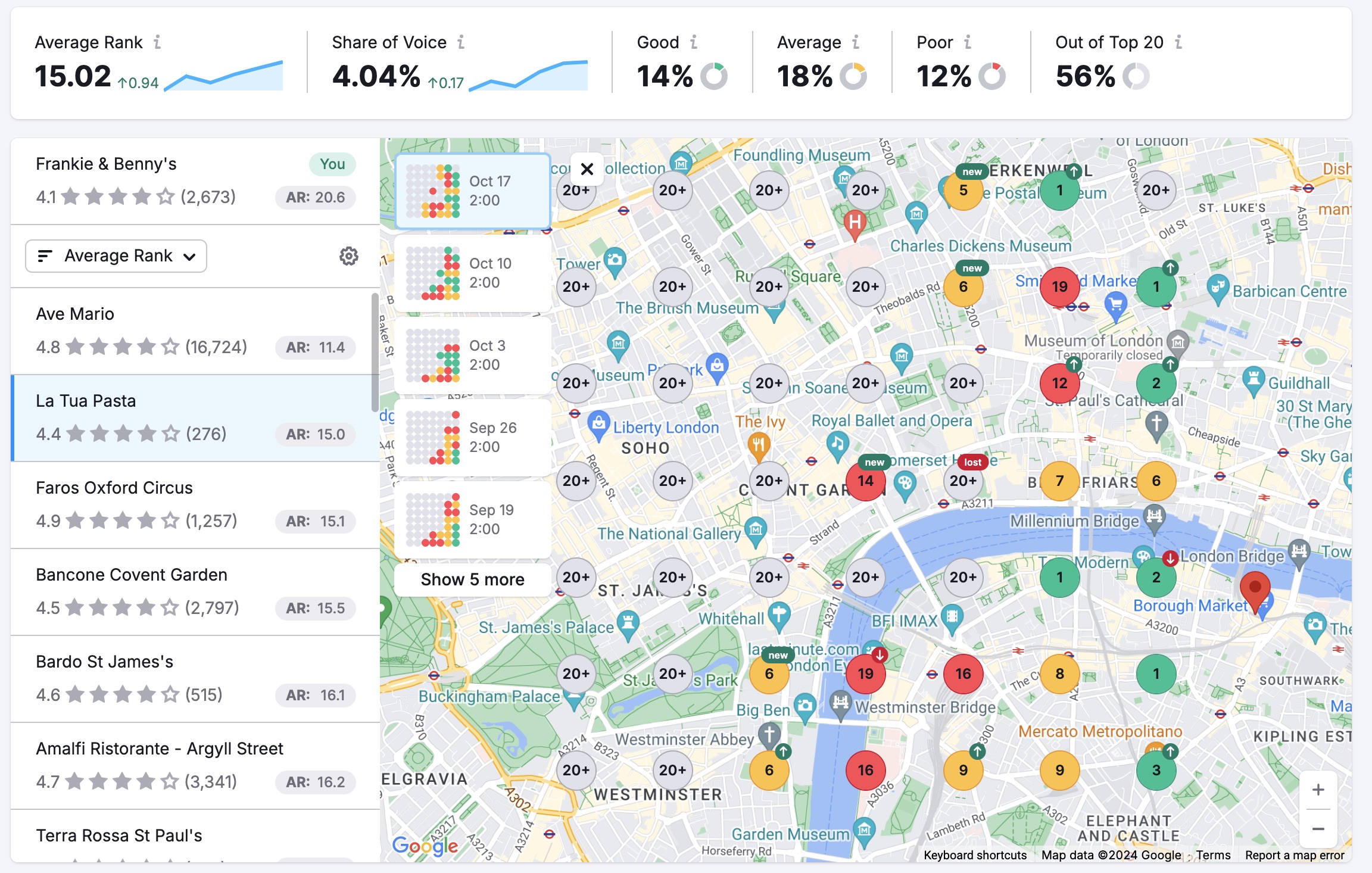
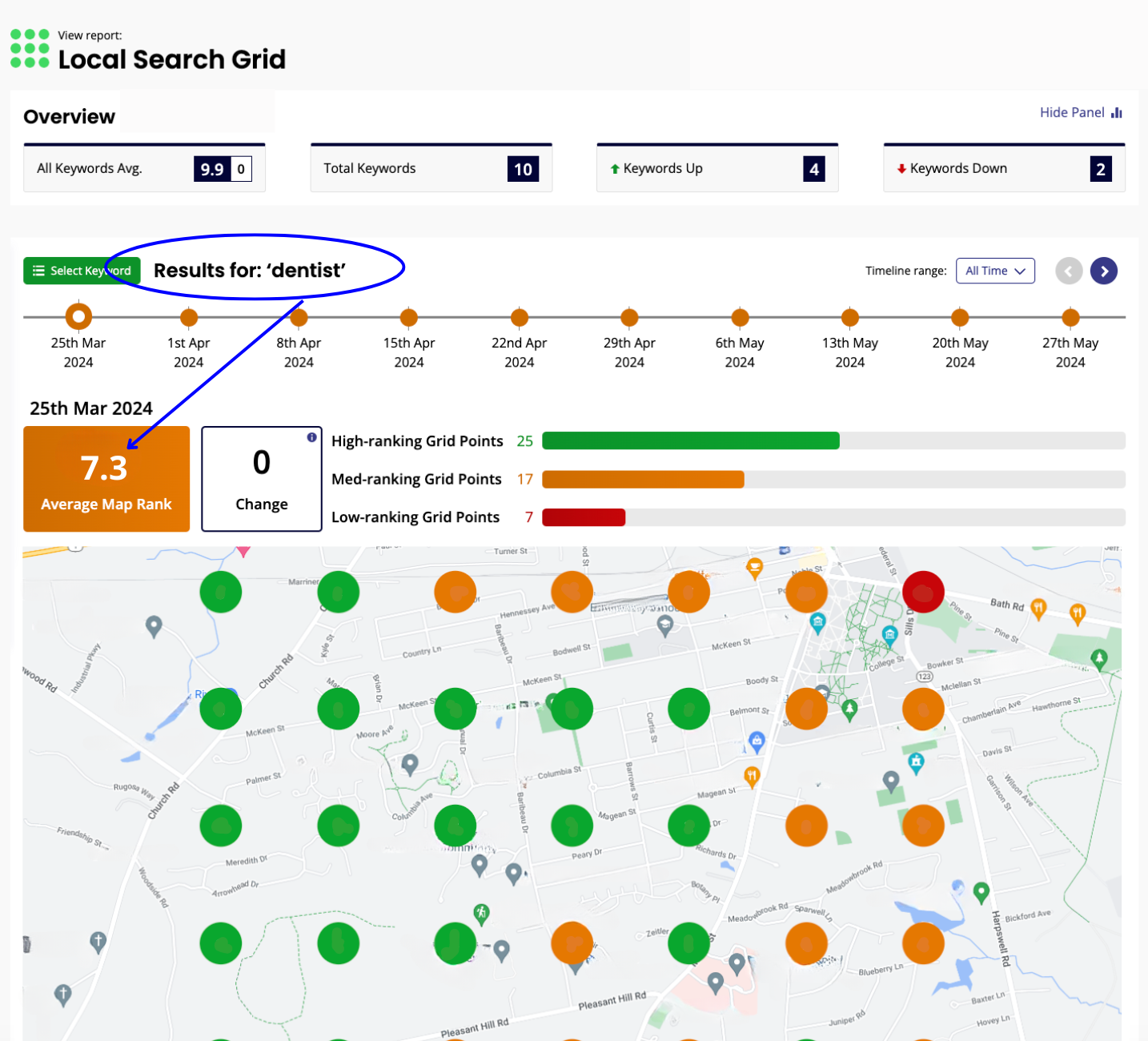
These vendor-published examples show the interfaces behind the features discussed below. Screens may change as products evolve.
What is Semrush Local?
Semrush Local is a toolkit for Google Business Profile operations, map visibility, listings, and reviews. Its current Base plan emphasizes GBP automation and Map Rank Tracker credits. Pro adds Listing Management, review management and generation, and a larger map-tracking allowance. Business is a custom-priced option for larger organizations.
The reason to consider it is operational continuity. A team already using Semrush for site audits, keywords, content, or reporting may prefer to keep local presence work near those tasks. That does not mean the Local toolkit includes the whole SEO Toolkit or every reporting add-on. Evaluate the subscriptions separately and confirm the cross-tool workflow your team expects.
Where it is useful
- Google Business Profile management in the Local toolkit
- Map Rank Tracker with grid-style visibility
- Pro adds listing and review operations
- Fits teams already using other Semrush products
Check before buying: Base does not include every listing and review capability shown on the broader Local product site. Model the per-location cost, map credits, and any other Semrush subscriptions.
Visit Semrush LocalWhat is BrightLocal?
BrightLocal organizes the local marketing workflow into Track, Manage, and Grow. Track includes local audits, ranking reports, a local search grid, citation monitoring, and GBP analysis. Manage adds ongoing listing work, and Grow adds review operations. The public pricing table shows how the subscription changes as the number of active locations grows.
Its focus is local SEO depth. A consultant can investigate a location, identify a citation or GBP issue, monitor a neighborhood grid, and present progress from the same platform. Teams that already pay for a broad SEO suite should decide whether that dedicated workflow is worth a second subscription. Teams without one may still need separate tools for technical crawling or broader keyword research.
Where it is useful
- Connected local audit and ranking workflow
- Citation Tracker and optional Citation Builder service
- Local Search Grid and conventional local tracking
- Published pricing by plan and active-location band
Check before buying: Track does not include everything in Manage or Grow. Confirm the number of locations and whether citation-building services are needed separately.
Visit BrightLocalIntegrated suite or dedicated local SEO platform?
Semrush Local makes the most sense when local marketing is one part of a larger SEO program. The team that checks rankings, audits a site, and researches competitors may appreciate a familiar account and adjacent reporting. The actual advantage is the handoff between tasks, not simply the brand on the dashboard. Ask a colleague to complete a GBP update and a map-ranking review using the subscriptions you already have.
BrightLocal starts with local work itself. Its audit, citation, ranking, listing, and review features are arranged for recurring location campaigns. That focus can be valuable for an agency serving local businesses, where the monthly output needs to show what was found, what changed, and what to do next. A dedicated tool can also add a second login and bill to a stack that is otherwise consolidated.
Do not assume either product replaces your entire SEO stack. Local presence software cannot substitute for technical crawling, content strategy, or analytics. Map the jobs your team performs before treating a product ecosystem as an automatic win.
Practical takeaway: Pick the platform that shortens your team's real sequence of tasks, not the one with more adjacent menus.
Google Business Profile and listing management
A Google Business Profile needs accurate categories, hours, photos, services, and timely responses to changes. Semrush Local's Base plan includes GBP management features and an AI agent for posts and some response tasks. Its Pro plan adds Listing Management and broader review operations. This tier boundary is critical: the $30 per-location Base price should not be presented as the cost of a complete listings-and-reviews workflow.
BrightLocal's Track plan can audit a GBP and surface local visibility problems. Its Manage tier adds listing synchronization and ongoing business-data work, while Grow extends the review workflow. The comparable BrightLocal plan therefore depends on whether you only want measurement or also want to distribute and protect business details across publishers.
Use a test location with incorrect hours or an outdated phone number. See how each system identifies the issue, what it can update, which sites it covers, and how the team verifies the change. If your business has many locations, check who can approve edits and how exceptions are handled.
Practical takeaway: Compare Semrush Local Pro with BrightLocal Manage when ongoing listing management is required.
Map rank tracking and local visibility
Local results vary across a service area. Semrush Map Rank Tracker visualizes positions on a map grid, and its Local plans provide different credit allowances. BrightLocal combines Local Search Grid with traditional local rank tracking and audits. Both approaches can show where a business is visible, but the value depends on whether you have enough scans, keywords, and locations to spot a reliable trend.
Set the same grid center, radius, keyword, date, and device before comparing maps. A wide grid may make a storefront look weak where it never expects customers; a very tight grid may conceal a real service-area problem. Run repeated scans instead of reacting to one colorful snapshot. Record a concrete next action for each report: check a category, inspect a competing location, improve a landing page, or correct a listing.
If the reporting audience is a client, export the views each platform can produce under your intended plan. The best measurement tool is the one that makes a change understandable without overstating what rank movement means for leads.
Practical takeaway: Price the scan cadence you need and judge the reports by the decisions they support.
Citations, audits, and competitive context
BrightLocal's local audit and Citation Tracker make citation consistency part of the same review as rankings and GBP health. Its separate Citation Builder service can act on specific placement or cleanup needs. This is valuable when local citation work is an explicit client deliverable and you need to explain which gaps matter, rather than simply counting all mentions on the web.
Semrush Local's Pro tier includes Listing Management for distributing business information. The wider Semrush SEO Toolkit can add site audits, keyword research, and competitive context if your team subscribes to it. These are related jobs but separate purchases. A buyer should verify which screens and reports are in the Local subscription, which require another toolkit, and which are useful enough to justify both.
For citations, build a short list of the publishers that matter to your industry and region. Compare coverage and the ability to correct records on those sites. A long generic publisher list is less useful than a small set of accurate, customer-visible listings.
Practical takeaway: BrightLocal has a clearer dedicated citation research path; Semrush Local Pro emphasizes ongoing listing distribution.
Semrush Local vs BrightLocal pricing
Semrush's current Local price page lists Base at $30 per month per location and Pro at $60, both when billed annually. Base includes a Map Rank Tracker credit allowance, while Pro includes more credits plus Listing Management and review features. Business requires a sales conversation. Extra users or reporting capabilities may have separate charges, so calculate the exact team setup.
BrightLocal lists one-location monthly prices of $41 for Track, $54 for Manage, and $65 for Grow. Annual billing is lower on an effective monthly basis, and multi-location bands change the account total. This is not a direct $30-versus-$41 decision. Compare Semrush Base with BrightLocal Track for diagnosis and tracking, then Semrush Pro with BrightLocal Manage or Grow for ongoing listings and reviews.
A team already paying for Semrush should also check whether Local is an addition to its existing subscription and how much combined reporting will actually improve. A team considering BrightLocal should include any separate citation-building service. Write down the complete annual cost, location count, map credits, users, and renewals before choosing.
Practical takeaway: Compare equivalent plans and full-year totals. The headline entry price covers different work in each product.
Adding or replacing a local SEO tool
If you already use one of these platforms, identify which reports and routines would disappear during a switch. Export location lists, tracked keywords, map scan settings, citation issues, and client reports before changing subscriptions. A new grid can look different because it samples another center, area, or time, even when the business has not changed. Preserve screenshots or exports from the old baseline and document the settings used to collect them.
A team adding Semrush Local to an existing Semrush account should first decide whether it is replacing another local tool or filling a specific gap. If BrightLocal continues to manage listings while Semrush starts publishing GBP changes, duplicate ownership can create conflicting business information. Put one person or system in charge of each update path and verify changes at the public profile and publisher, not only inside a dashboard.
A team moving toward BrightLocal should check whether Semrush remains necessary for broader keyword and technical research. The dedicated local platform may improve location delivery without replacing those jobs. Run an overlap pilot for a few weeks, record total subscription cost during and after the transition, and retire only the reports no one needs.
Practical takeaway: Define ownership of location facts and preserve comparable baselines before you change the software stack.
Reporting for agencies and in-house teams
An agency needs to turn data into a short, defensible client update. BrightLocal's specialized audit, ranking, citation, listing, and review views support a local SEO narrative. Semrush Local can fit a broader marketing report when the same team already uses Semrush tools for site and keyword work. In either case, confirm the export and sharing features in the purchased plan rather than assuming every dashboard is client-ready.
In-house teams should ask a different question: what decision gets made after a metric changes? A falling map grid may call for checking GBP fields, recent reviews, competitors, or on-page relevance. An automated post or generated recommendation is useful only when someone verifies that it is accurate and appropriate for the business.
Pilot reporting with one manager who does not use SEO software daily. Give them each platform's output and ask what happened, what was done, and what should happen next. If they cannot answer, simplify the report before expanding the tool purchase.
Practical takeaway: The most useful report connects an observed change to an owned action, not a collection of charts.
Who should choose which tool?
Already paying for Semrush
Trial Semrush Local
Test whether the Local toolkit fits your existing research and reporting workflow. Check if Base or Pro covers listings and reviews before comparing price.
Agency focused on local clients
Trial BrightLocal
Its audit-to-report workflow and local citation tools are well aligned with recurring location campaigns.
Single-location business
Compare Base and Track
Run a small GBP and map-tracking pilot. Buy a higher tier only if you will actively manage listings or reviews there.
Multi-location in-house team
Test both at scale
Model the full location count, credit usage, permissions, reporting, and who will own profile changes.
How to test your shortlist
Run the same small pilot in each product. Keep the locations, keywords, and success criteria fixed so a polished dashboard does not disguise a workflow mismatch.
- 01Choose two representative locations and five commercial local queries; fix the grid center and scan cadence.
- 02List the exact GBP, listing, review, citation, and reporting tasks your team performs in a month.
- 03Ask each vendor to demonstrate those tasks in the proposed plan, including any separate toolkit or service.
- 04Calculate annual cost with your location count, scan credits, users, add-ons, and renewal terms.
Final verdict
Semrush Local is a sensible first trial for a team that already works in Semrush and wants local presence tasks near the rest of its SEO process. Its Base and Pro tiers do materially different jobs, so choose the tier only after listing the operations you need. The same caution applies to map credits and any separate toolkit subscription.
BrightLocal is the stronger default when local SEO itself is the main service. Its audit, ranking, and citation workflow gives practitioners a focused way to investigate and report on locations. If you need listings and reviews, compare the relevant higher tiers instead of treating the Track entry price as the whole platform.
Frequently asked questions
Is Semrush Local better than BrightLocal?
Semrush Local can be a better fit for teams already using Semrush that want GBP work, map tracking, and local operations in the same ecosystem. BrightLocal is often a better fit when dedicated local audits, citations, rank tracking, and client reporting are the core job. Compare the exact tiers and subscriptions your team would buy.
Does Semrush Local include Listing Management?
Semrush's October 2026 pricing page lists Listing Management in Local Pro, not Base. Base focuses on Google Business Profile work and Map Rank Tracker. Check the current plan table and your location count before assuming the $30 per-location starting price covers listing distribution.
Does BrightLocal include a geo-grid tracker?
Yes. BrightLocal includes Local Search Grid in its local visibility offering, alongside conventional local rank tracking. Confirm the grid and keyword allowances for your chosen plan and location count, then run repeated scans using a consistent geographic setup.
How much do the tools cost for one location?
Semrush lists Local Base from $30 per month per location and Pro from $60 when billed annually. BrightLocal lists one-location monthly prices of $41 for Track, $54 for Manage, and $65 for Grow. Those starting prices use different billing terms and include different work, so compare equivalent plans and full-year totals.
Can Semrush Local replace BrightLocal?
It may replace parts of a BrightLocal workflow if your team mainly needs GBP management, listings, reviews, and map tracking. Test citation research, local audits, reporting, and the exact features of your Semrush Local tier before migrating. Keep a list of tasks that would still need another tool.
Which is better for an agency?
BrightLocal is a strong first trial when an agency sells repeatable local SEO audits, citation work, ranking analysis, and reporting. Semrush Local is worth testing when the agency already uses Semrush for broader SEO and can reduce duplicated work. Model the total location, user, and reporting cost in either case.
Sources and pricing checks
Product capabilities and prices were checked against vendor pages on October 6, 2026. Reconfirm a plan before purchasing.